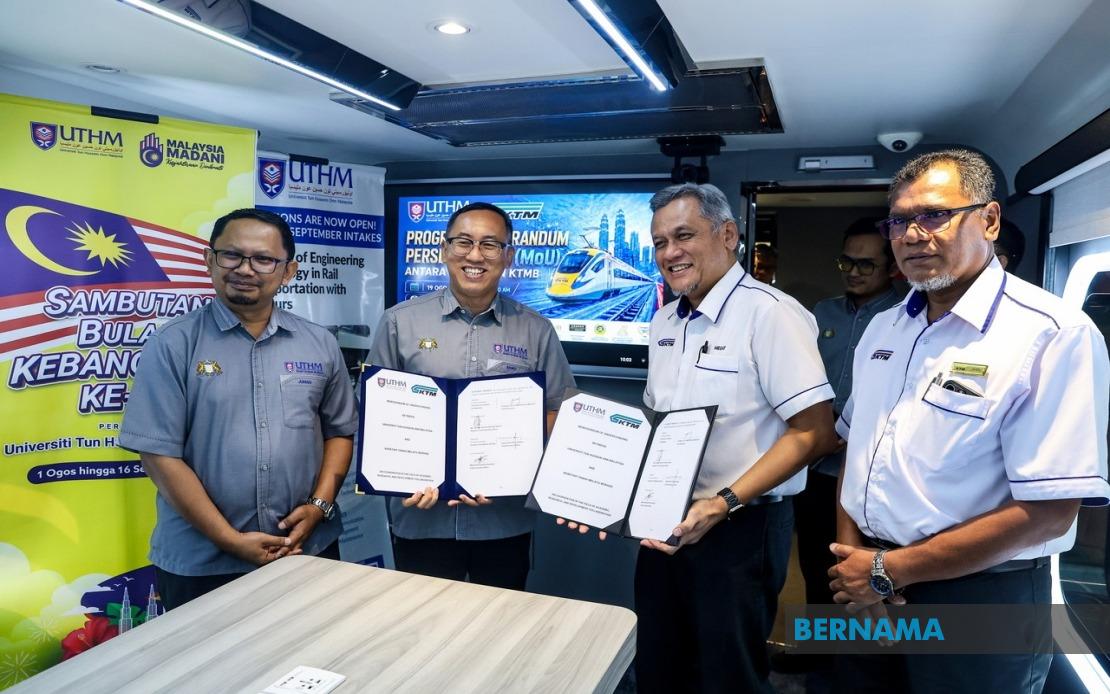
Malaysia's rail sector is gaining momentum through renewed institutional partnerships aimed at bridging the gap between academic excellence and industry demands. Universiti Tun Hussein Onn Malaysia (UTHM) and state-owned rail operator Keretapi Tanah Melayu Bhd (KTMB) have committed to an expanded three-year collaboration spanning October 2026 to July 2029, building on foundations laid during an earlier agreement in 2019. The renewed commitment signals confidence in the model's effectiveness and reflects both parties' recognition that technical education must remain tightly aligned with real-world operational requirements.
The partnership architecture centres on four pillars designed to create a continuous pipeline of skilled professionals. Work-based learning opportunities allow UTHM students to rotate through actual KTMB operations, observing and participating in the complex systems that keep the nation's rail networks functioning. This immersive exposure proves invaluable for undergraduates who might otherwise graduate with theoretical knowledge detached from practical realities. Simultaneous joint research initiatives leverage UTHM's academic rigour and laboratory capabilities alongside KTMB's institutional knowledge of operational bottlenecks and technical challenges. The collaboration also encompasses formal competency development activities and structured expertise-sharing forums where industry practitioners mentor emerging researchers and students.
UTHM Vice-Chancellor Prof Dr Mas Fawzi Mohd Ali framed the extended agreement within the university's broader aspirations as a Global Technopreneur University 2030. This vision seeks to cultivate graduates who understand not merely technical specifications but also entrepreneurial mindsets, innovation processes, and the intersections between technological advancement and market opportunity. For UTHM, rail technology offers an ideal proving ground—it involves cutting-edge systems, high-stakes operational environments, and genuine scope for incremental improvements that can translate into measurable gains in efficiency, safety, or cost-effectiveness.
The evidence of success from the previous phase is quantifiable and compelling. Nearly 200 graduates from UTHM's Bachelor of Rail Transportation Engineering Technology with Honours programme have entered the workforce, meeting documented labour shortages in Malaysia's rail sector and even finding employment opportunities beyond national borders, including positions in Singapore and Saudi Arabia. This international placement record suggests that Malaysian rail engineering education, when properly structured, meets internationally recognised standards. The programme's graduates possess the technical depth and professional competence that allow them to compete for roles in more mature, heavily-regulated rail markets.
Work-based learning creates a distinctive advantage for UTHM students relative to peers at other institutions. Rather than learning from case studies and simulations alone, undergraduates gain firsthand experience with KTMB's operational realities—the constraints, trade-offs, and practical solutions that characterise mature transportation systems. They observe how maintenance schedules balance safety requirements against revenue-generation needs, how safety protocols evolve in response to near-misses and actual incidents, and how technology investments require years of procurement and integration planning. This exposure fundamentally shapes professional judgment in ways that classroom instruction alone cannot replicate.
For KTMB, the collaboration represents strategic investment in its future workforce while simultaneously addressing immediate operational challenges through university research capacity. KTMB Chief Corporate Officer Megat Khairulazhar Khairodin highlighted the company's intent to leverage UTHM's expertise, technology infrastructure, and research facilities to diagnose and resolve persistent technical issues affecting train operations and rail infrastructure. This represents a pragmatic recognition that state-owned enterprises often lack in-house capacity to tackle complex research questions, particularly those requiring sustained investigation beyond operational timelines.
The research and development dimension deserves particular emphasis for Malaysian readers and policymakers. Rail infrastructure projects typically involve large capital expenditures with long operational lifespans. Engineering decisions made during design phases have consequences spanning decades. By establishing formal mechanisms for knowledge transfer between universities and operating authorities, Malaysia creates opportunity to embed innovations into future projects. Rather than relying entirely on imported expertise or commercial vendors, the partnership enables Malaysian researchers to develop contextualised solutions addressing Malaysia-specific challenges—tropical climate impacts on infrastructure durability, cost-sensitive engineering within developing-market constraints, and integration with other transport modalities serving Malaysian commuters.
The collaboration extends beyond undergraduate engineering programmes to encompass formal academic contributions to KTMB's training infrastructure. UTHM will provide academic consultation supporting curriculum development at KTM Academy (MyRA) across diploma, bachelor's and postgraduate specialisations in rail transportation engineering technology. This institutional engagement ensures that technical education remains current with evolving industry requirements. The arrangement also reflects KTMB's commitment to continuous professional development—the company has already seconded five staff members to pursue master's degrees in rail-related fields at UTHM, indicating serious investment in deepening internal expertise.
Additional partnership activities including industry forums, structured academic visits, and systematic competency development programmes create multiple touchpoints for knowledge exchange beyond formal research collaboration. These mechanisms allow UTHM faculty to understand emerging industry priorities while enabling KTMB professionals to engage with cutting-edge scholarship and emerging technological possibilities. For students, exposure to experienced practitioners provides mentorship and career guidance informed by genuine understanding of hiring requirements and advancement trajectories within the rail sector.
The timing of this extended commitment carries significance within Malaysia's broader transportation policy context. Nationwide rail expansion initiatives, including ongoing investments in urban transit systems and long-distance connectivity, will require sustained workforce development over the coming decade. The UTHM-KTMB partnership, now formalised through 2029, provides a structural mechanism ensuring that talent pipeline development keeps pace with infrastructure expansion. This alignment between educational capacity and labour market demand represents precisely the kind of forward-looking coordination that develops highly competitive technical workforces.
For Malaysian policymakers monitoring the country's position within regional technical education rankings, this partnership model offers instructive lessons. Enduring institutional relationships between universities and major employers create ecosystems where innovation, training, and practical application reinforce one another. Students gain competitive advantages, companies access fresh talent and research capability, and universities enhance relevance while advancing knowledge. The success of this partnership—measured by graduate employment outcomes, research publications, and reported operational improvements at KTMB—suggests that comparable models could be adapted across other technically-intensive sectors essential to Malaysia's economic competitiveness.
The document exchange ceremony aboard a KTMB chartered train travelling from Kluang Station to KL Sentral carried symbolic weight, occurring during celebrations marking Rel Merdeka 69 and the 69th National Month Celebration at UTHM. The setting underscored that rail transportation itself constitutes important national infrastructure deserving serious investment in human capital development. As Malaysia transitions toward higher-value economic activities and knowledge-intensive industries, ensuring that essential infrastructure sectors like rail remain staffed with world-class technical professionals becomes increasingly critical. Through sustained partnership between premier technical universities and experienced operating authorities, Malaysia demonstrates commitment to building indigenous expertise capable of managing complex systems and driving continuous improvement across decades of operational service.

