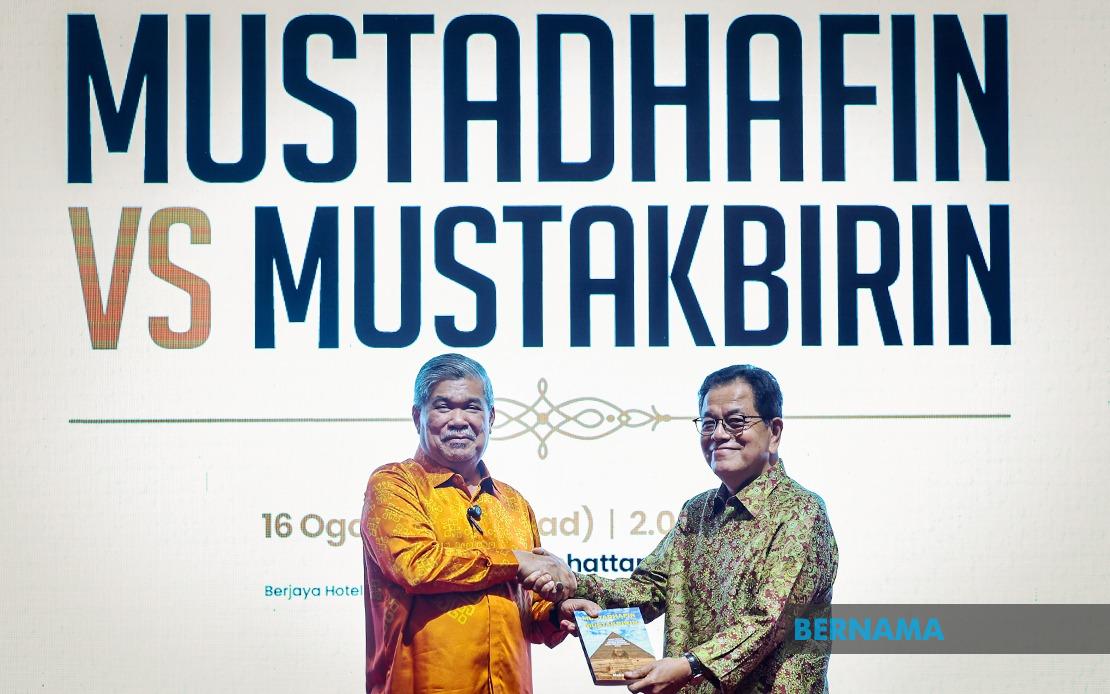
Datuk Seri Mohamad Sabu, president of the Amanah party and Agriculture and Food Security Minister, has issued a stark warning to Malaysians about the dangers of accepting unverified political claims without proper examination. Speaking after launching his new book, Mohamad highlighted how the uncritical acceptance of allegations can reinforce 'asabiyyah'—a concept rooted in group identity that leads people to defend their faction reflexively whilst dismissing the positive contributions of rival groups. This phenomenon, he suggested, represents a fundamental obstacle to reasoned political debate in Malaysia and undermines the nation's capacity to address substantive policy questions.
The minister's intervention comes at a time when Malaysian politics continues to be characterised by competing narratives and frequent accusations levelled across coalition lines. Rather than accepting information at face value, Mohamad called on the public to adopt a more rigorous approach: verifying facts independently, seeking clarity before forming opinions, and resisting the gravitational pull of partisan loyalty. His remarks suggest growing concern within political circles about the erosion of factual discourse and the ascendancy of tribal thinking in shaping public opinion. The emphasis on individual verification reflects broader anxieties about the quality of democratic deliberation in Southeast Asia's largest English-speaking nation.
The timing of Mohamad's message is particularly significant given the persistent circulation of inflammatory claims within Malaysian political discourse. He specifically referenced the recurring accusation that the Democratic Action Party (DAP) harbours communist sympathies and that political cooperation with the party inherently constitutes support for communism. Rather than dismissing such claims outright, Mohamad posed the fundamental question: is the DAP genuinely communist? This rhetorical move invites citizens to distinguish between allegation and reality, a distinction he views as essential to healthy democratic functioning. The question itself challenges the assumption underlying much contemporary political rhetoric—that accusation alone constitutes proof.
Central to Mohamad's analysis is an observation about the differential weight of truth and falsehood in the information landscape. Facts and substantive knowledge, he noted, demand cognitive effort and extended processing time, making them inherently less viral than sensational accusations or unsubstantiated suspicions. Social media platforms, with their architectural bias towards engagement and emotional resonance, have dramatically amplified this asymmetry. Allegations spread with remarkable velocity across networks because they trigger immediate emotional responses, whilst factual clarification requires sustained attention and intellectual labour. This structural reality, Mohamad suggested, necessitates deliberate counter-effort from citizens committed to truth-seeking.
The minister drew extensively on his own intellectual autobiography to illustrate the practice he advocates. From youth onwards, he has resisted the default acceptance of received information, preferring instead to investigate matters directly and understand ground realities rather than relying on propaganda or hearsay. This personal methodology—verification through direct observation and engagement—provides a model for the kind of citizenship Mohamad believes Malaysia requires. His approach reflects a broader philosophical conviction that individuals possess the capacity to think independently, but that such thinking requires conscious effort and deliberate resistance to comfortable narratives propagated by one's own group.
The book launched on this occasion serves as a repository of Mohamad's experiential learning across multiple domains. It documents encounters with diverse parties and stakeholders undertaken precisely to understand complex issues grounded in actual circumstances rather than distorted through the lens of partisan interpretation. By grounding his analysis in lived experience rather than abstract principle, Mohamad positions empirical observation as the foundation for political judgment. This methodology proves particularly valuable in Southeast Asia, where regional geopolitical dynamics grow increasingly complex and where regional actors must navigate competing great power interests with sophistication.
Beyond domestic Malaysian politics, Mohamad's reflections encompass broader geopolitical terrain. The book engages substantively with global power shifts, the historical legacy of colonialism, contemporary Islamic movements, the Palestinian question, and the evolving architecture of international relations. These thematic preoccupations indicate a conviction that Malaysian political leaders must develop comprehensive understanding of global contexts if they are to serve national interests effectively. The inclusion of such material suggests that reasoned political discourse cannot remain confined to domestic concerns but must integrate international awareness and historical perspective.
The book's launch by National Journalism Laureate Tan Sri Johan Jaaffar carries additional significance. A director of Star Media Group Berhad, Jaaffar's involvement signals alignment between establishment media institutions and the intellectual project Mohamad advances. This institutional validation may amplify the book's reach beyond typical reader demographics and lend credibility to its central arguments within mainstream discourse. The choice of a journalism laureate as launch figure underscores the connection between rigorous information practices and democratic health—a connection Mohamad clearly considers fundamental.
The broader context for Mohamad's intervention encompasses persistent anxieties about information quality and democratic resilience throughout Southeast Asia. Malaysia, despite its relative institutional sophistication compared to some regional neighbours, has witnessed considerable polarisation around information and truth in recent years. Political divisions have hardened partly through competing interpretations of historical events and contemporary political actors. The phenomenon Mohamad addresses—uncritical acceptance of allegations filtered through group loyalty—represents a significant threat to constructive political dialogue and effective governance. His intervention suggests determination within progressive political circles to reverse this trajectory.
Critically, Mohamad's argument does not counsel neutrality or false balance between established fact and convenient fiction. Rather, it demands that verification precedes judgment, that direct observation inform understanding, and that citizens resist the psychological comfort of tribal belonging when such belonging contradicts factual reality. This represents a challenging standard, particularly in polarised contexts where political and social identity overlap significantly. Yet Mohamad's conviction appears to be that democratic culture capable of addressing Malaysia's considerable challenges—from economic inequality to environmental degradation to regional security—cannot sustain itself on a foundation of mutual suspicion and unchecked allegation.
The implications for Malaysian and regional politics are substantial. If significant political voices genuinely commit to the verification-first approach Mohamad advocates, the character of public discourse could gradually shift towards greater factuality and reduced toxicity. Conversely, if his exhortation remains largely performative whilst politicians continue exploiting tribal instincts and spreading unverified claims for tactical advantage, Malaysian political culture will likely continue deteriorating. The question Mohamad implicitly poses is whether political actors and citizens possess sufficient commitment to truth-seeking to reverse established patterns of polarised discourse. His book and public statements represent an attempt to model and encourage such commitment, though their ultimate impact depends on broader willingness to privilege fact over faction in the messier reality of contemporary Malaysian political life.

