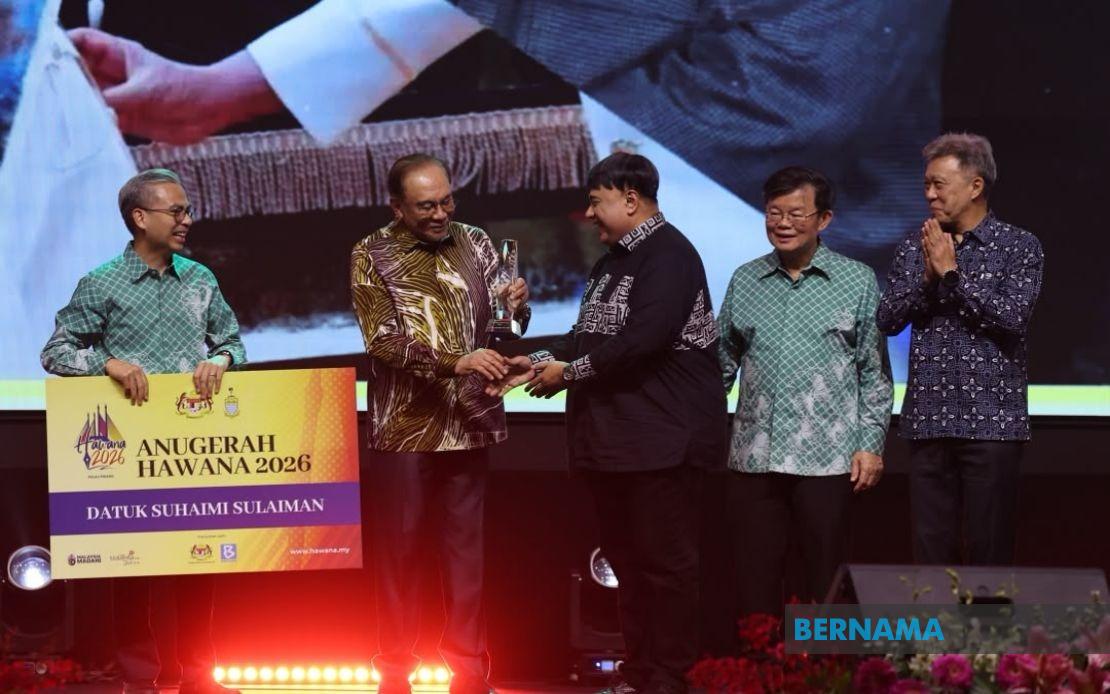
Datuk Suhaimi Sulaiman, a towering figure in Malaysian broadcasting who spent more than thirty years shaping the nation's media landscape, has been recognised with the National Journalists' Day (HAWANA) 2026 Award. The honour was bestowed upon him during the HAWANA 2026 Grand Finale held at PICCA @ Arena Butterworth Convention Centre in Butterworth on June 20, with Prime Minister Datuk Seri Anwar Ibrahim presenting the accolade. The ceremony brought together senior figures from Malaysia's media and political establishment, underscoring the significance of Suhaimi's contributions to the country's journalism and broadcasting sectors.
The presentation of the award was attended by a distinguished gathering that included Penang Chief Minister Chow Kon Yeow, Communications Minister Datuk Fahmi Fadzil, and Malaysian National News Agency (Bernama) chairman Datuk Seri Wong Chun Wai. Also present at the event were key Bernama executives, including chief executive officer and HAWANA 2026 Working Committee chairman Datin Paduka Nur-ul Afida Kamaludin, alongside editor-in-chief Arul Rajoo Durar Raj. The calibre of attendees reflects the respect Suhaimi commands across Malaysia's government and media institutions, highlighting how his career trajectory has influenced institutional development across the broadcasting sector.
Speaking to Bernama following the recognition, Suhaimi characterised the award as both a profound honour and an accompanying responsibility that he does not take lightly. Rather than viewing the accolade as a crowning achievement marking the end of his professional journey, he framed it as motivation to persist in learning and to transfer knowledge accumulated over decades to the next generation of media professionals. His comments reveal a mindset of intellectual humility despite his seniority, suggesting that even at the pinnacle of his career, he maintains the curiosity and openness essential for navigating an evolving media ecosystem.
A central theme in Suhaimi's reflection on the award concerned the seismic shifts occurring within the media industry as artificial intelligence increasingly influences journalistic practice and content production. He acknowledged that media practitioners today face the imperative of continuous adaptation, particularly in an era where technological transformation demands new competencies and ways of thinking about information dissemination. His remarks underscore a broader challenge confronting Malaysian and regional newsrooms, where AI applications are expanding from administrative functions to substantive roles in editorial decision-making, story research, and audience analytics.
The recognition accorded to Suhaimi takes on particular significance given the precarious position many journalism professionals find themselves in across Asia. As newsrooms contend with declining advertising revenue, digital disruption, and shifts in audience consumption patterns, the experience and institutional memory of veteran journalists becomes increasingly valuable. Suhaimi's career spans an era when Malaysian broadcasting underwent radical transformation—from the analogue and broadcast-dominant systems of the 1990s through the digital revolution of the 2000s and 2010s—providing him with a unique vantage point on how the industry has evolved.
His tenure as Broadcasting Malaysia director-general positioned him at a critical juncture for the national broadcaster, a period when RTM confronted questions about its role and relevance in an increasingly fragmented media environment. The challenges he navigated during this period—including competition from private broadcasters, the rise of cable and satellite television, and eventually streaming platforms—mirror difficulties that regional public broadcasters continue to grapple with. His leadership during these transitions has influenced institutional responses to technological change across Southeast Asia's media sector.
The HAWANA awards programme itself plays an important role in Malaysia's media ecosystem by publicly recognising journalistic excellence and contributions to the profession. By honouring individuals like Suhaimi, the awards help establish benchmarks for professional conduct and commitment within an industry that often operates under considerable commercial and political pressure. Such recognition also serves to elevate the profession's standing in public consciousness, reinforcing the importance of quality journalism at a time when trust in media institutions has become increasingly contested globally.
For Malaysian media practitioners, particularly those navigating the dual pressures of commercial viability and editorial independence, Suhaimi's career and his acceptance of this recognition carry instructive lessons. His emphasis on continuous learning, coupled with his demonstrated commitment to evolving with technological change, suggests that longevity in journalism requires intellectual flexibility alongside principled commitment to core professional values. These qualities become increasingly relevant as newsrooms in Malaysia and across the region experiment with artificial intelligence applications while attempting to maintain editorial integrity.
The award also arrives at a moment when Malaysian media institutions are actively debating their role in a digitally fragmented landscape. Questions about how traditional broadcasters and news agencies can maintain relevance while competing with social media platforms, digital-native news outlets, and algorithm-driven information distribution occupy strategic discussions across the sector. Suhaimi's recognition suggests that experience in navigating previous technological transitions, combined with openness to new methodologies, remains valuable in addressing these contemporary challenges.
Looking forward, Suhaimi's articulated commitment to sharing experience with emerging journalists indicates his continued engagement with the sector beyond formal retirement from executive roles. This mentoring dimension of his work, though not always quantifiable in conventional industry metrics, contributes substantially to the profession's institutional health. By transmitting knowledge about ethical journalism, professional standards, and the historical context of Malaysian media's development to younger practitioners, he helps sustain professional culture across generations of journalists.
%22%2F%3E%3C%2Fpattern%3E%3C%2Fdefs%3E%3Crect%20width%3D%22100%25%22%20height%3D%22100%25%22%20fill%3D%22url(%23ph366w1g)%22%2F%3E%3Crect%20width%3D%22100%25%22%20height%3D%22100%25%22%20fill%3D%22url(%23ph366w1p)%22%2F%3E%3Ctext%20x%3D%2250%25%22%20y%3D%2250%25%22%20text-anchor%3D%22middle%22%20dominant-baseline%3D%22central%22%20fill%3D%22rgba(255%2C255%2C255%2C0.95)%22%20font-family%3D%22Georgia%2C%20'Times%20New%20Roman'%2C%20serif%22%20font-weight%3D%22700%22%20font-size%3D%22320%22%20letter-spacing%3D%22-0.02em%22%3ETV3%3C%2Ftext%3E%3C%2Fsvg%3E)
%22%2F%3E%3C%2Fpattern%3E%3C%2Fdefs%3E%3Crect%20width%3D%22100%25%22%20height%3D%22100%25%22%20fill%3D%22url(%23ph50o6fg)%22%2F%3E%3Crect%20width%3D%22100%25%22%20height%3D%22100%25%22%20fill%3D%22url(%23ph50o6fp)%22%2F%3E%3Ctext%20x%3D%2250%25%22%20y%3D%2250%25%22%20text-anchor%3D%22middle%22%20dominant-baseline%3D%22central%22%20fill%3D%22rgba(255%2C255%2C255%2C0.95)%22%20font-family%3D%22Georgia%2C%20'Times%20New%20Roman'%2C%20serif%22%20font-weight%3D%22700%22%20font-size%3D%22170%22%20letter-spacing%3D%22-0.02em%22%3EMalaysia%3C%2Ftext%3E%3C%2Fsvg%3E)
%22%2F%3E%3C%2Fpattern%3E%3C%2Fdefs%3E%3Crect%20width%3D%22100%25%22%20height%3D%22100%25%22%20fill%3D%22url(%23ph5vazwg)%22%2F%3E%3Crect%20width%3D%22100%25%22%20height%3D%22100%25%22%20fill%3D%22url(%23ph5vazwp)%22%2F%3E%3Ctext%20x%3D%2250%25%22%20y%3D%2250%25%22%20text-anchor%3D%22middle%22%20dominant-baseline%3D%22central%22%20fill%3D%22rgba(255%2C255%2C255%2C0.95)%22%20font-family%3D%22Georgia%2C%20'Times%20New%20Roman'%2C%20serif%22%20font-weight%3D%22700%22%20font-size%3D%22170%22%20letter-spacing%3D%22-0.02em%22%3EMalaysia%3C%2Ftext%3E%3C%2Fsvg%3E)