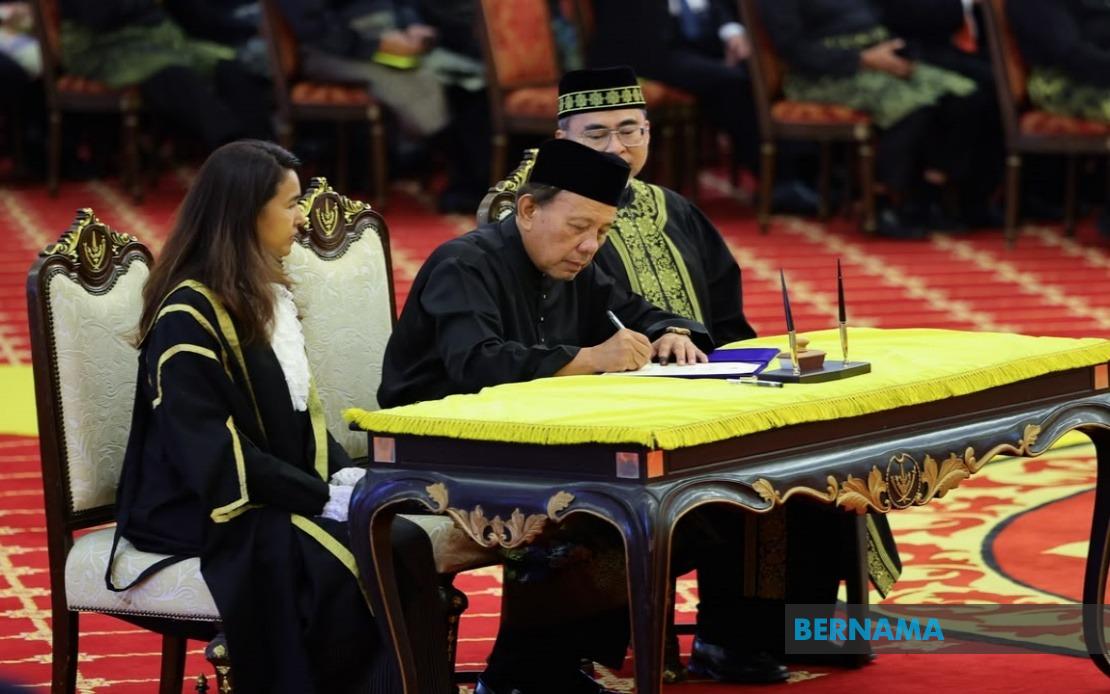
Datuk Ismail Lasim officially assumed the role of Menteri Besar of Negeri Sembilan on August 2, marking a significant moment in the state's political landscape. The 67-year-old took his oath of office before the Yang Dipertuan Besar of Negeri Sembilan, Tuanku Muhriz Tuanku Munawir, in a ceremony held at the Balairong Seri, Istana Besar Seri Menanti in Seremban. His appointment represents continuity and experience at the helm of the state administration, as Ismail brings a multifaceted background spanning law, governance, and party leadership to the position.
Ismail's entry into formal political life came in 1999 when he was elected to the Negeri Sembilan State Legislative Assembly, representing the Senaling seat. This milestone marked the beginning of what would become nearly three decades of sustained engagement in state politics and public administration. His early years as an assemblyman established him as a committed representative, laying the groundwork for deeper involvement in executive governance and policy formulation at the state level.
The Juasseh assemblyman's professional trajectory intersects meaningfully with his political career. Before his foray into electoral politics, Ismail had already established himself as a qualified legal practitioner, holding a Bachelor of Laws (LL.B Hons) degree from the University of Malaya. This legal foundation has informed his approach to governance and policy-making throughout his political journey. Additionally, his experience in corporate management at the board of directors level demonstrates a capacity for navigating complex institutional structures and strategic decision-making beyond the purely political domain.
Ismail's influence on state education policy forms a substantial part of his administrative legacy. He was first appointed to the State Executive Council in 2004 and maintained that position through three consecutive terms until 2018, during which he bore primary responsibility for the education portfolio. Throughout this extended tenure, he was instrumental in developing and implementing policies related to human capital development, shaping the state's approach to fostering talent and skills among younger generations. His sustained focus on education reflects a long-term strategic vision for the state's socioeconomic development.
Following the 16th Negeri Sembilan state election, which restructured the state's political dynamics, Ismail's experience was again called upon within the emerging Unity Government framework. Rather than stepping away from administrative responsibilities, he transitioned to serve as Chairman of the Education and Human Capital Action Committee, indicating both his continued relevance to state governance and the continued prioritization of educational and developmental concerns within the new political arrangement. This continuity suggests that education policy will remain a focus during his tenure as Menteri Besar.
Ismail's electoral victory in the 16th Negeri Sembilan state election demonstrated continued public confidence in his stewardship. Contesting the Juasseh state seat—his home constituency—he secured victory with a majority of 4,091 votes, defeating candidates from Pakatan Harapan and Parti Pribumi Bersatu Malaysia. His victory was part of a broader result that saw Barisan Nasional capture 18 of the state's seats while Perikatan Nasional secured seven, enabling the two coalitions to establish state government with a commanding two-thirds majority and providing a stable foundation for governance.
Beyond his formal government roles, Ismail has maintained consistent involvement within UMNO's organizational structure. He currently serves as the Negeri Sembilan UMNO Information Chief and has occupied various leadership positions within the party organization over the years. His dual roles as both state representative and party functionary have positioned him as a bridge between UMNO's party apparatus and state government machinery, facilitating coordination between party directives and administrative implementation.
Ismail's biographical background reveals roots firmly planted within Negeri Sembilan society. Born in Juasseh, Kuala Pilah, he completed his early schooling at Sekolah Kebangsaan Pusat Juasseh before progressing to Sekolah Menengah Kebangsaan King George V. His constituency is thus not simply a political jurisdiction he represents but a community where he has lived and where his family maintains deep social connections. This locally-rooted identity may contribute to his understanding of grassroots concerns and regional priorities.
On the personal front, Ismail is married to Datin Noraishah Othman, and the couple has five children together. This family foundation provides both personal stability and broader social integration within Negeri Sembilan's community networks. For Malaysian observers and policymakers, Ismail's appointment as Menteri Besar represents the elevation of a politically seasoned figure whose experience spans three distinct phases of state governance: the pre-2008 political landscape, the post-2008 reformed state administration era, and the contemporary Unity Government period.
The appointment carries implications for how the state navigates current policy challenges and opportunities. Given Ismail's sustained focus on education and human capital development, coupled with his legal background and corporate management experience, the state administration may emphasize institutional capacity-building, skills development, and regulatory frameworks during his tenure. His legal training suggests an inclination toward procedurally rigorous governance, while his business board experience indicates awareness of efficiency and resource optimization.
For regional observers, Ismail's elevation to Menteri Besar serves as a case study in how Southeast Asian state governments balance continuity with renewal. Rather than pursuing dramatic organizational overhauls, the Negeri Sembilan political establishment has opted to retain and promote experienced administrators whose track records are demonstrable. This approach prioritizes proven competence and institutional knowledge, though it may also raise questions about whether such continuity adequately addresses evolving public expectations and emerging governance challenges.
Looking forward, Ismail's administration will face pressures common to Malaysian states: balancing revenue generation with service delivery, managing federal-state fiscal relationships, addressing infrastructure deficits, and responding to constituent demands across multiple policy domains. His nearly three decades of experience provide institutional memory and established networks, yet the contemporary political environment—characterized by coalition complexity and competing priorities—may present governance scenarios unprecedented during earlier phases of his career. How he adapts his accumulated experience to these novel challenges will largely define his tenure as Menteri Besar.

