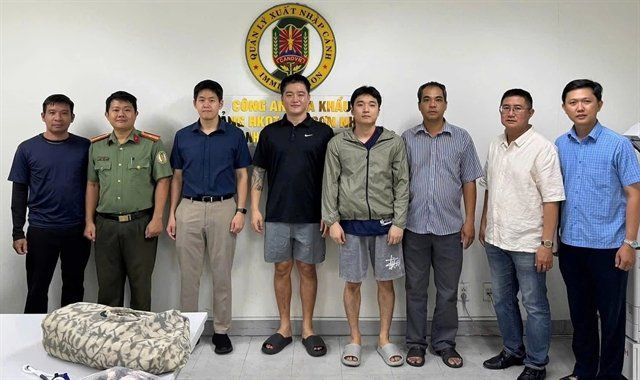
Vietnamese law enforcement has successfully apprehended and extradited four South Korean nationals wanted internationally on fraud charges, demonstrating the country's commitment to cross-border criminal cooperation. Three of the suspects—Wang Taesan (born 1990), Han Joonhee (born 1992), and Bang Giseong (born 1997)—were arrested in Ho Chi Minh City by officers from the city's Police Investigation Agency working in coordination with the Ministry of Public Security's investigation division. The arrests culminated in the handover of all three to South Korean authorities at Tan Son Nhat International Airport on August 3, following a coordinated operation involving multiple Vietnamese law enforcement units.
The crimes for which these individuals are being pursued reveal the increasingly sophisticated nature of transnational cybercrime networks operating across Southeast Asia. According to Vietnamese police, the three Ho Chi Minh City suspects orchestrated what security analysts describe as a sextortion scheme, a particularly invasive form of online extortion that has proliferated in recent years. The criminals falsely informed victims that they possessed compromising intimate videos and threatened to distribute this material publicly unless substantial sums were paid. Crucially, police investigations established that no such videos existed—the entire premise was fabricated as a psychological manipulation tactic designed to frighten victims into compliance.
Beyond the sextortion element, the fraud network employed an additional layer of deception involving impersonation of legitimate authority figures. The suspects contacted victims by telephone while impersonating South Korean prosecutors or other law enforcement officials, lending false credibility to their demands. They accompanied these calls with links to forged documents, including fraudulent arrest warrants bearing the victims' names, creating the illusion of official legal action. This social engineering approach exploited victims' natural fear of legal consequences and their trust in ostensible government communications.
The ultimate objective of these impersonation schemes was financial extraction through manufactured urgency and authority. Once victims were sufficiently alarmed by the fabricated legal warnings, the criminals claimed that the victims' bank accounts had become entangled in criminal activities and demanded immediate money transfers to designated accounts for purported "verification" purposes. This final stage of the fraud typically resulted in substantial financial losses for victims who believed they were complying with legitimate government requests to protect their legal standing.
A fourth South Korean national, Lee Sammin (born 1996), was arrested separately in Hanoi on December 31, 2025, under an Interpol Red Notice for telecommunications-related online fraud. Lee's criminal enterprise operated through a different but equally sophisticated methodology focused on investment fraud rather than sextortion. He and his co-conspirators impersonated legitimate investment advisors and financial experts, primarily targeting victims through social media platforms and internet channels. The network disseminated false information regarding stocks purportedly scheduled for upcoming public listing, using these fabricated opportunities to persuade victims to transfer funds for investment purposes.
The Lee Sammin network's scale of theft demonstrates the substantial financial damage these operations inflict. Vietnamese police documented that the fraud ring collectively misappropriated approximately US$10,693,343 from deceived investors before being disrupted by law enforcement. The victims were deliberately provided misleading information designed to create artificial urgency and competitive pressure—the suggestion that investment opportunities were time-limited and available to a select group encouraged rapid decision-making without proper due diligence. Once funds were transferred, the criminals maintained the deception briefly before abandoning victim communications entirely, with the misappropriated money disappearing into the criminal network's financial infrastructure.
These arrests reflect a broader pattern of Southeast Asian nations, particularly Vietnam, becoming hubs for criminal organizations that target fellow East Asian countries. The region's geographic proximity to South Korea, combined with relatively accessible visa policies and established Korean expatriate communities, creates operational advantages for such networks. Vietnam's major international airports and large metropolitan areas provide natural transit points and operational bases for criminals seeking to evade detection in their home countries. The sophistication and scale of the schemes targeting South Korean victims specifically suggest organized criminal syndicates with established hierarchies and specialized divisions of labor.
The extradition process itself underscores Vietnam's integration into international law enforcement cooperation mechanisms. The handovers at Tan Son Nhat and Noi Bai airports represent the culmination of coordination between Vietnamese police units and South Korean authorities, suggesting prior diplomatic arrangements and formal mutual legal assistance agreements. Vietnam's consistent cooperation on Interpol red notices and extradition matters reflects both formal bilateral arrangements and the country's broader commitment to maintaining standing within international law enforcement communities, particularly important for a nation increasingly concerned with attracting foreign investment and maintaining positive international relations.
The typology of these crimes—sextortion, investment fraud, and official impersonation—demonstrates criminals' evolving adaptation to digital communication environments. Rather than relying on traditional confidence games or street-level deception, modern fraud networks weaponize legitimate technological infrastructure, exploiting psychological vulnerabilities and the natural hesitancy of individuals to question authority figures, particularly law enforcement. For Malaysian readers and authorities, these cases serve as instructive examples of emerging threats within the regional cybercrime ecosystem. Malaysian nationals and businesses are similarly vulnerable to these same methodologies, and regulatory bodies have begun issuing public warnings about investment fraud schemes and sextortion attempts.
The financial magnitude of these operations—particularly the Lee Sammin network's US$10.7 million haul—indicates that individual victims often lose substantial amounts, suggesting these networks target higher-income individuals or operate through accumulated theft from numerous victims. Law enforcement agencies across Southeast Asia, including Malaysian authorities, have increasingly prioritized cybercrime units and digital forensics capabilities in recognition of these threats. The successful Vietnamese operations demonstrate that persistent investigation, multi-agency coordination, and international cooperation remain effective tools against organized transnational criminal networks despite the borderless nature of digital crime.

