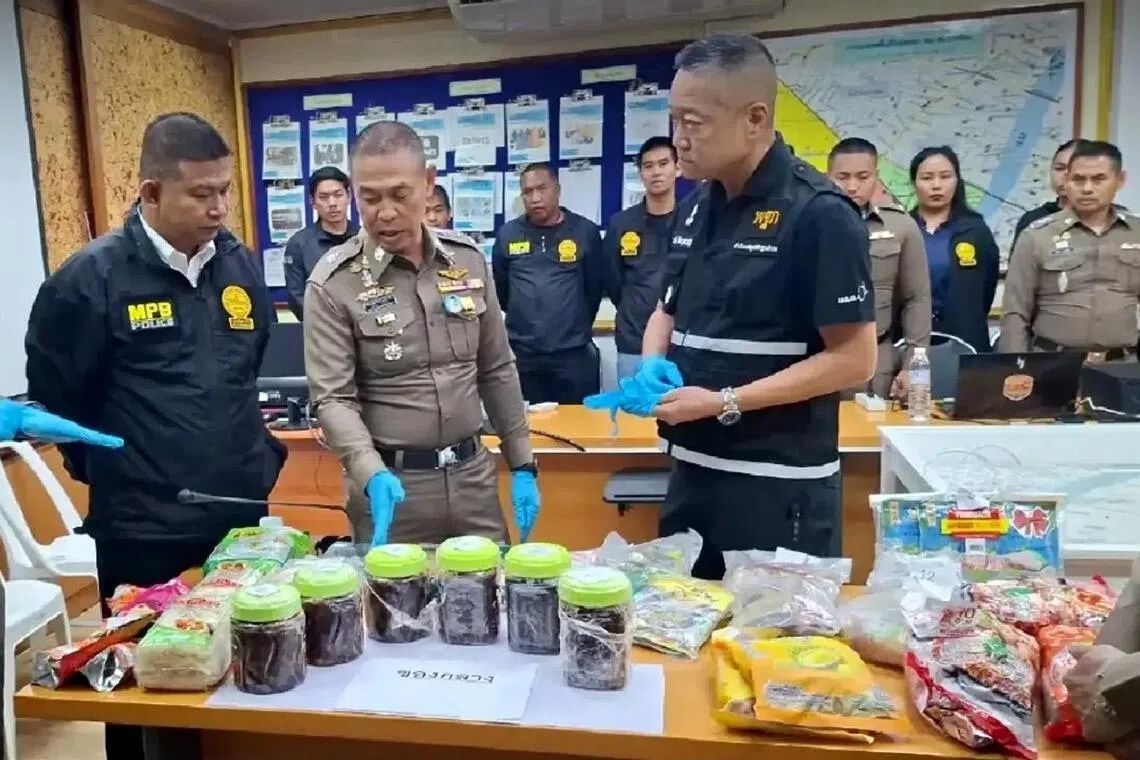
Thai metropolitan police have uncovered a sophisticated international drug smuggling network operating across Southeast Asia, with Vietnamese nationals orchestrating the shipment of crystal methamphetamine to Japan via Thailand using an ingenious concealment method. The operation, which came to light after a suspicious courier alerted authorities on July 13, represents a significant trafficking route that exploits Thailand's position as a regional transportation hub and the trust associated with legitimate food exports.
The investigation began when a delivery courier contracted to transport goods overseas grew wary of several jars of tamarind paste destined for Tokyo. The containers possessed an abnormal weight that triggered concern, leading the courier to voluntarily present them for police examination rather than proceed with the shipment. Upon inspection, Bangkok authorities discovered six foil-wrapped packages nestled inside the jars, containing more than 2 kilograms of crystal methamphetamine—street value representing a significant commercial operation. Metropolitan Police Bureau commissioner lieutenant-general Siam Boonsom announced the findings on July 17 alongside senior officials from Bangkok's Division 7.
What makes this case particularly noteworthy for Southeast Asian security analysts is the operational sophistication employed by the Vietnamese-led network. Rather than operating as a centralised unit, the smugglers constructed a deliberately fragmented supply chain designed to obscure accountability and complicate investigative efforts. The leadership reportedly remained based in Hanoi, operating through anonymous Facebook accounts to recruit delivery riders who collected packages from safe houses occupied by Vietnamese nationals throughout Thailand. These riders then transferred shipments to Thai couriers hired specifically for overseas transport, creating multiple buffer layers between command and execution.
This compartmentalisation strategy reflects evolving tactics within transnational drug networks seeking to evade law enforcement across borders. By employing contract workers unfamiliar with the broader operation, ensuring geographic separation between organisers and transporters, and rotating personnel, the syndicate attempted to construct an arrangement where no single individual possessed comprehensive knowledge of the full operation. Such methods have become increasingly common in Southeast Asian trafficking as authorities develop better intelligence-sharing capabilities and implement tighter border controls.
Financial flows provided the crucial breakthrough that ultimately exposed the network's structure. Investigators traced payments and operational expenses through a bank account registered to Sompong, a Thai national arrested during the initial investigation. Vietnamese operatives allegedly made regular withdrawals of between 20,000 and 50,000 baht in cash from this account before departing for Vietnam, suggesting a deliberate strategy to minimise electronic transaction records and reduce exposure to financial intelligence units. Police believe this rotating withdrawal pattern was intended to avoid triggering automated suspicious activity alerts that banks typically flag for large or repetitive transfers.
The geographic scope of this operation carries particular implications for Thailand and the broader region. Thailand's infrastructure, combined with its established role in legitimate regional trade and tourism, creates optimal conditions for smugglers seeking to move contraband inconspicuously. The concealment method—hiding methamphetamine within tamarind paste jars—exploits the legitimacy of Thai food exports and the lower scrutiny often accorded to agricultural products compared to manufactured goods. Tamarind itself is a Southeast Asian staple ingredient with established export markets, making the chosen commodity particularly effective for avoiding suspicion at customs checkpoints.
Arrest warrants have been issued for four individuals: Sompong, the Thai national whose bank account facilitated transactions, and three Vietnamese nationals allegedly involved in withdrawal operations, social media account management, or command responsibilities. However, Sompong has consistently denied the allegations, while investigators continue examining the potential involvement of his girlfriend, who has not been formally charged but is believed to have possessed knowledge of the operation. This uncertainty reflects the investigative challenges authorities face when attempting to establish culpability within compartmentalised criminal structures where plausible deniability remains widespread.
Police assessment suggests that more than four individuals participated in this particular smuggling cycle, indicating that the visible network represents only a portion of the broader criminal enterprise. This assessment aligns with international law enforcement understanding that successful transnational drug operations typically maintain redundant personnel and supply chains to mitigate the impact of individual arrests. The exposure of this single route likely prompted the syndicate to pivot toward alternative methods, transit countries, or concealment techniques.
For Malaysian security analysts and border officials, this case illuminates vulnerabilities within regional trafficking networks that sometimes transit Malaysian territory or exploit Malaysian ports and airports. The use of unsuspecting couriers, often individuals recruited through online platforms and unaware of cargo contents, remains a persistent challenge across Southeast Asia. Malaysia's own geographic position between major production regions and demand markets in Japan, South Korea, and Australia makes it similarly vulnerable to such transit operations.
The incident also demonstrates how traditional law enforcement methods—combined with voluntary cooperation from industry participants—remain effective in disrupting supply chains. The courier's decision to report suspicions rather than proceed with delivery proved instrumental in unravelling months of operational planning. This underscores the importance of awareness campaigns and whistleblower mechanisms that encourage transport workers and logistics personnel to recognise indicators of trafficking.
Regional cooperation frameworks will be essential in addressing these networks, as individual country enforcement remains insufficient when criminals operate across multiple jurisdictions. The involvement of Vietnamese command, Thai intermediaries, and Japanese targets illustrates how modern drug trafficking transcends borders and requires coordinated intelligence-sharing, joint investigations, and harmonised legal frameworks. The successful exposure of this particular operation validates existing cooperation mechanisms while simultaneously highlighting their continued limitations in preventing new smuggling attempts.

