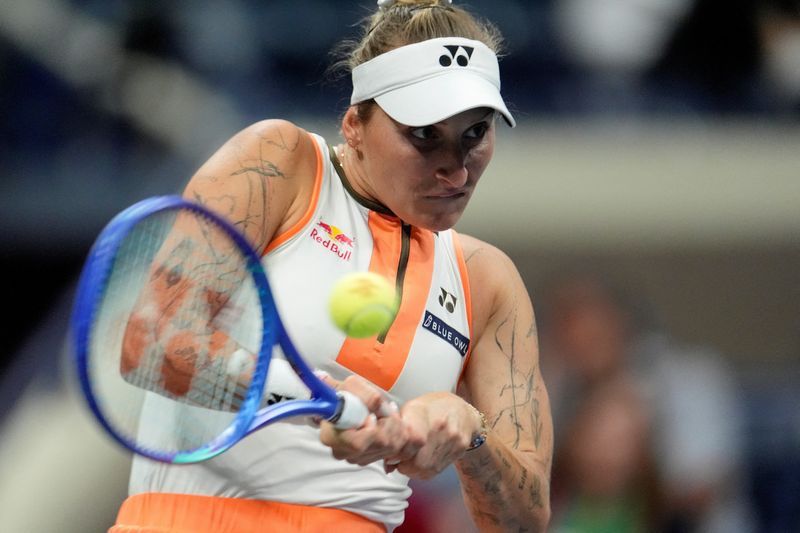
Marketa Vondrousova, the 2023 Wimbledon champion, faces a four-year suspension after missing a doping control test at her Czech home in December, a ruling that has reignited a simmering dispute over how much influence professional athletes should have in the governance of anti-doping procedures. The International Tennis Integrity Agency handed down the ban on Monday, determining that the 26-year-old failed to provide a sample when a testing officer arrived unannounced during an out-of-competition inspection. The decision has prompted the Professional Tennis Players Association to demand that governing authorities grant players a meaningful role in establishing the rules that affect their careers and privacy.
Vondrousova's explanation for refusing to comply with the test reveals the human dimension underlying what is often treated as a technical procedural matter. In April, she disclosed that months of mental and physical stress culminated in what she perceived as a frightening intrusion when an unidentified officer appeared at her residence at 8:15 p.m. demanding immediate sample provision. The late-hour visit triggered deep-seated anxieties rooted in a traumatic 2016 knife attack on fellow Czech player Petra Kvitova at her home, an incident that continues to shape how female athletes experience unannounced visits from strangers. This context transforms the case from a straightforward rule violation into a question about whether current testing protocols adequately account for player welfare and the particular vulnerabilities women athletes face when subjected to home visits outside conventional hours.
The Professional Tennis Players Association's response pointedly distinguishes between supporting the principle of rigorous anti-doping enforcement and challenging the proportionality of consequences imposed on athletes with unblemished testing records. In a statement emphasizing this distinction, the PTPA noted that a four-year career suspension for someone who has never returned a positive test result warrants critical examination, particularly given the circumstances surrounding Vondrousova's refusal. The organisation called for players to gain real influence over the rules governing them, acknowledging that testing remains necessary while arguing that the current system is shaped entirely by authorities without athlete input into policy formation. This demand reflects broader frustration within professional tennis about the asymmetry of power in anti-doping governance.
Tension surrounding anti-doping enforcement in tennis has intensified following controversial outcomes in cases involving higher-ranked players. Jannik Sinner, the world's top-ranked men's player, and Iga Swiatek, a former world number one, both escaped substantial bans despite positive drug test results, decisions that fuelled perceptions of inconsistent application depending on player status. These cases exposed what many athletes view as opacity in how anti-doping authorities evaluate evidence and determine sanctions, reinforcing the PTPA's argument that players deserve transparency and voice in a system that profoundly affects their livelihoods. The contrast between how high-profile players' cases were resolved and Vondrousova's four-year ban has crystallised frustrations about potential bias or inconsistency in enforcement.
The International Tennis Integrity Agency defends its approach by emphasising that all cases are determined solely by factual and evidentiary merit, insisting that a player's ranking, nationality, or public profile plays no role in decision-making. ITIA Chief Executive Karen Moorhouse articulated this position in a formal response, stressing that the independent tribunal examining Vondrousova's case acted in accordance with principles established under the World Anti-Doping Agency code, which tennis adopted to align with anti-doping standards across other sports. Moorhouse acknowledged that testing creates discomfort and adds burden to athletes whose professional lives already carry extraordinary pressure and public scrutiny, but framed it as a necessary sacrifice required to maintain competitive integrity. This perspective reflects an institutional view that preserves fairness in sport by prioritising unpredictable testing as fundamental to clean competition.
Concerns about player safety and privacy during out-of-competition testing have assumed particular prominence in the context of women's professional tennis. Vondrousova's case crystallised these anxieties by demonstrating how current procedures can intersect with legitimate personal security concerns specific to female athletes. The late-evening timing of the attempted test, the unannounced nature of the visit, and the requirement to allow a stranger into one's private residence creates multiple vulnerability points that male athletes, statistically speaking, may experience differently. The PTPA and other advocates have begun arguing that anti-doping procedures require gender-sensitive redesign to account for these differentiated security realities, rather than applying a uniform testing model across all athletes regardless of sex or personal circumstances.
Moorhouse countered safety concerns by detailing procedural protections embedded in the ITIA's testing protocols. She noted that all testing witnesses are specially trained professionals who carry identification and can be verified through additional methods if athletes have doubts about their legitimacy. The authority also ensures gender matching between testing witnesses and players, recognising that same-gender interactions may feel less intrusive to athletes during sample collection. These measures suggest the ITIA has invested in safeguarding mechanisms, yet Vondrousova's experience indicates that formal procedures may not fully alleviate the psychological impact of late-night visits or address the historical trauma informing some athletes' threat perception. The gap between institutional design and individual experience points toward a deeper structural problem in how anti-doping authorities engage with player perspectives.
The dispute also reflects differing philosophies about athlete autonomy and regulatory authority. Tennis authorities operate within an international framework requiring unpredictability to prevent athletes from timing their participation in doping schemes around testing schedules. From this perspective, allowing athletes to negotiate testing times, locations, or circumstances would fundamentally compromise the system's integrity. However, the PTPA's insistence on meaningful player voice does not necessarily demand removal of unpredictability but rather inclusion of athletes in designing procedures that balance deterrence with respect for privacy and safety. This distinction suggests room for negotiated solutions that strengthen rather than undermine anti-doping enforcement while accounting for legitimate athlete concerns.
Vondrousova's case intersects with a broader regulatory conversation happening across international sport about how to modernise anti-doping systems in response to athlete activism. The PTPA filed a lawsuit against tennis governing bodies in recent years specifically challenging the privacy implications of random testing protocols, signalling that this dispute will likely continue beyond individual cases in formal legal venues. As professional tennis navigates pressure from multiple directions—athletes demanding greater voice, governing bodies insisting on rigorous enforcement, and the public maintaining expectations of clean sport—the Vondrousova precedent may force a reckoning about whether current structures can adapt to incorporate athlete input without sacrificing competitive integrity.
The implications for Southeast Asian tennis and the broader regional sports ecosystem deserve consideration. As professional tennis expands throughout Asia and more regional players compete at elite international levels, they will encounter the same anti-doping procedures that triggered Vondrousova's case. Understanding how these systems operate and advocating collectively for reform becomes relevant for rising athletes from Malaysia, Thailand, Vietnam, and other Southeast Asian nations who may face similar pressures. The Vondrousova case demonstrates that professional athletes increasingly possess sufficient collective power to challenge regulatory regimes, a lesson that could inspire regional players to demand more transparent and athlete-inclusive governance structures across international sports organisations overseeing their competition.
Vondrousova retains the right to appeal her four-year ban through the Court of Arbitration for Sport, potentially offering an opportunity for closer judicial examination of whether current ITIA procedures adequately balance testing necessity against player rights and safety. Regardless of the appeal outcome, her case has permanently altered the discourse surrounding anti-doping governance in professional tennis, forcing authorities to defend not only their technical enforcement but also their willingness to incorporate athlete perspectives into rule formation. The resolution of this particular suspension will matter less for tennis's long-term direction than whether governing bodies genuinely expand player involvement in anti-doping policy or simply weather criticism while maintaining existing structures unchanged.