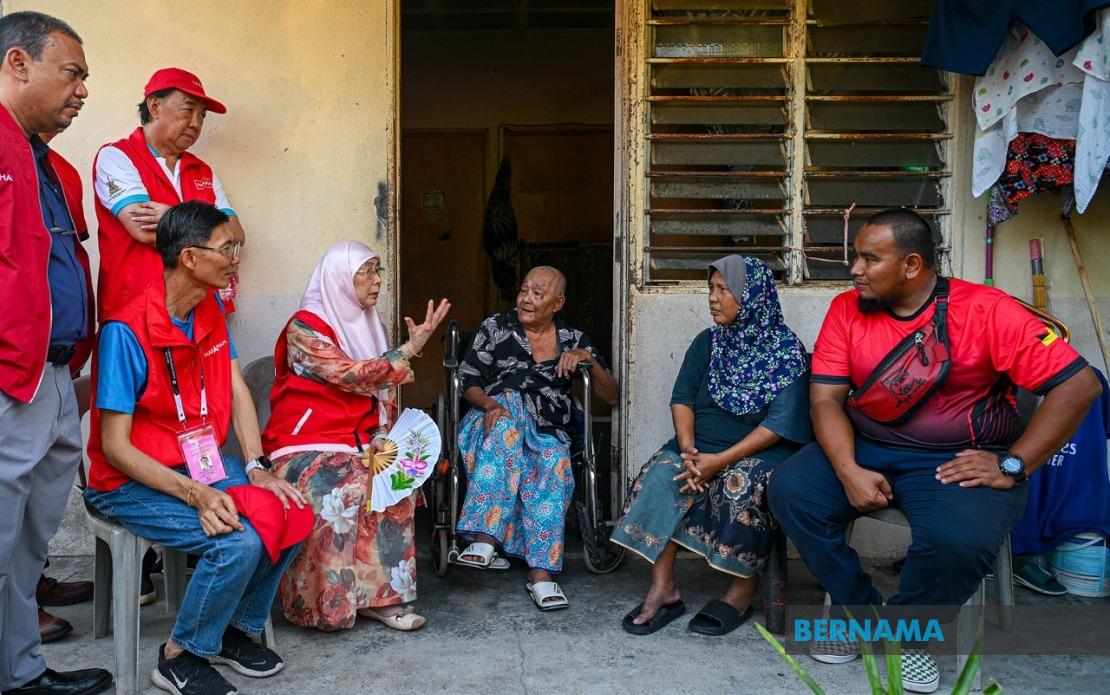
Pakatan Harapan leadership has intensified grassroots engagement in Negeri Sembilan as the state election campaign enters its final stretch, with party figures making direct contact with voters grappling with economic pressures and healthcare challenges. The personal visit by Wan Azizah to a household in the Chuah constituency underscores the coalition's strategy of connecting senior party figures with ordinary Malaysians whose daily struggles often go unheard in political discourse.
Accompanied by Datuk Yew Boon Lye, who carries the PH banner in the Chuah state legislative seat, Wan Azizah spent approximately 20 minutes at the residence of Zaiton Hasan and Paimin Sapari. The couple, aged 60 and 71 respectively, have been navigating the compounded difficulties of managing chronic illnesses—Zaiton with high blood pressure and Paimin with diabetes—while contending with financial constraints that make medical care and daily living increasingly burdensome for pensioners and retirees in Malaysia's lower-income bracket.
For residents of modest means in states like Negeri Sembilan, the intersection of health emergencies and limited income represents an acute policy concern that has gained traction as an election issue. Rising healthcare costs, even within Malaysia's public system, combined with inadequate pension provisions for senior citizens, create situations where elderly individuals must make agonising choices between medication, nutrition, and housing. The couple's candid discussion of their circumstances reflects a broader demographic challenge facing the country as its population ages.
Zaiton expressed profound gratitude for the visit, describing the encounter as emotionally significant. She told reporters that receiving a senior political figure in her home felt surreal, emphasizing that the genuine warmth displayed by both Wan Azizah and Yew represented something unusual in her experience with elected representatives. Her reaction suggests that many Malaysians, particularly in rural or semi-urban areas, feel disconnected from political leadership and view direct engagement as a rarity worth celebrating.
The visit incorporated a tangible gesture of support beyond the symbolic act of showing concern. The Port Dickson People's Spirit Welfare Association presented Paimin with a wheelchair, a practical aid that addresses his mobility constraints directly. Such donations highlight the role that civil society organizations play in supplementing government welfare systems, particularly in providing equipment and services for elderly citizens with limited purchasing power. The provision of mobility aids can significantly enhance quality of life and independence for individuals managing multiple chronic conditions.
Within the Chuah contest, Yew faces direct competition from Pau Jeou Ching of Perikatan Nasional, setting up a two-candidate race that will test voter preferences between the two broad political coalitions. The battleground seat reflects the nuanced political positioning in Negeri Sembilan, where no single coalition dominates entirely and individual candidate performance and local engagement can prove decisive. PH's deployment of established figures like Wan Azizah suggests an effort to build momentum heading into polling.
The campaign occurs amid the broader context of Malaysia's evolving political landscape, where coalitional politics at the state level increasingly diverges from federal alignments. Negeri Sembilan has experienced shifting political dynamics, and the 16th state election provides an opportunity for parties to recalibrate their standing in this strategically important state. How effectively parties address local concerns—healthcare, pensions, employment—may weigh more heavily with voters than national partisan messaging.
Election Commission procedures set early voting for July 28, with the official polling day scheduled for August 1. This compressed campaign timeline places emphasis on efficient voter engagement and the ability of candidates to penetrate communities with their message and presence. Ground-level visits and personal testimonials from voters become particularly valuable currency in such condensed election cycles, where traditional advertising and mass media compete for limited voter attention.
The elderly couple's situation encapsulates vulnerabilities that extend beyond individual households to represent systemic issues in Malaysia's social safety net. While the country boasts universal healthcare and a pension system, coverage gaps and inadequate benefit levels leave many senior citizens exposed to financial stress. State-level politicians increasingly recognize that addressing these structural problems—through enhanced healthcare subsidies, improved pension schemes, or targeted assistance programs—constitutes a core electoral promise that can mobilize lower-income voters.
Wan Azizah's visit also reflects the ongoing repositioning of Pakatan Harapan following the coalition's loss of federal power in 2023. Rebuilding grassroots connections and demonstrating commitment to constituent welfare has become essential to the opposition's strategy for regaining electoral credibility. Personal engagement by senior figures, though time-intensive, carries symbolic weight that mass campaigns cannot replicate, particularly among older voters who appreciate direct human connection with their representatives.
The timing of such visits during active election campaigns raises questions about the sustainability of such engagement beyond polling day. Citizens naturally wonder whether the attention they receive during campaigns translates into actual policy outcomes and continued support from elected officials. Building trust requires not merely symbolic gestures but demonstrable follow-through on promises made during the heat of electoral competition.
As Negeri Sembilan voters prepare to cast their ballots, the interplay between national political narratives and local constituent needs will ultimately determine election outcomes. Visits like Wan Azizah's to elderly households facing genuine hardship remind voters that elections carry material consequences for real people managing precarious circumstances, making the choice between competing candidates and coalitions a consequential decision rather than an abstract political exercise.

