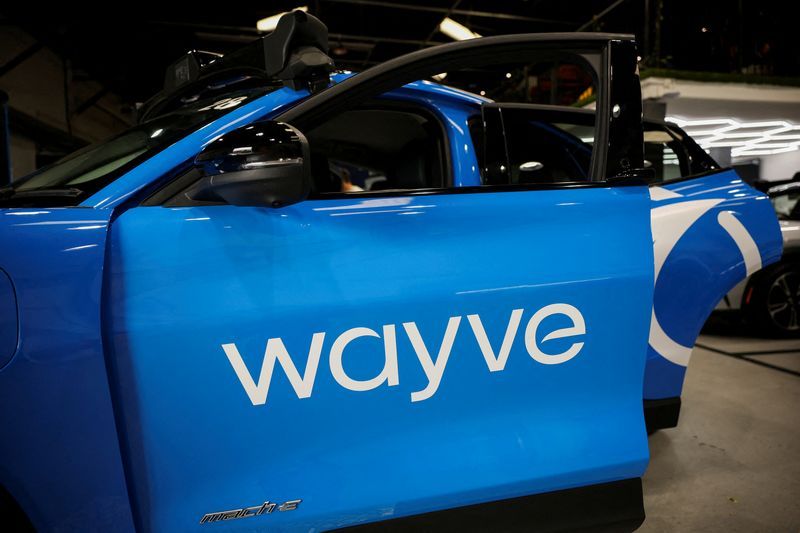
Wayve, the London-based autonomous-driving startup, is capitalising on surging investor appetite for self-driving technology by securing $2.8 billion in funding from a constellation of industry heavyweights. The funding round includes backing from Nvidia, Mercedes-Benz, Nissan, and other strategic partners spanning the technology and automotive sectors. The momentum underscores a fundamental shift in how the industry approaches the challenge of building truly autonomous vehicles that can operate across diverse driving environments without extensive pre-programming.
Central to Wayve's appeal is its novel technological foundation: end-to-end machine learning, an AI approach that processes raw sensor data and translates it directly into driving decisions in real time. This methodology represents a departure from the traditional paradigm, which relies on combining pre-written software rules with high-definition mapping systems to instruct vehicles how to respond to specific driving scenarios. Rather than encoding every conceivable driving situation into code, Wayve's system learns driving patterns through data, much as a human driver develops intuition behind the wheel. The company has already demonstrated commercial traction, announcing in June that its technology will power robotaxis built by Stellantis, the Jeep manufacturer, for deployment on Uber's ride-hailing platform.
Wayve's approach echoes the strategic direction taken by Tesla, which transitioned to end-to-end learning several years ago. A crucial distinction, however, separates the two companies' implementations. Tesla's system relies exclusively on cameras as its sensory input, whereas Wayve designed its architecture to interface with a broad spectrum of sensors and artificial intelligence chips. This hardware-agnostic design philosophy opens significant licensing opportunities, allowing Wayve to partner with virtually any vehicle manufacturer or autonomous-driving developer regardless of their existing sensor configurations or computing platforms. CEO Alex Kendall, a 33-year-old New Zealander who founded Wayve in 2017 shortly after completing his doctorate in AI deep learning at Cambridge University, articulated the company's expansive vision: to make full self-driving accessible to any vehicle, any brand, and anywhere globally.
Wayve's timing capitalises on renewed industry confidence sparked by Alphabet's Waymo, which has dramatically expanded operations over the past two years. Waymo now offers paid autonomous rides to the public across roughly a dozen cities following more than a decade of development and testing. This tangible commercial success has reignited investor enthusiasm in the autonomous-driving sector after years of missed timelines and overstated claims. The contrast is striking: a decade ago, end-to-end AI research was confined to academic circles, with researchers like Kendall pursuing largely theoretical investigations. Today, most autonomous-driving developers have incorporated at least some elements of end-to-end learning into their operational systems, reflecting industry-wide validation of the approach.
Yet the shift towards AI-centric navigation introduces a profound challenge that technologists and regulators continue grappling with: interpretability. End-to-end systems operate as computational "black boxes," making it difficult for engineers and regulators to understand precisely why a vehicle made a particular driving decision. Earlier driverless-car architectures, which depended on explicit software programming to guide navigation, offered greater transparency in their decision-making logic. This transparency was comforting but also constraining. Wayve's engineering team contends that rigid, rule-based systems become problematic when encountering genuinely novel driving situations that developers failed to anticipate and encode. When such unforeseen scenarios arise, pre-programmed safety logic "becomes brittle," according to Vijay Badrinarayanan, Wayve's vice president of AI. Human drivers manage comparable uncertainty by adapting cautiously when facing unfamiliar conditions, a capacity that end-to-end learning systems can theoretically emulate more effectively than traditional rule-based approaches.
Wayve itself addresses the interpretability concern by generating what it describes as a safety map that visualises emerging traffic situations and identifies secure driving paths for the vehicle. Despite this innovation, scepticism persists within the industry. Waymo, despite adopting end-to-end AI as a core component of its system, deliberately maintains a parallel rules-based approach grounded in conventional software coding and mapping. The company explicitly stated to Reuters that end-to-end models alone are insufficient to guarantee safety at scale, signalling that hybrid architectures may represent the pragmatic middle ground. This hesitation from an industry leader underscores the lingering caution surrounding pure end-to-end systems.
Nissan, one of Wayve's marquee customers, exemplifies this cautious evaluation process. Eiichi Akashi, Nissan's chief technology officer, indicated that his team is methodically assessing Wayve's safety framework before the automaker deploys the technology in Japan. Nissan has committed to introducing Wayve's system in a people-mover van called the Elgrand by the fiscal year ending March 2028. While Akashi acknowledged that Wayve's technology represents the "most advanced" available, he simultaneously highlighted the practical difficulty: it remains "difficult to peer into it and see how it makes decisions." This tension—between recognising technological sophistication and demanding explainability—will likely shape autonomous-driving adoption across the automotive industry as manufacturers balance innovation with the institutional and regulatory expectation of transparency.
Wayve's competitive advantage resides partly in its efficiency of deployment. The company does not require the labour-intensive preliminary phases of road mapping and customised code development to accommodate local driving conventions. Kendall argues that this streamlined approach enables rapid expansion into new markets. Wayve claims to have successfully tested its AI driving system in hundreds of cities worldwide without such preparatory work, a capability that could substantially compress time-to-market for autonomous services in new geographies. With major operational centres in Tokyo, Stuttgart, and Vancouver, Wayve is positioned to rapidly tailor its offering for Asian, European, and North American markets simultaneously.
However, expert voices introduce measured perspectives on Wayve's technological claims and timeline aspirations. Siddartha Khastgir, a professor of safe autonomy at the University of Warwick, suggests that end-to-end models should indeed accelerate development and commercial deployment compared to conventional approaches. Yet he cautiously declines to declare one technology inherently safer than alternatives. Phil Koopman, a computer-engineering professor at Carnegie Mellon University and recognised expert in autonomous systems, frames Wayve's approach to navigating unusual traffic situations as one among several potentially viable strategies, rather than a definitively superior solution. Koopman estimates that at least another decade will be required before driverless systems can be safely deployed comprehensively across the United States, requiring new technological breakthroughs beyond current capabilities.
For Malaysian and Southeast Asian readers, Wayve's emergence carries strategic implications. The region's rapidly expanding urban centres, characterised by chaotic traffic patterns and informal driving conventions, present both opportunities and obstacles for autonomous-vehicle deployment. Wayve's capacity to operate across diverse driving environments without extensive pre-programming could theoretically simplify the path to autonomous services in cities like Kuala Lumpur, Bangkok, and Manila. Conversely, the interpretability and safety concerns raised by Waymo and Nissan suggest that Asian regulators and automotive stakeholders should scrutinise transparency mechanisms before authorising large-scale deployment. The next phase of Wayve's expansion will likely pivot towards Asian markets, where both the commercial opportunity and the regulatory complexity remain substantial.

