For more than two decades, thousands of students across New York City have taken on the role of junior landscape architects, fundamentally transforming the way their schools look and feel. What began as a simple initiative to improve bleak asphalt schoolyards has evolved into the Community Schoolyards programme, which has fundamentally changed the relationship between children and their physical learning environments. Since 2002, the Trust for Public Land has partnered with city education and environmental officials to oversee the construction of 225 kid-designed playgrounds that have collectively cost nearly US$200 million, financed through government allocations and private philanthropic contributions. These spaces now serve not just as recreational areas for students but as vibrant community hubs that operate year-round and welcome residents from all walks of life.
The design process itself represents a democratic approach to urban planning that rarely extends to children in most cities. Rather than having architects or administrators impose designs from above, students engage in a comprehensive hands-on journey that begins with brainstorming sessions where they articulate their wildest desires—swimming pools, chocolate fountains, koi ponds, and merry-go-rounds feature prominently in these initial wish lists. Over successive weeks and months, the young designers learn the practical constraints of budgets and feasibility, gradually refining their visions into realistic proposals. They measure spaces, create maps, and crucially, they incorporate feedback from the broader school community including teachers, parents, and neighbours. This iterative process culminates in community votes on final designs, ensuring that the resulting playgrounds reflect genuine consensus rather than the preferences of a select few.
What makes these schoolyard transformations particularly remarkable is how they balance whimsy with pragmatism in ways that only genuine users can truly understand. The thematic elements—unicorns, dragons, aliens, and other fantastical motifs—create spaces that ignite childhood imagination and make play inherently more engaging. Yet beneath the creative surface lies functionality designed by those who spend hours in these spaces daily. The playground at a Queens middle school demonstrates this principle elegantly through its "introvert's corner," a contemplative area featuring a gazebo surrounded by vegetation specifically designed for students who prefer quiet reading or solitary reflection rather than competitive games. This insight reveals something fundamental about playground design: children understand the nuanced social dynamics of their peers in ways that adult designers often miss.
One striking example of how children's perspectives enhance playground functionality emerged at a Bronx school where girls felt increasingly excluded from basketball courts that boys dominated. Rather than accepting this gendered spatial divide, the students proposed and implemented a solution: dedicating one half-court painted in pink specifically for girls, while maintaining mixed-use courts elsewhere. The psychological impact proved significant; girls reported feeling more confident and less anxious about judgment, creating a space where they could develop athletic skills without pressure. As Charlotte Lawrence, eleven, articulated, the designated space made her feel less alone and genuinely confident in her abilities. Notably, the design didn't create permanent barriers; boys could still use the pink court but understood that it required asking permission first, demonstrating how thoughtfully designed spaces can reshape social norms around inclusion.
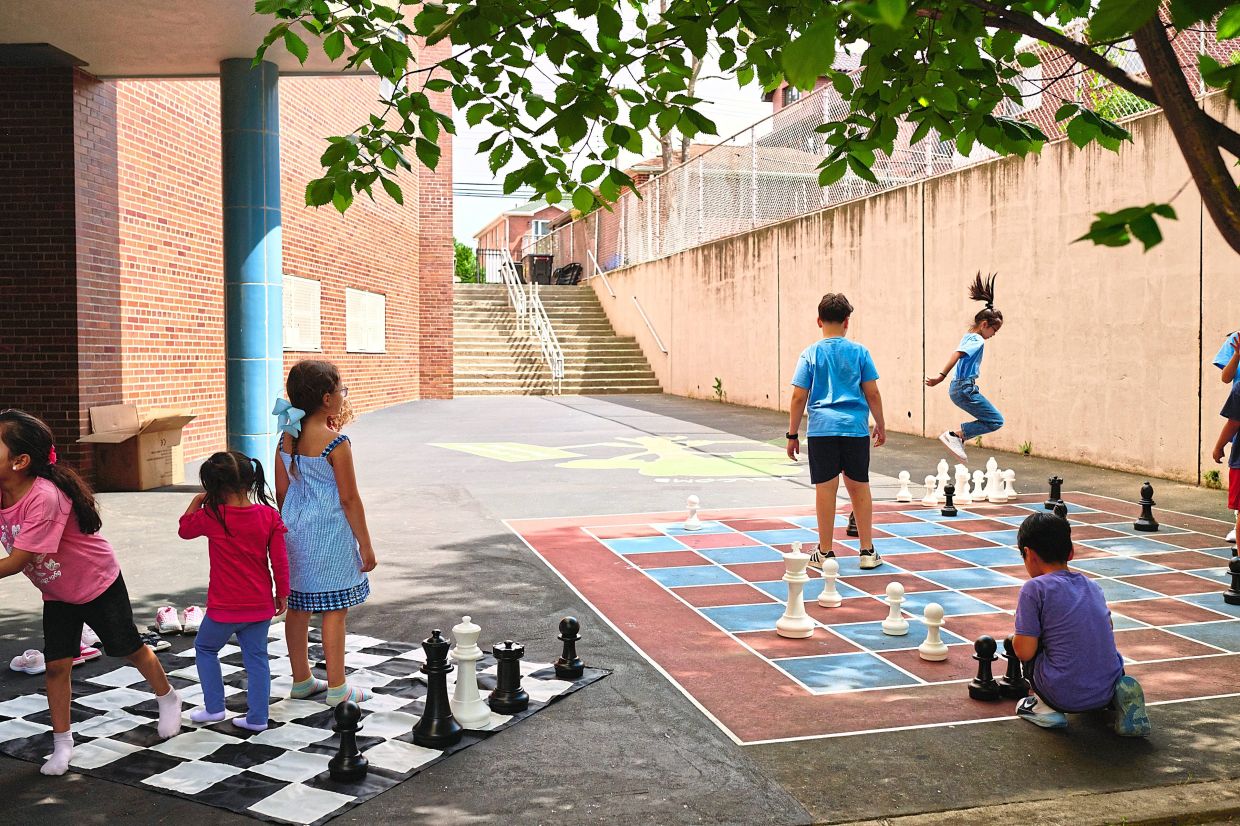
Literary inspiration has also sparked playground innovation in ways that reflect the intellectual curiosity of young designers. Students at North Hills School in Queens, enchanted by Harry Potter's depiction of life-size wizard chess, envisioned and created two giant painted chessboards on their playground. The scale transformation fundamentally changes the gameplay experience; the larger pieces make the strategic elements more visible and the physical movement more engaging for players. Ayden Chabane, eleven, noted that the larger format adds vitality to what might otherwise be a sedentary game. However, the students quickly learned about real-world maintenance challenges, as the oversized pieces proved vulnerable to breakage and loss—a valuable lesson in understanding the gap between imaginative vision and practical implementation.
Student designers have also demonstrated acute awareness of their peers' needs beyond typical athletic activities. At a Harlem playground, students observed that girls frequently gathered to have their hair braided, yet sat uncomfortably on standard ground seating. They responded by designing tiered benches with three pairs of steel slat seats, each pair featuring one slightly lower seat to accommodate the specific posture needed for braiding. Yet these purposefully designed fixtures became multipurpose; students discovered that the benches functioned equally well for parkour jumping, served as impromptu dance stages, and even became props in imaginative play where the height differential suggested driver and passenger positions in imaginary vehicles. This adaptability reveals how well-conceived student-led design anticipates multiple uses rather than constraining spaces to single functions.
Playful gamification of schoolyards has emerged as a powerful tool for community building and social connection. A Brooklyn playground embraced the "floor is lava" concept through an elaborate rock-star and gems theme, painting a volcano in the basketball court's centre with lava flowing around equipment and seating. The game has proven remarkably effective as an icebreaker, enabling students from different grade levels and social groups to interact through shared imaginative play. Amia Peoples, eleven, highlighted how the game's accessible nature created genuine connection opportunities across the student population. This demonstrates how thoughtfully themed play spaces can address social fragmentation that often characterises large, diverse schools.
Other playgrounds incorporate natural education and ecological awareness into their design philosophy. The Emanuel Kaplan School in Queens created mushroom-shaped stools with bright red caps and white spots, a design reflecting their neighbourhood's pre-urban history as woodland. These functional art pieces serve dual purposes: providing resting spots while simultaneously enabling active play through hopping games. Young Jack Henshaw described the simple joy of progressing sequentially across the stools or playfully skipping ahead, showing how form and function seamlessly integrate in student-designed spaces.
The most ambitious ecological undertaking appears at Pacific School in Brooklyn, where students originally envisioned a petting zoo featuring goats, donkeys, and llamas. When budget constraints made this infeasible, they pivoted toward creating a pollinator garden that ultimately proved more educationally valuable and sustainable. The garden operates through distributed responsibility: Team Tomato, a fourth-grade club, provides primary stewardship while the entire school participates through winter seedling cultivation and parent plant donations. This model transforms abstract environmental education into lived experience where students directly observe ecological relationships. Kamali Foreman, nine, captured the visceral learning that occurs when children engage directly with nature, describing how smelling mint and lavender produces sensory confirmation that they are "breathing in nature."
These New York schoolyard transformations carry particular relevance for Southeast Asian urban contexts, where rapid development and intensifying school pressures often result in similarly barren play environments. Malaysia's expanding cities frequently prioritize building density over green space, leaving students with utilitarian concrete yards that offer little imaginative possibility. The Community Schoolyards model demonstrates that meaningful environmental improvement requires neither massive capital expenditure nor external expertise but rather genuine investment in child agency and community participation. When students participate in designing their own spaces, they develop spatial awareness, collaborative problem-solving skills, and deeper attachment to their immediate environment—outcomes with lasting developmental significance beyond the playgrounds themselves.
The programme's success also illustrates how participatory design processes can democratize urban planning in ways increasingly rare in hierarchical institutional contexts. By positioning children as legitimate stakeholders in decisions affecting their daily lives, schools teach fundamental lessons about civic engagement and the possibility of improving one's surroundings through collective action. These playgrounds become visible proof that children's ideas matter, that their observations merit serious consideration, and that they possess genuine insight into creating functional, joyful spaces. As Malaysian urban planners grapple with questions about how to make cities more liveable and inclusive, the example of thousands of New York students transforming their schoolyards suggests that solutions sometimes emerge not from professional expertise imposed from above but from genuine engagement with those most intimately familiar with the spaces in question.

