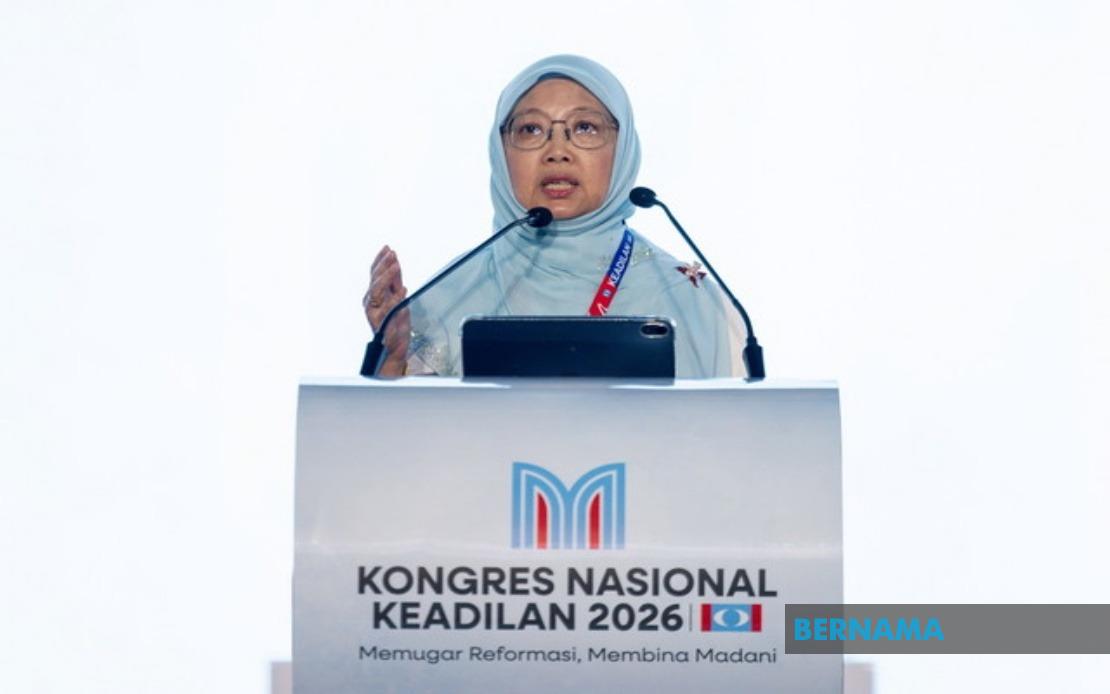
Datuk Seri Dr Zaliha Mustafa, the Parti Keadilan Rakyat (PKR) vice president, has reframed the party's entry into government not as a culmination but as a critical juncture that will reveal whether it possesses the fortitude and strategic acumen to fundamentally reshape how Malaysia is administered. Speaking during her closing address at the PKR 2026 National Congress in Melaka, Zaliha contended that the party's quarter-century journey toward reform should never be reduced to a mere organisational takeover, but rather understood as a commitment to systemic governance overhaul.
The distinction Zaliha drew is philosophically significant for Malaysian politics. She rejected the notion that decades of advocacy can be characterised as a singular pursuit to occupy Putrajaya, arguing instead that such a narrow reading would trivialise the intellectual and moral foundation underpinning PKR's existence. Rather, she positioned the party's current ministerial responsibilities as the arena where its foundational principles must be validated through concrete action. This framing carries particular weight in a political landscape where promises often exceed performance, and where the transition from opposition activism to governing has historically tested the cohesion and idealism of political movements.
Zaliha articulated a comprehensive agenda that government membership demands from PKR. The party, she insisted, must now demonstrate its ability to fortify institutional frameworks, wage sustained battle against corruption and the abuse of state power, and ensure that justice reaches all demographic and socioeconomic strata. These are not peripheral aspirations but central to the legitimacy of PKR's governance mandate. The emphasis on institutional strengthening is particularly relevant given Malaysia's documented challenges with bureaucratic accountability and the concentration of discretionary power within executive structures.
Crucially, Zaliha identified internal accountability as an indispensable element of this reform project. She urged party members to possess sufficient moral clarity and courage to critique and correct deficiencies emerging from their own ranks, signalling that reformist credentials depend substantially on the willingness to apply standards consistently rather than selectively. This represents an implicit challenge to the historical pattern in Malaysian politics where governing parties have often shielded their own members from scrutiny while condemning opposition conduct.
Zaliha emphasised that reform implementation requires not impulsiveness but disciplined strategy. Drawing conceptually from the historical example of Khalifah Umar Abdul Aziz, which PKR president Datuk Seri Anwar Ibrahim had invoked at the congress opening, she argued that transformative change must unfold through carefully sequenced phases without abandoning overarching objectives. She acknowledged that certain reforms demand immediate execution whilst others necessitate negotiation, groundwork, and temporal investment to achieve durability. This nuanced stance distinguishes between ideological commitment and operational realism.
The distinction between gradualism and procrastination formed a core element of her message. Zaliha insisted that proceeding cautiously does not constitute abandonment of reform zeal, but rather reflects wisdom about implementation. She stressed that the direction must remain unmistakable and the party must retain clarity about which specific areas require correction, maintaining momentum toward those targets even as timelines extend. For Southeast Asian audiences observing PKR's governance experience, this represents a crucial test of whether reform movements can maintain integrity whilst accommodating the pragmatic constraints of state administration.
Zaliha identified a critical weakness in PKR's current effectiveness: the gap between policy implementation and public understanding. She observed that achieving something substantive does not automatically translate into citizen awareness or appreciation, and that the party cannot expect populations to intuitively grasp governmental accomplishments without deliberate communicative effort. This diagnosis reflects a broader challenge facing reform-oriented administrations across the region, where technical competence often outpaces the ability to construct compelling public narratives.
The party must fundamentally restructure its communication apparatus, Zaliha argued, making messaging more systematic, responsive, and linguistically accessible to ordinary Malaysians. She positioned effective communication not as supplementary to governance but as integral to it, since public confidence rests partly on comprehension. The challenge extends beyond traditional media, encompassing what she characterised as the digital realm where opposition forces have developed considerable sophistication.
Zaliha explicitly warned against ceding narrative dominance on social media platforms to opposition actors, recognising that contemporary political contests are substantially waged through digital channels where messaging cadence and rhetorical framing shape perception. She contended that numerical parliamentary majorities and sound policy formulation do not automatically ensure popular acceptance without corresponding success in capturing public sentiment and controlling interpretive frameworks. This insight reflects the evolving sophistication of Malaysian political communication, where information wars increasingly determine electoral and governance outcomes.
The overarching implication of Zaliha's address is that PKR faces a sustainability challenge fundamentally different from opposition politics. Whilst opposition movements can function primarily through critique and alternative visions, governing parties must reconcile idealistic commitments with operational constraints, maintain internal discipline whilst projecting unity, and demonstrate competence across diverse policy domains. For Malaysian observers and regional analysts monitoring whether reform movements can survive the transition from advocacy to administration, Zaliha's framework suggests PKR recognises these tensions and is attempting to navigate them with strategic intentionality rather than assume that ideology alone suffices for effective governance.

