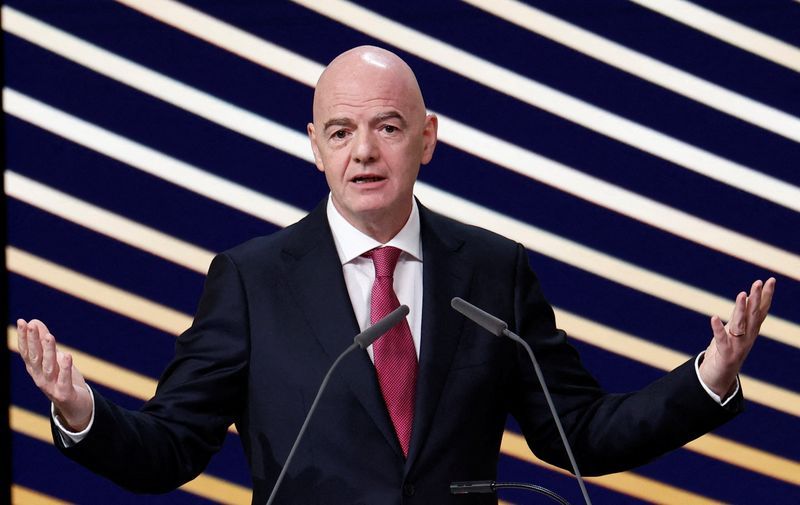
The deepening governance crisis at FIFA has an unexpected characteristic: women are steering the resistance. As President Gianni Infantino faces the most serious challenge to his authority since taking office in 2016, the most articulate and uncompromising critics voicing institutional concerns happen to be female administrators operating within UEFA's leadership structures. Laura McAllister of Wales and Lise Klaveness of Norway, the only women serving on UEFA's executive committee, have moved from periphery to centre stage in confronting what many observers now view as a fundamental breakdown in FIFA's decision-making apparatus.
The crisis erupted when Infantino pushed aggressively for FIFA Football Enterprises, a private equity venture designed to commercialise the sport's global governance apparatus. The proposal triggered unprecedented revolt across European and other regional football bodies, fundamentally fracturing Infantino's political coalition. Wales became the first of several national associations to publicly withdraw support for his potential re-election, with dissent spreading rapidly through FIFA's own institutional machinery. The deterioration of consensus reached such velocity that Infantino was forced to convene an emergency meeting in Morocco as his political position weakened considerably within days.
McAllister's influence extended beyond rhetorical opposition to concrete organisational action. During UEFA's emergency convocation, she proposed a comprehensive boycott of FIFA events, receiving unanimous backing from member federations—an extraordinarily powerful expression of institutional solidarity that underscored the breadth of organised resistance. This support represented more than routine disagreement; it reflected deep concerns that FIFA's governance trajectory had become untenable. McAllister's framing of the situation as approaching or already at crisis point resonated with stakeholders who felt the organisation had systematically breached fundamental principles governing international sports administration.
When asked whether football might finally be ready for female leadership at the presidency level, McAllister offered a candid assessment that transcended mere optimism. She acknowledged that while the possibility existed, the sport's political infrastructure remained profoundly resistant to such transformation. She emphasised that meritocratic advancement—the notion that the most qualified candidate simply rises to prominence—functions as aspiration rather than reality within FIFA's Byzantine power structures. The comment reflected hard-won understanding of how football's governance operates beyond public rhetoric about modernisation and inclusion.
Former FIFA President Sepp Blatter unexpectedly amplified this conversation by publicly endorsing Klaveness and suggesting that football's global governing body required female leadership. His intervention, delivered through media channels, elevated the question from internal UEFA discussion to broader international debate. Yet even this support from a historically significant figure could not overcome McAllister's more pessimistic assessment of structural obstacles. The disconnect between emerging consensus that women should lead football and the actual mechanisms through which such leadership could materialise remained stark.
McAllister and Klaveness bring distinctive professional perspectives beyond football administration. McAllister holds training in political science while Klaveness practised law before ascending to football governance roles. Both previously represented their respective nations as international players, experiences that shaped their values-driven approach to institutional leadership. They articulated a conviction that their outsider status relative to football's traditional power brokers—derived from their relative newness to governance and their emphasis on core principles over commercial opportunity—enabled clearer thinking about what the sport fundamentally represents. This positioning suggested that women's marginalisation from football's traditional hierarchies might constitute an unexpected advantage in confronting institutional corruption and misgovernance.
The substantive grievances McAllister identified extended far beyond the FFE proposal itself. She catalogued a pattern of ethical deterioration: FIFA's involvement with the failed European Super League project, controversial World Cup geopolitical dimensions, and the extraordinary decision to rescind a red card given to American player Folarin Balogun after Donald Trump's public intervention requesting presidential review. Each instance, in McAllister's analysis, illuminated systemic governance failure and demonstrated that FIFA had abandoned principled decision-making in favour of reactive accommodation of powerful external pressures. The accumulated pattern suggested an institution fundamentally unmoored from its stated regulatory mission.
McAllister's articulation of football's essential values offered philosophical grounding for the rebellion beyond simple opposition to privatisation. She contended that football's legitimacy derives from its universality—accessibility across economic strata, across gender lines, across geographic boundaries. Private capital commercialisation threatened this foundational character by converting football into primarily an asset class for wealthy investors rather than a social institution serving communities globally. She rejected the presumption that commercial maximisation and football's democratic essence could coexist peacefully, arguing that the two ultimately represent incompatible logics.
The statistical reality of female leadership in football remains sobering: only 10 of FIFA's 211 member associations are led by female presidents, with Klaveness counted among this small cohort. This disparity becomes more striking when contrasted with other international sporting bodies. Michael Payne, formerly a senior marketing director at the International Olympic Committee, highlighted how the IOC has prioritised gender equity for two decades, achieving near-parity in athlete participation across Olympic competitions. Football, despite its global prominence, lags significantly behind this standard, with the FIFA World Cup remaining markedly unequal in competitive opportunities between men's and women's divisions.
Despite the momentum generated by current resistance, McAllister cautioned against aggressive tactics intended to force female leadership onto football's institutional agenda. She advocated instead for patient, persistent foundation-building—what she termed the "softly softly" approach. This strategic patience reflected sophisticated understanding that revolutionary institutional change often generates backlash that ultimately entrenches resistance. By contrast, incremental advancement of women's leadership capacity, combined with visible demonstrations of female administrators' competence and values, might generate organic institutional evolution toward greater gender balance.
For Malaysian and Southeast Asian readers, the FIFA governance crisis carries particular significance given the region's substantial football constituencies and ASEAN member associations' voting weight within FIFA structures. The precedent of successful institutional resistance to a president's agenda holds implications for how regional federations might exercise collective influence on future FIFA decisions affecting Asian football development. Moreover, the framing of governance reform around institutional principles and values rather than mere commercial efficiency presents alternative models for evaluating how regional sports bodies should function, applicable beyond football to broader questions of how international sporting organisations should balance commercialisation pressures against social mission.
The rebellion's success in forcing Infantino to the negotiating table without securing his immediate departure suggests that coalitional politics within FIFA remain more fragmented and unpredictable than his earlier consolidation of power suggested. The emergence of women leaders as architects and public defenders of institutional resistance indicates that football's governance transformation may proceed through unexpected channels. Whether this moment crystallises into sustained pressure for female leadership advancement or dissipates as initial crisis momentum fades depends substantially on whether McAllister, Klaveness and their allies can translate institutional opposition into concrete structural reforms that embed values-driven governance more deeply within FIFA's decision-making architecture.

