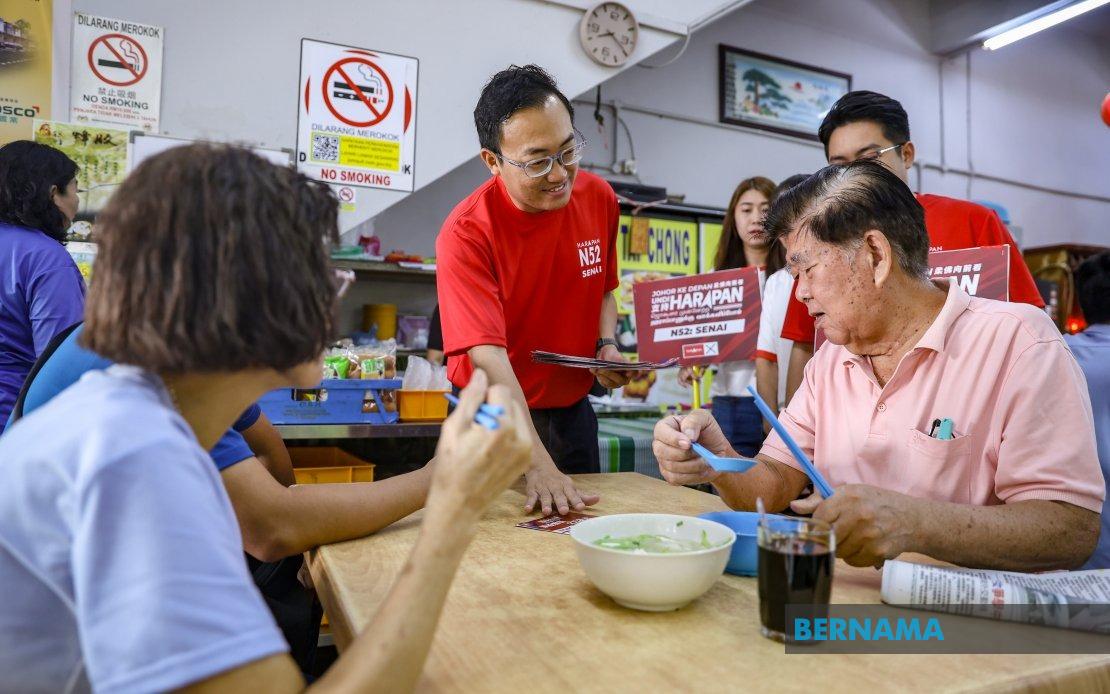
Wong Bor Yang, the sitting assemblyman for Senai, is mounting his re-election campaign on a foundation of concrete achievements rather than political rhetoric, arguing that his track record across multiple governing structures positions him uniquely to serve the Johor constituency. Speaking in Kulai ahead of the 16th Johor state election scheduled for July 11, Wong emphasised that his decade-long involvement in district governance—beginning with his role as a special officer at the Kulai MP's office in 2014—demonstrates sustained commitment to constituent welfare. This consistency, he contends, distinguishes him from candidates presenting themselves as fresh political commodities.
The former journalist's career trajectory across Malaysia's shifting political landscape offers an unusual vantage point. Wong has worked as an opposition member, transitioned into government service as a local councillor in 2018, and subsequently secured election as the Senai state assemblyman. Rather than presenting each phase as disconnected chapters, Wong frames his journey as continuous learning that has honed his problem-solving approach. His experience straddling opposition and ruling coalition benches, he suggests, has equipped him with pragmatic methods to navigate bureaucratic structures and deliver results regardless of which coalition controls particular levels of government.
Flood management has emerged as Wong's signature achievement, reflecting a persistent problem that plagued several low-lying areas within Senai's boundaries. During his previous term, he utilised parliamentary procedures—specifically petitions and state assembly debates—to secure government approval for critical drainage upgrades. His efforts yielded RM1 million in state funding to improve the drainage system in Taman Aman and direct overflow toward Sungai Skudai. This breakthrough provided foundation for a subsequent RM3 million joint initiative with Kulai MP Teo Nie Ching, which targeted flooding hotspots in Peladang Kulai Besar and Saleng. Both areas have subsequently been removed from the district's official list of flash-flood-prone locations, representing tangible progress on an issue that directly impacts residents' safety and property values.
Beyond essential infrastructure, Wong has invested effort into preserving and activating Senai's cultural heritage, a dimension often overlooked in routine constituency development. He transformed a defunct cinema into a community operations centre and rehabilitated an ageing badminton facility into a family-oriented recreational space branded as Tiny Lake under the Sejati MADANI initiative. These projects reflect Wong's belief that constituency development encompasses not merely roads and drains but also community identity and recreational quality of life.
Healthcare provision has crystallised as Wong's emerging priority for a potential second term, particularly concerning hospital capacity constraints. Kulai Hospital's current 93-bed configuration appears insufficient for a district whose population is projected to reach 500,000 by 2030. As a holder of journalism credentials from Shih Hsin University in Taiwan, Wong brings intellectual rigor to his advocacy for healthcare infrastructure expansion. He has consistently pressed for upgrades and has identified land acquisition bureaucracy as a critical bottleneck delaying construction of a new health clinic in Taman Mewah, Senai. Resolving this administrative impasse and enabling the Health Ministry to commence clinic construction represents a concrete objective for his next term.
Wong's campaign strategy deliberately positions him as a deliverer who exploits institutional relationships and procedural mechanisms to achieve constituency goals rather than as an ideological warrior. This framing holds particular resonance in Johor, where voters across multiple election cycles have demonstrated receptivity to candidates demonstrating tangible accomplishments. Wong's emphasis on practical problem-solving rather than partisan posturing attempts to appeal to an electorate he characterises as politically mature and performance-conscious.
The Senai contest itself presents a three-way contest among 66,635 registered voters, with Wong facing opposition from Barisan Nasional candidate Tai Chee Chee and Bersama candidate Tew Chien How. The presence of three distinct candidates reflects broader fragmentation within Malaysian electoral politics, potentially advantaging an incumbent with demonstrated delivery credentials. Wong's ability to consolidate support among voters prioritising infrastructure and services over ideological affiliation may prove decisive in a fractured field.
Contextually, Wong's campaign unfolds within Johor's distinctive political environment, where the state has historically oscillated between coalition control and where regional identity—Bangsa Johor sentiment—exercises considerable gravitational force on electoral behaviour. Wong's framing of his track record as responsive to constituent needs rather than driven by external party directives aligns with voter expectations in a state where pragmatism often trumps partisan loyalty. Early voting occurs on July 7, with main polling on July 11.
Wong's narrative ultimately positions experience accumulated across governance levels—opposition politics, local administration, state assembly—as superior to candidates lacking such multifaceted exposure. Whether this emphasis on continuity and proven delivery resonates with an electorate that may desire fresh leadership remains a central tension in his campaign calculus. The July 11 election will provide definitive answer regarding whether Senai voters reward demonstrated performance with renewed mandate.

