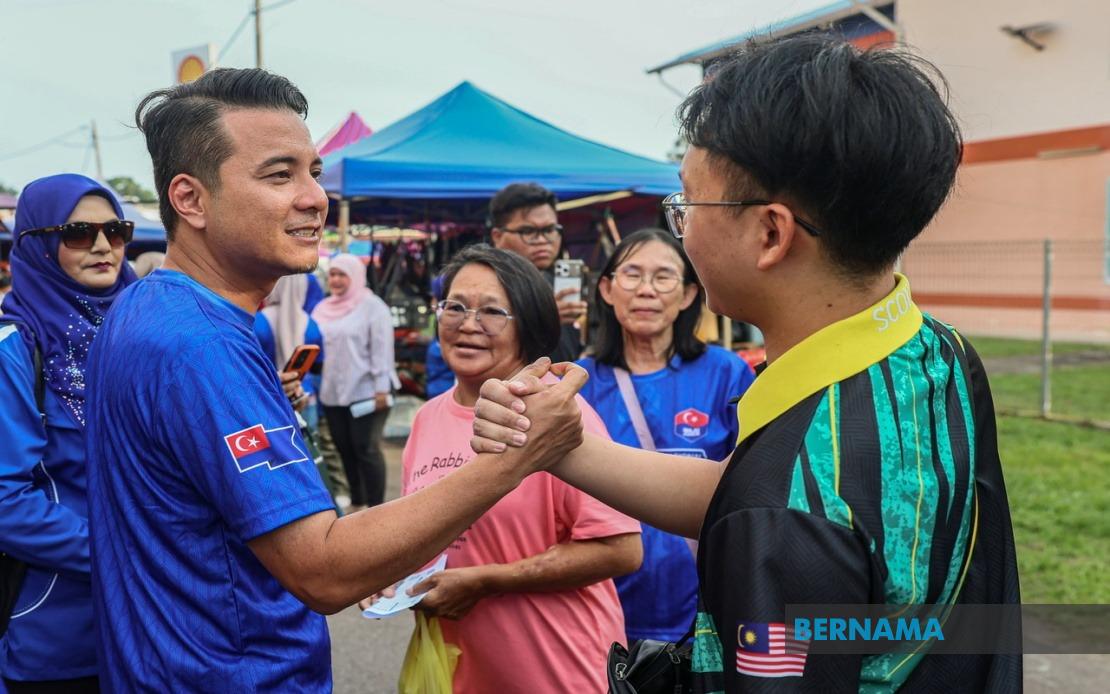
Barisan Nasional candidate Syed Hussien Syed Abdullah is staking his campaign for the Mahkota state constituency on an innovative approach that seeks to bridge the perennial divide between urban opportunity and rural lifestyle. His vision centres on enabling Kluang residents to access premium-paying employment in Johor's bustling industrial and commercial zones while preserving the affordability and community values that define rural living. This "Work in the City, Live in the Countryside" framework represents an attempt to address a longstanding challenge in Malaysian politics: retaining young talent in less-industrialised areas while providing them with career prospects that justify staying connected to their hometowns.
The cornerstone of Syed Hussien's proposal relies heavily on improving transportation infrastructure, particularly the Electric Train Service (ETS), which would enable seamless daily commuting between Kluang and major employment centres. For residents of a constituency long overshadowed by more developed urban areas, this connectivity argument carries considerable weight. Enhanced public transport networks effectively compress geographical distance and reduce the time cost of commuting, potentially making the economic calculus far more attractive for young professionals who might otherwise relocate permanently to cities like Johor Bahru or Kuala Lumpur. The implicit promise is that residents need no longer make the binary choice between career advancement and maintaining roots in their community.
This initiative aligns strategically with the broader Johor Economic Transformation Plan (JETP) announced by Menteri Besar Datuk Onn Hafiz Ghazi, which aims to distribute growth across all ten districts in the state rather than concentrating prosperity in traditional urban centres. For a constituency like Mahkota, the JETP represents a genuine opportunity to tap into planned industrial and commercial development without the massive infrastructure spending that local authorities alone could rarely afford. By anchoring his campaign messaging to this state-level initiative, Syed Hussien positions himself as a conduit for Mahkota residents to benefit from higher-level economic planning and investment.
On the campaign trail, Syed Hussien has been pursuing a methodical grassroots strategy rather than relying on last-minute intensive canvassing. According to his account, the BN machinery has already blanketed over half of Mahkota's component areas, with plans to complete outreach across remaining localities within four to five days of his interview with Bernama. This sustained engagement reflects a broader shift in Malaysian political campaigning towards year-round constituency work backed by both digital and face-to-face contact. The emphasis on consistency over seasonal intensity suggests an attempt to build deeper voter relationships than episodic election-time activism typically allows.
Syed Hussien's fluency in Mandarin Chinese has become a notable element of his electoral positioning, particularly in a state with a significant Chinese population. However, he has been careful to frame language proficiency as merely instrumental—a tool for communication that matters far less than genuine sincerity, mutual respect, and equitable treatment of all communities. This calibrated messaging appears designed to signal inclusivity without allowing his language skills to overshadow substantive policy discussion or create the perception that he is pandering to any single demographic.
The battle for young voters has emerged as a critical battleground in Mahkota, and Syed Hussien believes this demographic could prove decisive. Rather than chasing youth support through populist promises of immediate benefit, he is advocating for what he terms political maturity—encouraging young voters to understand that their electoral choices carry genuine civic responsibility. This messaging strategy reflects a calculated judgment that young Malaysians, particularly those with tertiary education, may be fatigued by unrealistic campaign pledges that fail to materialise after election day. By positioning BN as the party offering realistic development and responsible governance rather than empty commitments, Syed Hussien is attempting to frame his candidacy as more credible than alternatives that might prioritise short-term electoral appeal over long-term delivery.
The three-cornered contest in Mahkota involves significant competition. Pakatan Harapan has fielded Dr Ahmad Zuhan Md Zain, while Bersama candidate Abd Hamid Ali completes the field. This multi-candidate scenario creates complex vote-splitting dynamics that will largely determine the outcome. Syed Hussien's ability to consolidate the BN base while capturing swing voters and first-time voters will prove crucial to victory, particularly given that political alignments have become increasingly volatile across Malaysian constituencies.
Electorally, the Mahkota seat has shown notable recent volatility. In 2022, BN-UMNO's Datuk Sharifah Azizah Syed Zain won with a majority of 5,166 votes, a relatively modest margin that indicated competitive conditions. However, in the 2024 state by-election held earlier this year, Syed Hussien himself achieved a commanding majority of 20,648 votes—a fourfold increase that signals either substantial demographic shifts, improved BN consolidation, or reduced opposition momentum. If that by-election victory proves durable, Syed Hussien would be positioned as a strong favourite for the general state election scheduled for July 11.
The broader Johor state election context involves 172 candidates competing for 56 state seats across the state's ten districts. This relatively large candidate field suggests competitive contests across much of the state, with few seats likely to be determined by acclamation. Early voting commenced on July 7, with main polling day set for July 11, giving candidates limited remaining campaign time to shift voter sentiment or consolidate support. For Syed Hussien, the transition from by-election to general state election carries both opportunity and risk; strong by-election performance can create momentum but also raises voter expectations for continued performance and delivery.
The economic vision Syed Hussien is articulating—linking employment opportunity with rural sustainability—speaks to genuine anxieties facing constituencies across Malaysia's less-developed regions. Young people increasingly feel pulled toward cities by economic necessity, yet retain emotional and social attachments to hometowns. If infrastructure improvements and targeted industrial development can genuinely reduce the friction of commuting while creating local job opportunities, the Mahkota model could offer insights applicable to constituencies throughout Southeast Asia facing similar demographic and economic pressures. The success or failure of this approach during the 2024 election campaign may therefore influence how political candidates throughout the region address the fraught relationship between rural retention and urban opportunity.

