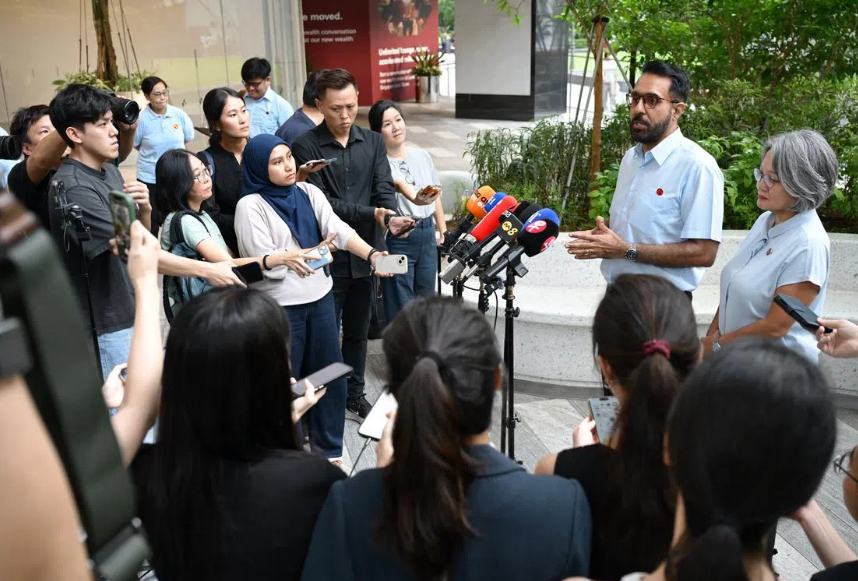
When Pritam Singh walked out of an extended leadership confrontation on June 28, his composed demeanour and confident media engagement signalled that the Workers Party had firmly resolved its internal crisis. The opposition party's secretary-general had just survived both a no-confidence motion and a competitive party election, emerging with the backing of 82 of 106 cadre members—a supermajority that definitively ended months of uncertainty about his future. His relaxed demeanour at the subsequent media engagement suggested a leadership vindicated by its own membership, yet the full implications of Sunday's vote extend well beyond party headquarters into the broader landscape of Singapore's political contestation.
The challenge Singh faced was unprecedented in his seven years leading the Workers Party. Unlike his previous electoral contests where he had run unopposed, this time a faction of dissatisfied cadres had triggered a special conference explicitly to hold him accountable for his conviction on charges of lying to Parliament. The origins of this crisis traced back to the 2021 Raeesah Khan scandal, where the former Sengkang GRC Member of Parliament had fabricated a narrative about police mistreatment during a parliamentary statement. When Khan later recanted, investigations by Parliament's Committee of Privileges determined that Singh had played a role in allowing her falsehood to persist uncorrected. This finding led to formal charges, a guilty verdict in the lower courts, and ultimately a High Court confirmation of his conviction in December 2025.
What sets this moment apart from typical intra-party disputes is the severity of the charge—lying to Parliament strikes at the heart of legislative accountability and undermines the credibility any opposition politician requires to challenge government authority. The parliamentary response was correspondingly unforgiving. After Singh's conviction, the House of Representatives passed a motion deeming him unsuitable to continue as Leader of the Opposition, a position he had held. Prime Minister Lawrence Wong subsequently removed him from this formal role, a public rebuke that might have triggered resignation or withdrawal from leadership among politicians in other democracies. Instead, the Workers Party's senior cadre rallied, refusing to nominate a replacement despite the opportunity to do so, and the party's disciplinary process concluded with merely a formal letter of reprimand—a sanction widely characterized as insufficient to the gravity of the transgression.
Sunday's cadre voting represented the crucial moment where party membership could have altered this trajectory. Those who initiated the no-confidence procedure had evidently hoped the special conference would transform into a genuine inquisition, creating pressure for Singh's removal. Their strategy included lobbying for alternative leadership candidates, efforts that continued intensively until the week before the meetings. Yet the anticipated rebellion never materialised. While Singh faced questioning from fellow cadres, party sources indicate that several speakers also rose to defend him, fracturing what might have become a unified opposition front. More tellingly, no credible challenger emerged willing to stake a claim to the party leadership, suggesting either that Singh commands deeper loyalty than dissidents recognized, or that other senior figures deemed the political cost of opposing him too high.
The decisive nature of the vote—with Singh securing supermajority support and subsequently standing unopposed for the full secretary-general position—reflects the consolidation of party ranks that leadership prizes above all else. The endorsement of Low Thia Khiang, the party's venerable founder and architect of its modern institutional structure, carried particular symbolic weight. When the veteran politician publicly confirmed his continued support ahead of the meetings, he effectively signalled that the party's historical guardians backed Singh's continuation. Such unity matters acutely for opposition movements, which face asymmetrical scrutiny from media, security services, and an electorate that often views dissent with suspicion. Singapore's political history demonstrates repeatedly that opposition parties rent by factionalism tend toward irrelevance, their energies consumed by internal struggle rather than parliamentary effectiveness.
Yet this very consolidation raises uncomfortable questions about whether political survival has genuinely superseded principles. Singh's response when directly confronted about serving as a convicted liar was deflection rather than substantive engagement—he referred questioners to his website and restated his unchanged parliamentary position without addressing the underlying credibility deficit. This evasion suggests the party collectively recognises the vulnerability of its position on this issue but has calculated that closing ranks and moving forward represents the optimal strategy. For party chair Sylvia Lim, a 23-year veteran of that position, the focus now shifts toward leadership renewal, a euphemistic acknowledgement that the current generation's time at the helm approaches its natural conclusion.
The Workers Party's leadership will argue, with some justification, that the broader electorate has already rendered its own verdict. The May 2025 general election, held after Singh's lower court conviction but before his High Court appeal, saw the opposition party not merely consolidate its existing Sengkang GRC constituency but expand into previously uncaptured territory by winning two Non-Constituency MP seats. This outcome could be interpreted as public acquittal of sorts—voters aware of Singh's conviction nonetheless chose to strengthen the Workers Party's parliamentary presence. For the party's supporters, Singh's legal troubles become filtered through political rather than ethical lenses; the question becomes whether his transgression reflected venality or a justifiable instinct to shield a junior colleague from institutional brutality.
However, translating cadre support and electoral resilience into genuine expansion of the party's political base requires navigating the critical middle ground. Singapore's pragmatic electorate—particularly those professional and business voters who neither reflexively support the People's Action Party nor identify with traditional leftist opposition—requires reassurance about competence and judgment. A party led by someone recently convicted of parliamentary dishonesty carries an image problem that electoral victories alone cannot fully resolve. These swing voters remain unconvinced that opposition is necessary for effective governance but might be persuaded if the Workers Party could demonstrate moral seriousness and unflinching honesty about the failings of its leadership.
The question of institutional credibility becomes particularly acute given Singapore's political culture, where the government enjoys significant structural advantages and opposition relies disproportionately on moral authority. Unlike systems where opposition parties rotate into power regularly, creating natural mechanisms for renewal and accountability, Singapore's PAP dominance means the Workers Party operates in perpetual opposition without the moderating pressure of governing responsibility. Under such circumstances, internal discipline and ethical standards become even more important—they constitute the primary mechanism through which an opposition party signals that it deserves public trust. When a party leadership survives challenge largely through closed-ranks solidarity rather than genuine reconciliation or reform, it risks confirming suspicions among moderate voters that even opposition politics in Singapore operates through factional loyalty rather than principle.
The Workers Party's path forward requires threading an exceptionally fine needle. It must maintain the internal cohesion that Singh's victory demonstrates while simultaneously addressing the credibility questions that his conviction raised. Party leaders must articulate a vision of governance and opposition that resonates beyond their existing constituencies, particularly among the educated middle class whose votes determine electoral margins in close contests. The leadership renewal that Lim flagged suggests some recognition of this challenge, yet implementation remains uncertain. Until the party demonstrates tangible steps toward genuine institutional reform and fresh faces in senior positions, suspicions will persist that Sunday's vote represented defensive closure rather than principled endorsement.
Ultimately, the Workers Party's fate hinges not on whether it maintains internal unity—that appears assured—but whether it can convince growing numbers of Singaporeans that recovering from institutional crisis requires more than cadre loyalty. The party has survived its most significant internal challenge since Singh assumed leadership, and it has done so decisively. Yet survival and growth operate on different scales. For the opposition to consolidate and expand its role in Singapore's political future, it must demonstrate that it learns from institutional failures rather than merely containing them. The test ahead is not parliamentary or intra-party; it is whether the Workers Party can regain the moral authority necessary to appeal convincingly to middle ground voters who seek political alternatives but demand they come with uncompromised integrity.

