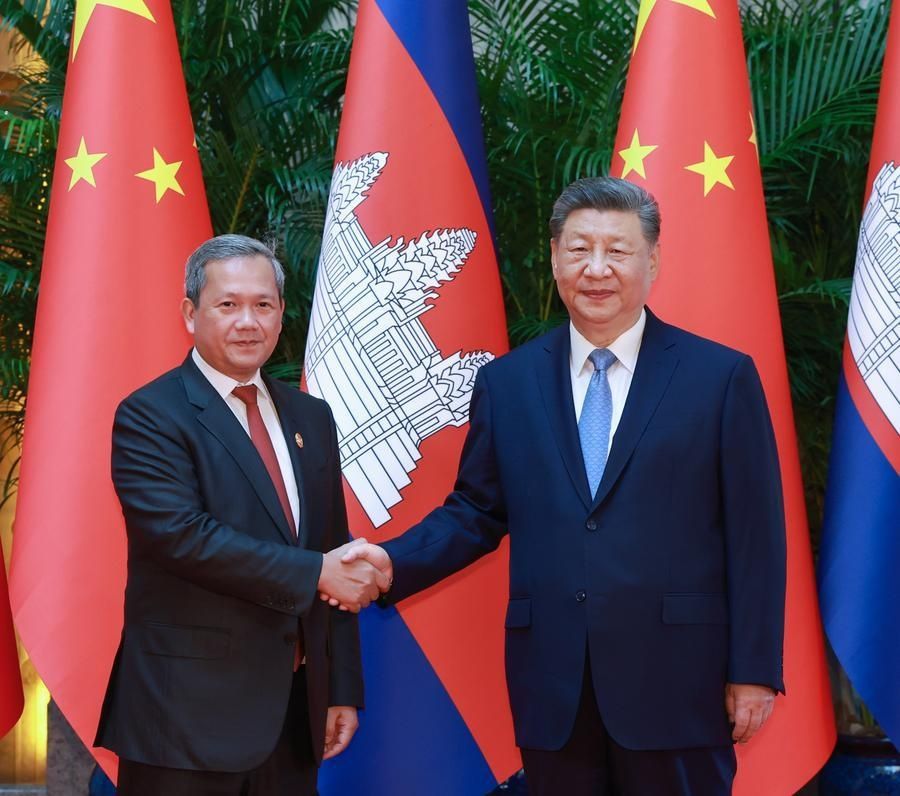
Chinese President Xi Jinping met with Cambodian Prime Minister Hun Manet in Shanghai on Friday, July 17, to reaffirm the enduring partnership between Beijing and Phnom Penh. The meeting, held during Hun Manet's attendance at the 2026 World Artificial Intelligence Conference and High-Level Meeting on Global AI Governance, underscored the two countries' commitment to elevating their relationship beyond traditional frameworks. Xi characterised the friendship between the nations as "ironclad," invoking the legacy of previous generations of leaders while positioning the partnership for contemporary challenges and opportunities in the region.
The discussion centred on enriching the "Diamond Hexagon" cooperation framework, a strategic initiative designed to deepen engagement across multiple sectors. Rather than limiting collaboration to conventional areas, the two leaders identified specific development corridors requiring acceleration and modernisation. The Industrial Development Corridor and the Fish and Rice Corridor emerged as priority zones where joint investment and infrastructure development could generate tangible economic benefits for both nations and create employment opportunities across Cambodia and southern China.
Beyond physical infrastructure, Xi and Hun Manet identified technology and digital innovation as critical pillars for future growth. They agreed to upgrade traditional sectors such as electricity generation and agricultural production with contemporary methods while simultaneously fostering emerging industries, particularly artificial intelligence and the digital economy. This dual approach reflects broader regional trends as Southeast Asian economies increasingly seek to balance resource-intensive traditional sectors with high-value technology services. For Malaysian observers, this development signals intensifying competition for regional tech leadership and investment, as Cambodia positions itself as a potential hub for AI development in mainland Southeast Asia.
The security dimension of the relationship received considerable emphasis during their discussion. Xi pressed both nations to coordinate efforts against cross-border criminal networks involved in counterfeiting, smuggling, online gambling operations, and telecommunications fraud. These crimes represent growing challenges across Southeast Asia, with criminal syndicates increasingly operating across jurisdictional boundaries. Cambodia's cooperation with Chinese law enforcement on telecom fraud particularly resonates in Malaysia, where telecommunications scams originating from bases in Southeast Asia have become a persistent problem affecting citizens and financial systems throughout the region.
The meeting also addressed the contentious Cambodia-Thailand border situation, an issue with broader implications for Southeast Asian stability. Xi articulated China's position supporting dialogue and peaceful resolution through negotiation, while emphasising Beijing's willingness to facilitate discussions between Phnom Penh and Bangkok. This mediation stance reflects China's increasing role as a regional power broker, particularly in disputes involving its neighbours and partners. Hun Manet's explicit endorsement of dialogue-based approaches suggests both nations view escalation as counterproductive, though underlying tensions regarding demarcation and resource access remain unresolved.
Hun Manet's response to Xi's overtures revealed Cambodia's strategic calculations in maintaining its alignment with Beijing. The Cambodian Prime Minister explicitly acknowledged the consistency of his nation's foreign policy orientation, stating that regardless of shifts in the international situation, Cambodia's commitment to close cooperation with China remains unwavering. This formulation carries particular significance given regional geopolitical shifts, including US strategic competition with China and competing infrastructure initiatives across Southeast Asia. Hun Manet's affirmation of the one-China policy and commitment to deepening political mutual trust suggests Cambodia views its relationship with Beijing as foundational to its national interests and economic development strategy.
The emphasis on expanding bilateral trade during the meeting reflects the substantial economic interdependencies between the two countries. China remains Cambodia's largest trading partner and primary source of foreign direct investment, funding major infrastructure projects including roads, ports, and hydroelectric facilities. Hun Manet's commitment to advancing cooperation on major infrastructure and key projects signals continued reliance on Chinese capital and expertise for Cambodia's development agenda. This dependency structure, while economically beneficial to Cambodia in the short term, also raises questions about long-term debt sustainability and Cambodia's ability to pursue independent policy directions if tensions arise with Beijing.
The selection of Shanghai as the venue for this high-level meeting, particularly during an artificial intelligence conference, demonstrated deliberate symbolism. By hosting Hun Manet during a global technology summit, Xi positioned Cambodia within China's technological advancement narrative and signalled shared commitment to the digital economy. This framing offers Cambodia association with cutting-edge development while reinforcing its integration into Chinese-led regional initiatives. For Malaysia and other Southeast Asian nations pursuing their own technology strategies, this dynamic illustrates how diplomatic meetings increasingly serve as platforms for promoting technological cooperation and attracting investment in emerging sectors.
The "Diamond Hexagon" framework and the paired development corridors represent institutionalised mechanisms for deepening bilateral engagement beyond annual diplomatic visits. These structures provide continuity and operational frameworks for implementing agreed initiatives, creating expectation of sustained momentum in cooperation. However, the success of such frameworks depends on consistent resource allocation, institutional capacity, and political will to overcome practical implementation challenges. Cambodia's track record implementing large Chinese-funded projects offers mixed results, suggesting that framework expansion alone requires complementary efforts to strengthen governance and project management capabilities.
For Malaysia and the broader Southeast Asian region, the Xi-Hun Manet meeting illustrates how bilateral relationships are being reconfigured around emerging technologies and infrastructure development. The emphasis on artificial intelligence, digital economy cooperation, and technology-enabled governance reflects global trends but also reveals how individual nations are positioning themselves within China's expanding sphere of influence. Malaysia's own approach to technology cooperation and infrastructure development will increasingly be evaluated against initiatives pursued by Cambodia and other regional neighbours, potentially creating competitive dynamics for Chinese investment and technology partnerships.

