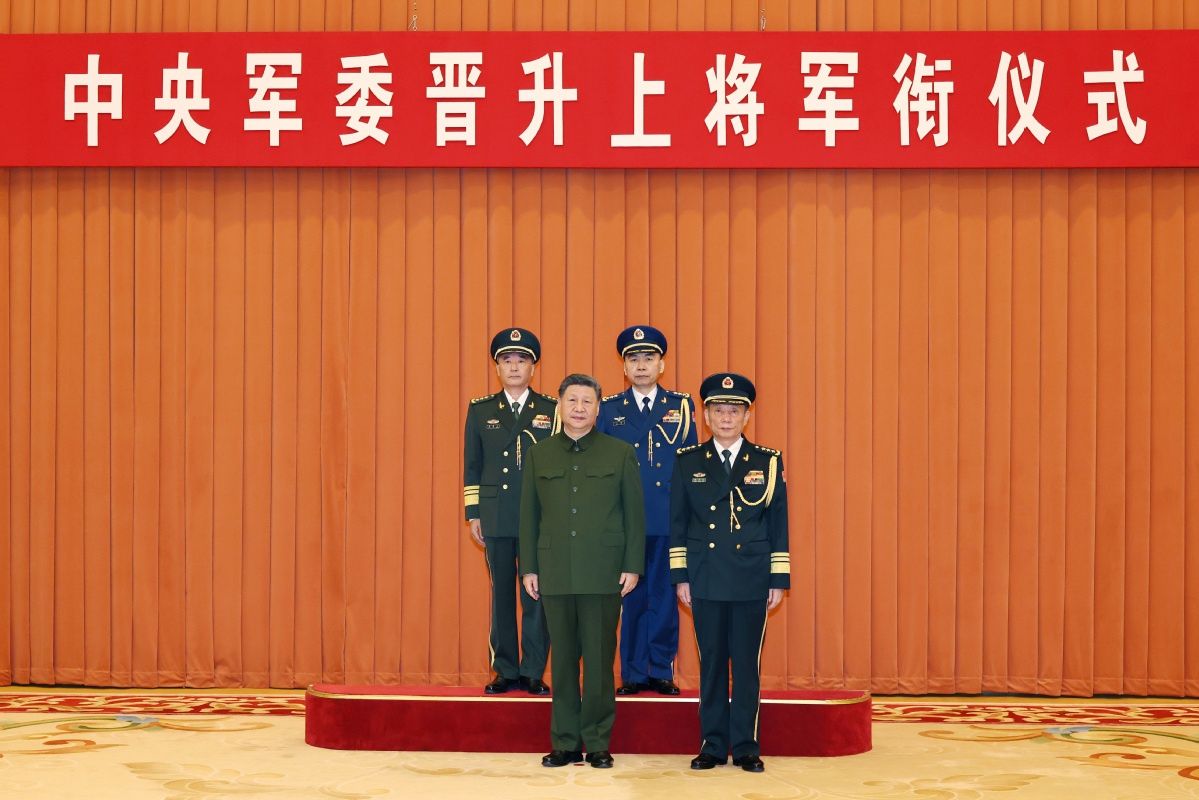
Chinese President Xi Jinping has accelerated his consolidation of military authority by appointing Zhang Shuguang as the new director of anti-corruption oversight within the armed forces, a move formally announced at a high-profile ceremony in Beijing on Friday, July 3. The appointment signals Xi's determination to maintain control over the People's Liberation Army at a moment when dozens of senior figures have faced investigation, removal, or demotion as part of what observers describe as China's largest military restructuring in fifty years. Zhang Shuguang now heads the discipline inspection commission under the Central Military Commission, the apex body overseeing all armed forces, and has been elevated to the rank of general, the highest active-service rank available to military officers.
The leadership changes extend beyond anti-corruption functions. Wang Gang has assumed command of the People's Liberation Army Air Force, replacing Chang Dingqiu, whose next posting remains undisclosed. Wang's promotion to general status reflects the scale of the generational transition underway. Meanwhile, Zhang Shengmin, the previous military anti-graft chief, has been reassigned to serve as vice chairman of the Central Military Commission itself. For Malaysian observers, the significance lies in understanding how military governance at China's highest levels directly influences the country's strategic posture in the region and its bilateral relationships with neighbouring states.
The purge that prompted these appointments began in mid-2023, mere months after Xi secured an unprecedented third term as General Secretary of the Communist Party, breaking the two-term convention observed by his predecessors. This timing is critical: the consolidation appears designed to ensure absolute loyalty within military ranks before any potential challenge to his authority could materialise. The campaign has been breathtaking in scope, removing two vice chairmen of the Central Military Commission—posts that traditionally represent career pinnacles for senior officers—along with three additional commission members. A former defence minister and at least a dozen commanding generals overseeing major military regions and operational commands have also been swept from their positions or face ongoing investigation.
Particular attention has focused on the investigation into Zhang Youxia, once regarded as one of Xi's most trusted generals and a key ally in earlier purges. Zhang's downfall earlier this year stunned military watchers because it demonstrated that proximity to Xi himself offers no guarantee of protection once allegiance is questioned. This development underscores a critical pattern: Xi's anti-corruption campaign, while nominally about rooting out graft and misconduct, functions simultaneously as a mechanism for eliminating rivals, consolidating factional advantage, and ensuring personal loyalty throughout the command structure. The inclusion of someone as senior as Zhang Youxia suggests the purge reaches into the innermost circles of military decision-making.
The apparatus through which this purge operates deserves scrutiny. By placing Zhang Shuguang at the helm of military discipline inspection, Xi ensures that future investigations and removals will be conducted by a figure of unquestionable loyalty. The discipline inspection commission wields extraordinary power—it investigates, recommends removal, and shapes narratives around misconduct. Control of this body is tantamount to control over which officers rise and which fall, making the appointment far more than a routine administrative shuffle. The succession of anti-corruption officials itself becomes a signal of institutional priorities and factional alignments within the military hierarchy.
For Southeast Asian governments, including Malaysia, these internal Chinese military developments carry substantial implications. A military purge of this magnitude creates uncertainty about decision-making processes, response capabilities during crises, and the relative influence of hardline versus moderate factions on questions of regional security. The removal and investigation of senior officers who may have advocated restraint in maritime disputes, for example, could shift the balance toward more assertive approaches in contested waters. Malaysia, as a claimant state in the South China Sea and a nation with significant economic interests in regional stability, cannot ignore signals about the composition and orientation of China's military leadership.
The broader context of these personnel changes reflects Xi's doctrine of centralised military control and modernisation. Since assuming power, Xi has initiated multiple rounds of military reform aimed at streamlining command structures, improving technological capabilities, and—importantly—ensuring that no regional commander or service branch chief accumulates enough independent power to challenge central authority. The anti-corruption campaign, whether addressing real misconduct or not, serves this centralisation agenda perfectly. By framing removals as responses to graft rather than political purges, the party maintains a veneer of institutional legitimacy while fundamentally reshaping power distribution.
The most recent development, last week's removal of six military lawmakers from the national parliament, illustrates how the purge extends beyond the defence establishment into civilian representative institutions. Military officers holding seats in the National People's Congress serve a symbolic and practical function, representing armed forces interests in legislation. The stripping of these seats from six individuals suggests they were either implicated in the corruption investigations or deemed unreliable by the new leadership configuration. This move further tilts the balance toward factions aligned with Xi's vision for military governance.
As these changes unfold, regional watchers should consider how military restructuring influences crisis management and escalation dynamics. Officers newly elevated through Xi's patronage networks may face pressure to demonstrate loyalty through assertiveness on issues like territorial disputes, military exercises, or confrontations with rival powers. Conversely, the removal of experienced commanders who understand the costs of miscalculation could shift institutional memory and decision-making calculus. For Malaysia and other ASEAN nations, the composition of China's military leadership directly affects the likelihood of restraint or escalation in any future regional incident.

