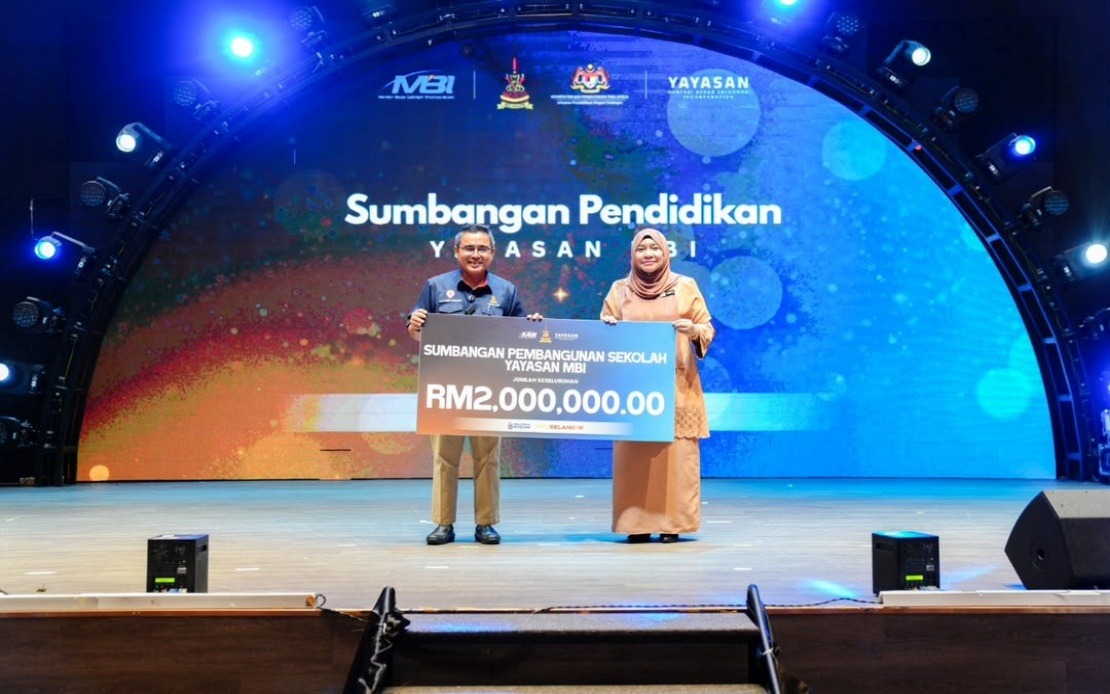
Yayasan Menteri Besar Selangor (Incorporated) has committed RM2 million through its School Development Contribution programme, marking a significant investment in strengthening the state's education sector. The disbursement, announced at the Yayasan MBI Education Aspiration 2026 event, seeks to enhance learning facilities and school infrastructure while creating improved working and learning environments for both teachers and students across Selangor.
Ahmad Azri Zainal Nor, head of Yayasan MBI, characterised education as a fundamental strategic priority for the foundation, with approximately two-thirds of its operational focus dedicated to this sector. This weighting reflects a deliberate institutional choice to position educational advancement as central to the organisation's mission and long-term vision for Selangor's development.
The foundation approaches its educational investment beyond conventional charitable framing, instead viewing it as a calculated long-term investment in human capital development. This perspective aligns Yayasan MBI's work with broader economic development logic: by strengthening the quality of educational infrastructure and support systems today, the foundation seeks to build a more capable workforce and competitive economy for Selangor in future decades.
Yayasan MBI's educational strategy extends across multiple interconnected programmes designed to reach different stakeholder groups within the school ecosystem. The Back to School Tour Programme targets students during key academic transitions, while the Selangor People's Tuition Programme provides free academic support to learners who might otherwise lack access to additional learning resources. The Didik Kasih Programme and collaborative work with Parent-Teacher Associations create additional layers of institutional support.
These initiatives collectively demonstrate a recognition that improving educational outcomes requires interventions operating at multiple levels simultaneously. Rather than attempting a single comprehensive solution, Yayasan MBI's approach acknowledges that students need academic support, teachers require adequate facilities and recognition, schools require infrastructure investment, and parent communities benefit from structured engagement opportunities. This multi-stakeholder approach reflects international best practice in education development.
The foundation's decision to strengthen collaboration with the Selangor State Education Department represents a crucial institutional linkage. By aligning Yayasan MBI's resource allocation with JPNS's assessment of priority needs, the foundation increases the likelihood that its investments directly address the most pressing gaps rather than duplicating existing provision or pursuing initiatives disconnected from classroom realities.
For Malaysian readers, Yayasan MBI's approach offers a model of how state-level institutions can leverage philanthropic and dedicated funding streams to supplement government education budgets. At a time when many Malaysian states and federal territories face resource constraints, the foundation's strategy of targeted infrastructure investment, teacher support, and student assistance programmes demonstrates one pathway for addressing educational access and quality challenges.
The emphasis on strategic partnerships and stakeholder engagement also reflects evolving thinking about education governance in Malaysia. Rather than viewing schools as isolated institutions, Yayasan MBI's collaborative framework recognises schools as embedded within broader community networks, where PTAs, local business groups, and government agencies each contribute to educational quality. This ecosystem perspective may gain increasing relevance as Malaysian education authorities seek to improve outcomes beyond what government funding alone can achieve.
From a regional perspective, Selangor's experience provides a reference point for other Malaysian states considering how to deploy foundation resources or state-controlled funding for education. The emphasis on free tutoring programmes, infrastructure support, and teacher recognition addresses universal challenges facing Southeast Asian education systems, where quality disparities between well-resourced urban schools and under-resourced rural institutions remain significant.
The RM2 million allocation, while substantial, also illustrates the scale of investment required to meaningfully improve educational outcomes across an entire state. Selangor's student population spans hundreds of schools, suggesting that the foundation's contribution functions best as catalytic funding that leverages additional government resources, private sector contributions, and international development assistance rather than as a complete solution to infrastructure or quality gaps.
Yayasan MBI's long-term commitment through the Education Aspiration 2026 initiative indicates planning that extends beyond immediate budget cycles. This temporal horizon permits evaluation of programme effectiveness, adjustment of strategies based on learner outcomes, and sustained relationship-building with schools and communities. For Malaysian policymakers, this forward-looking approach contrasts with funding models that operate on annual allocations without explicit long-term strategic frameworks.
The foundation's work ultimately reflects a conviction that Selangor's future competitive position depends significantly on its education quality. By treating school infrastructure improvement, teacher support, and student assistance as interconnected components of a single strategic objective, Yayasan MBI positions education investment as inseparable from broader state development ambitions.

