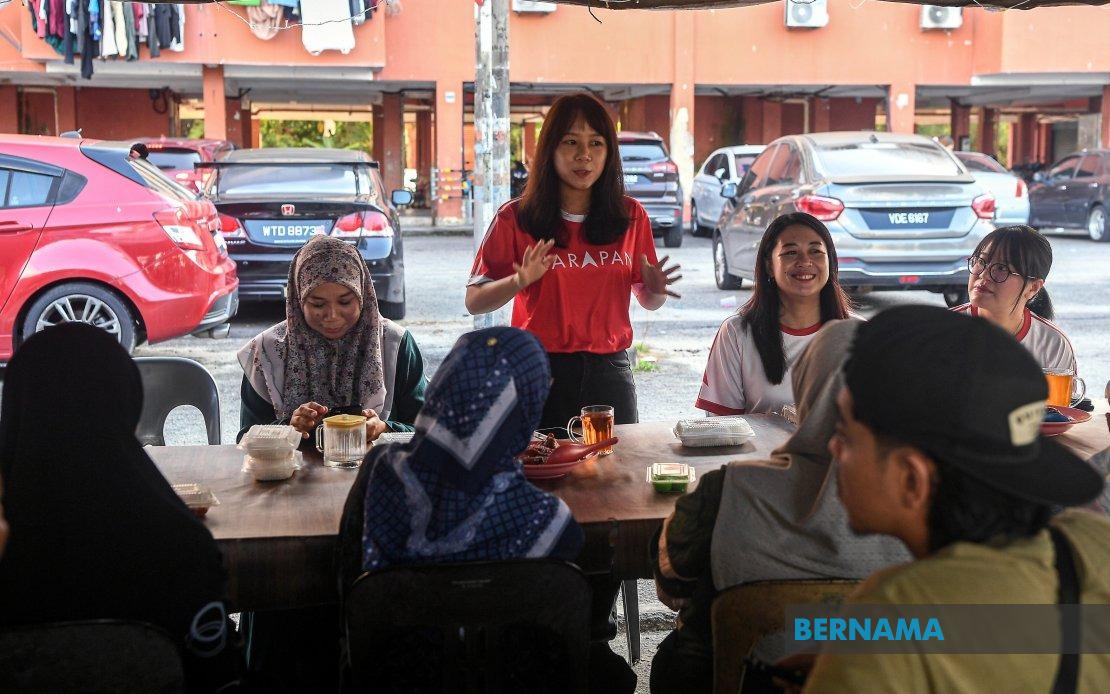
The Johor Jaya state constituency contest encapsulates a broader tension within Malaysian politics between generational renewal and established ground presence. Pakatan Harapan candidate Lee Wern Yiing, at 30 years old, represents the cohort of younger professionals who have deliberately chosen political engagement over overseas career advancement. Her trajectory reflects a specific moment in Malaysia's recent history—the decision to return from Singapore in 2018, when the reform agenda under the Eighth Malaysia Plan seemed to promise substantive systemic change. That optimism has since faced multiple tests, yet her candidacy embodies the persistence of that reform impulse within the coalition.
Lee's entry into electoral politics followed her stint as special officer to former Johor Jaya assemblyman Liow Cai Tung, a conventional pathway that nonetheless distinguishes her from candidates with purely administrative backgrounds. As Johor DAP Socialist Youth chief, she positions herself at the intersection of party machinery and grassroots mobilization, addressing what she perceives as a critical misconception about young voters. Rather than accepting the narrative that youth disengage from politics, Lee contends that this demographic conducts its own informed assessment and responds to substantive policy communication. This framing rejects both the paternalism of older political figures and the dismissiveness of those who view youth as apathetic.
Her campaign strategy reflects this analysis. By combining digital outreach through social media platforms with traditional community initiatives such as the Johor Jaya Run, Lee attempts to bridge the divide between online activism and ground mobilization. Her policy focus—job creation, housing accessibility, and cost-of-living relief—addresses the material conditions that shape young voters' political calculations. These concerns are not abstract in the Malaysian context. Johor, as a state adjacent to Singapore, experiences particular pressure as a destination for talent migration, with young professionals regularly choosing proximity to Singapore's financial ecosystem over opportunities within Johor itself.
Lee's vision for the Johor-Singapore Special Economic Zone (JS-SEZ) represents an attempt to reframe regional integration not as a threat to local employment but as a catalyst for economic density. The zone, a strategic partnership infrastructure project, remains incompletely realized in terms of its employment potential. Lee's argument that fuller utilization of the JS-SEZ could create a retention mechanism for young talent addresses a genuine demographic challenge facing Johor's interior constituencies. Her framing of Johor Jaya as a place where young professionals might choose to remain with their families, rather than seeking permanent relocation to Singapore, articulates an implicit critique of economic geography—the notion that regional opportunities must compete actively with external alternatives.
The Barisan Nasional candidate, Chan San San, offers a contrasting foundation rooted in longevity and demonstrated institutional commitment. Her background as an "anak Plentong"—a native of the Plentong area—provides inherited legitimacy in a constituency where family networks and long-term community presence carry significant electoral weight. More than a decade of community assistance work, formalized through positions as a Johor Bahru City Council member, Johor MCA deputy secretary, and volunteer with the MCA Crisis Relief Squad, constructs a narrative of progressive institutional integration.
Chan's positioning eschews abstract policy frameworks in favor of what she terms the reality of community problems. Her statement that people's difficulties are substantive concerns rather than statistical abstractions implicitly critiques the technocratic approach often associated with younger candidates. This represents not merely a rhetorical choice but a distinct epistemological stance—one that privileges accumulated experiential knowledge over analytical frameworks. For voters skeptical of generational change or concerned about institutional continuity, this emphasis on verified track record within established structures holds considerable appeal.
The four-point platform Chan articulates addresses both economic development and connectivity infrastructure. Her emphasis on Johor Jaya as a transportation hub connecting residents to the Rapid Transit System project reflects strategic thinking about the constituency's geographic potential within greater Johor Bahru. The RTS infrastructure, a significant Singapore-Johor integration project, creates economic corridors that candidates from both coalitions recognize. Chan's framing positions the constituency as a nodal point within this larger system rather than as a peripheral area requiring rescue from development. Her traffic congestion focus addresses a daily quality-of-life concern that affects voters across income and demographic categories.
The four-cornered contest itself reflects Johor's evolving political landscape. Beyond Lee and Chan, Lau Yi Leong from Parti Bersama Malaysia and Independent candidate Lim Hun Peaw compete for votes. Parti Bersama Malaysia, a newer political entity in the Malaysian coalition spectrum, represents the fractalization of opposition politics following the 2022 elections. Its presence in this race signals that traditional PH-BN bipolarization no longer fully captures electoral competition in the state. The independent candidacy further indicates that some voters and candidates view non-partisan credentials as marketable, particularly in constituencies where swing voters hold decisive influence.
The broader context of the 16th Johor state election involves 172 candidates contesting 56 seats, a ratio reflecting the intensity of electoral competition. Johor's significance within Malaysian politics cannot be overstated—the state represents a critical demographic and economic zone where results influence federal-level political positioning. Polling scheduled for July 11, with early voting on July 7, occurs within a period of continued institutional and political uncertainty at the national level. Johor voters' choices will provide indicators of whether reform-oriented politics maintains momentum, whether traditional BN support demonstrates resilience in state-level contests, and whether newer political movements gain meaningful traction.
For Johor Jaya specifically, the outcome will determine which political vision—regeneration through youth mobilization or consolidation through institutional depth—prevails in a constituency that bridges urban development zones and established residential areas. The candidates' distinct approaches to the JS-SEZ, infrastructure connectivity, and economic opportunity reveal competing assumptions about development pathways. Lee's emphasis on attracting return migration and job creation targets the outflow of human capital that characterizes Johor's relationship with Singapore. Chan's infrastructure and connectivity focus addresses the physical and institutional foundations necessary for any development strategy to succeed.
The election results will illuminate not merely which candidate wins the seat but which approach to constituency development and voter mobilization proves decisive in contemporary Malaysian electoral competition. The Johor Jaya contest, in its microcosm, captures tensions about generational political change, the relationship between established institutions and reform movements, and how constituencies navigate integration into larger economic systems while maintaining local identity and opportunity. These questions extend well beyond a single state seat, shaping the trajectory of Malaysian politics through the remainder of the decade.

