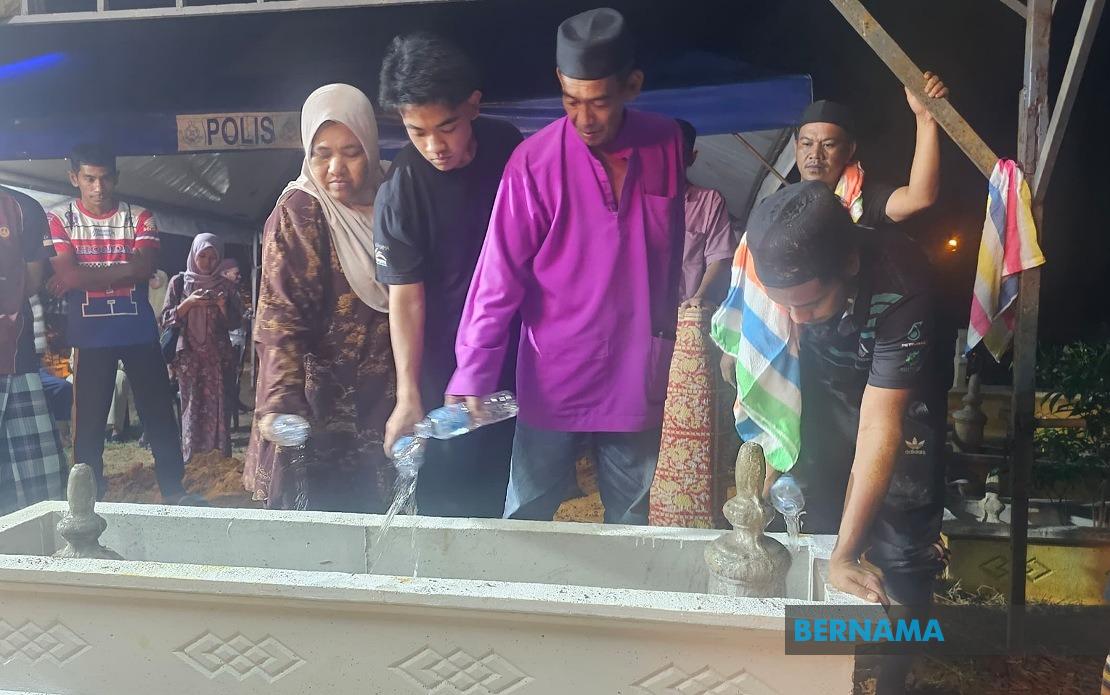
Constable Muhammad Raimi Ismarubee, a 24-year-old police officer who died in an electric shock incident in Beaufort, Sabah, was laid to rest at Felda Kerteh 2 Muslim Cemetery in Dungun, Terengganu in the early hours of Thursday. The young constable's body arrived at his family home in the settlement at 11.40 pm on Wednesday evening, where relatives and friends gathered for final prayers and funeral rites before he was committed to the ground shortly after 1.15 am.
The tragedy that claimed Muhammad Raimi's life occurred at 5.50 pm the previous day on Jalan Weston in Kampung Weston, Beaufort. The incident proved devastating not only for his family but for the entire police force in the district, as three officers were electrocuted simultaneously in circumstances that are still being investigated. Muhammad Raimi was among three personnel from Weston Police Station who suffered fatal electric shocks, alongside Corporal Chiu Teck Siong, 40, and Corporal Mohamad Nur Hafiz Ibrahim, 29.
The repatriation process underscored the respect accorded to fallen officers in Malaysia's law enforcement hierarchy. Muhammad Raimi's remains were transported by Royal Malaysian Air Force aircraft from Kota Kinabalu International Airport in Sabah to Kuantan Air Base in Pahang, a journey that reflected the solemnity with which the nation honours its police personnel who die in the line of duty. A hearse then conveyed him to his final resting place in the Felda Kerteh 2 settlement, where his community had awaited his homecoming.
The funeral ceremony attracted considerable attendance from the police fraternity and state officials, demonstrating the significance of the loss within law enforcement circles. Dungun District Police Chief Supt Nik Ab Halim Nik Mat attended alongside approximately 200 officers and police personnel who came to pay their respects. The funeral prayers were conducted by Datuk Satiful Bahari Mamat, chairman of Terengganu State Education, Higher Education, Science, Technology and Human Development Committee, lending official recognition to the occasion.
Muhammad Raimi had only recently begun his police career, having joined Weston Police Station in September 2024 less than a year before his death. As the second of three children in his family and unmarried at the time of his death, he represented the young generation of officers entering Malaysia's police service. His abbreviated tenure highlights the unpredictable dangers that members of the police force may encounter, sometimes within their first months of active duty.
The incident in Kampung Weston raises critical questions about workplace safety protocols and electrical hazard management at police facilities and their surrounding areas. Three simultaneous fatalities from electric shock suggest a potentially catastrophic failure in safety measures or an unforeseen electrical emergency. The circumstances of how three trained officers came into contact with a lethal electrical source warrant thorough investigation to prevent similar tragedies.
For Malaysian readers and Southeast Asian observers, this incident reflects broader concerns about occupational safety in the region's law enforcement agencies. Police officers across Malaysia, Indonesia, the Philippines, and Thailand regularly face workplace hazards that extend beyond conventional criminal threats. The deaths of Muhammad Raimi and his colleagues underscore the need for comprehensive safety audits and training programmes that address electrical and environmental hazards at police stations and patrol areas.
The tragedy also highlights the human cost of policing in Malaysia. Behind official statistics and duty rosters are young men and women like Muhammad Raimi who leave behind grieving families and communities. His death in his early twenties, just months into a promising career, resonates deeply with questions about how adequately the state prepares and protects its frontline personnel.
The response from police leadership and state government officials suggests that the incident will likely trigger reviews of safety procedures. The substantial turnout at Muhammad Raimi's funeral—200 officers plus officials—indicates that his death has galvanised attention within the police hierarchy to the conditions under which officers work. Whether this translates into concrete operational changes remains to be seen.
For the Dungun district and Felda Kerteh 2 community, the burial of this young constable represents not only the loss of a community member but also a reminder of the sacrifices made by those in uniform. Muhammad Raimi's family, consisting of his parents and siblings, must now navigate their grief knowing he died not in direct confrontation with criminals but through a preventable industrial hazard. The investigation into the exact cause and circumstances of the electric shock incident will be closely watched by police unions, safety advocates, and families of other officers throughout Malaysia.

