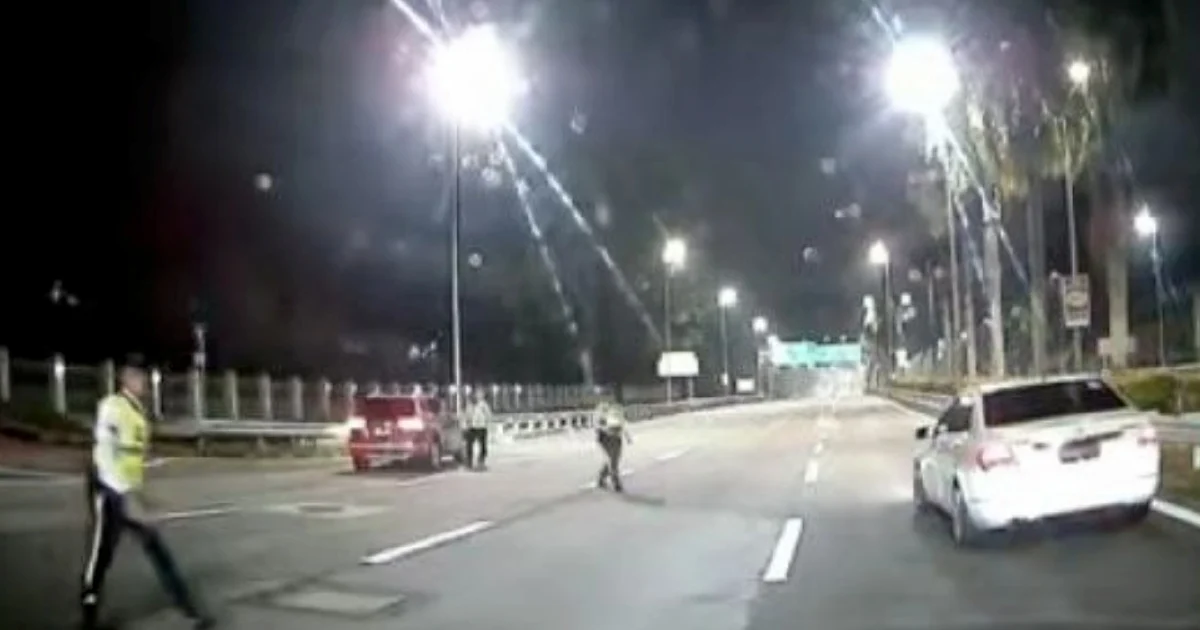
A 20-year-old motorist is now in police custody following an alarming incident involving his white Mercedes-Benz that crashed through an active roadblock on the Sprint Expressway near the National Institute of Public Administration (Intan) in Kuala Lumpur. The young driver proceeded to flee the scene at speed after the collision, triggering a response from law enforcement who were stationed at the checkpoint. The arrest comes days after video footage of the incident circulated widely on social media platforms, drawing widespread public attention to the dangerous manoeuvre and raising fresh concerns about road safety on the capital's expressway network.
The circumstances surrounding the crash reveal a troubling moment of either desperation or recklessness, depending on investigators' findings. The driver's decision to accelerate through the checkpoint rather than comply with standard protocol has prompted authorities to examine whether additional factors—such as mechanical failure, medical emergency, or deliberate evasion of law enforcement—may have contributed to the collision. This line of questioning is crucial for understanding whether the incident represents a criminal matter, a public safety lapse, or some combination of both.
Police roadblocks are regularly established along major expressways as part of routine traffic enforcement and security operations. The presence of officers at such checkpoints is intended to ensure compliance with road regulations, intercept vehicles involved in serious crimes, and maintain orderly traffic flow. However, the vulnerability of enforcement personnel standing at roadside positions during such operations has long been a concern for road safety advocates and law enforcement agencies alike. This incident underscores the potential dangers faced by officers manning these checkpoints when drivers fail to comply.
The Sprint Expressway, which connects central Kuala Lumpur with outlying areas, handles significant traffic volumes daily. The expressway's congested stretches create particular challenges for emergency response and enforcement operations. High-speed pursuits along such corridors pose risks not only to the fleeing driver and pursuing officers but also to innocent motorists sharing the road. The proliferation of vehicles, combined with the expressway's design and traffic patterns, means that any pursuit situation can rapidly escalate into a multi-vehicle incident with severe consequences.
The viral nature of the incident reflects the modern reality of road policing in Malaysia, where smartphone recordings and social media distribution can amplify public awareness of dangerous driving behaviour within hours. While such visibility can serve as a deterrent and strengthen public support for enforcement actions, it also creates immediate pressure on authorities to demonstrate visible progress in their investigations. The rapid circulation of footage may have influenced the speed with which authorities identified and detained the suspect.
Investigators will likely examine several dimensions of this case beyond the immediate collision. Forensic examination of the vehicle may reveal mechanical issues; interview protocols with the driver may uncover motivations; and reconstruction of the event will help establish the sequence and impact of the crash itself. The young age of the motorist also raises questions about experience levels and decision-making capacity that may factor into charging decisions and any subsequent court proceedings.
This incident arrives amid an ongoing national conversation about road discipline and traffic safety in Malaysia. Recent years have witnessed numerous high-profile cases of reckless driving, illegal racing, and dangerous vehicle modifications that have captured public attention and prompted calls for stricter enforcement. The case of this 20-year-old driver—if prosecuted vigorously—could become part of a broader narrative about accountability for dangerous behaviour on public roads, particularly among younger motorists.
The detention of the driver marks a significant step in the investigative process, but questions remain about what charges may eventually be filed. Possible offences could range from traffic violations to more serious charges related to obstructing police, reckless endangerment, or even criminal intimidation, depending on the specific circumstances and any injuries incurred. The legal framework available to prosecutors gives them several pathways to pursue accountability.
For Malaysian motorists and security-conscious observers, this incident serves as a stark reminder that roadblocks represent standard law enforcement operations and that non-compliance carries serious legal and safety consequences. The decision to flee a checkpoint, regardless of motive, creates a cascade of dangerous situations affecting multiple parties. As vehicle ownership and expressway usage continue to expand across the nation, the ability of enforcement personnel to conduct effective operations safely remains crucial to overall traffic management.
The outcome of this case will likely influence public perception of both road policing effectiveness and the risks associated with attempted evasion. Authorities will be monitoring how the incident unfolds through the legal system, as the resolution may send important signals about enforcement standards and deterrence. For now, the young driver's detention represents the conclusion of the initial dramatic phase and the beginning of formal investigative and judicial processes that will determine his ultimate accountability and any lessons derived for road safety policy.

