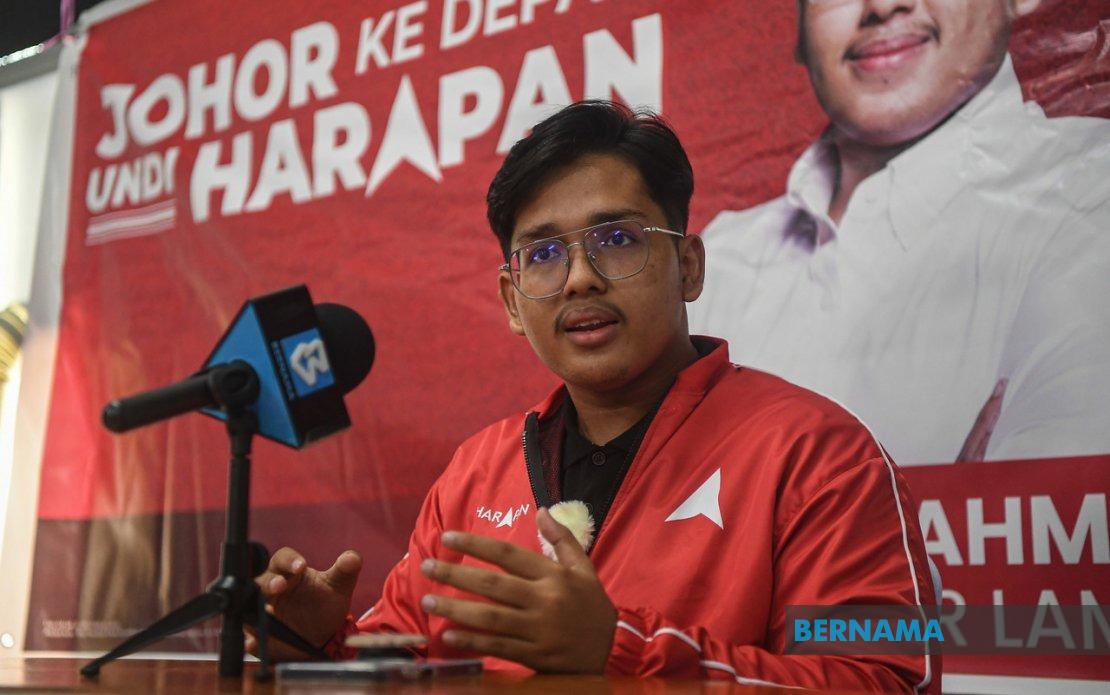
Danish Hossman Abd Rahman, the 23-year-old Pakatan Harapan standard-bearer contesting the Johor Lama state constituency in the 16th Johor state election, credits widespread voter receptiveness with fuelling his campaign momentum as ballots approach. The information technology postgraduate student from Universiti Tun Hussein Onn Malaysia describes the enthusiastic ground response across the electoral division as essential psychological reinforcement, lending credibility to his unconventional candidacy in a race typically dominated by older, more seasoned political figures.
Despite his relative youth and comparative lack of established political connections, Hossman has invested considerable effort in field-level engagement with constituents across different demographic segments. This methodical approach to understanding local grievances has strengthened his conviction that he can mount a competitive challenge against better-established opponents. His consistent presence in towns, villages, and Felda settlements has allowed him to identify patterns in community concerns and develop targeted policy responses that resonate with voters tired of unfulfilled promises.
Veterans and older voters have proven particularly receptive to Hossman's candidacy, viewing his age not as a disqualifying factor but rather as an indicator of genuine commitment to grassroots problem-solving. Many elderly constituents have expressed frustration with political representatives of their own generation who, they perceive, have retreated from public engagement after prolonged periods in office whilst local problems persist unaddressed. This generational disconnect has inadvertently opened space for a younger, visibly energetic candidate willing to invest time in direct voter contact.
Rather than presenting youth as inherently superior to experience, Hossman frames his position as a deliberate middle ground. He explicitly rejects the notion that age determines leadership quality, instead positioning himself as an intermediary capable of synthesising the institutional knowledge of veteran politicians with the forward-looking perspectives and technological fluency of younger voters. This rhetorical strategy allows him to appeal across age cohorts without dismissing either group's concerns or contributions to civic life.
With the campaign entering its final week, Hossman has intensified outreach to specific constituencies including young professionals, women voters, and small business operators. His repeated engagement with the same voter groups aims to build familiarity and trust through recognisable presence rather than transactional political interaction. He has explicitly called for campaign discourse grounded in substantive policy comparison rather than personalised attacks or divisive partisan messaging, a positioning that may resonate with voters fatigued by increasingly acrimonious electoral cycles.
The Johor Lama seat contest features a triangular battle between Hossman and two formidable opponents: Norlizah Noh, the incumbent representing Barisan Nasional, and Aisah Esa fielded by Perikatan Nasional. This three-way split complicates traditional swing voter calculations and potentially creates unexpected opportunities for insurgent candidacies, particularly if turnout patterns differ from historical norms.
Economic stagnation in the constituency has become Hossman's central campaign theme. He identifies inadequate employment options and chronic housing affordability as interconnected crises forcing young residents to migrate toward economic centres, progressively draining the locality of human capital and entrepreneurial energy. This diagnosis frames political renewal as inseparable from economic revitalisation, a linkage that may persuade pragmatic voters concerned primarily with material improvement.
Hostman's development platform centres on attracting downstream investment and industrial ventures aligned with Johor Lama's existing economic foundations. Rather than proposing speculative megaprojects, he emphasises building upon established sectors including agriculture and livestock production, sectors that could generate employment whilst maintaining environmental compatibility with the region's character. This calibrated approach avoids the unrealistic promises that have eroded voter confidence in previous election cycles.
The fundamental premise underlying his candidacy rests on a straightforward proposition: young people should encounter sufficient economic opportunity within their home constituency to justify establishing careers, families, and permanent residency there. This counternarrative to inevitable rural-urban migration reflects emerging recognition that demographic decline in non-metropolitan regions generates cascading economic and social consequences that threaten long-term regional viability. Reversing this pattern requires politically decisive intervention on business investment and employment generation.
Hossman's emphasis on capability-based voter assessment rather than partisan loyalty or personality-driven preference maps onto broader shifts in Malaysian electoral behaviour, particularly among younger demographic cohorts. Constituencies increasingly demand transparent policy frameworks and demonstrated competence rather than inherited political status or factional allegiance. For a candidate of Hossman's profile to succeed, these expectations would need to predominate over traditional voting patterns.
The broader Johor election context encompasses 172 candidates competing for 56 state assembly seats, reflecting intense competition across the state. Polling is scheduled for Saturday with early voting commencing the preceding day. Within this crowded competitive landscape, Hossman's campaign represents the type of insurgent candidacy that occasionally disrupts established political hierarchies, though success remains far from guaranteed. His ultimate performance will provide insight into whether Malaysian electorates genuinely prioritise policy substance and demonstrated commitment over conventional markers of political credibility.

