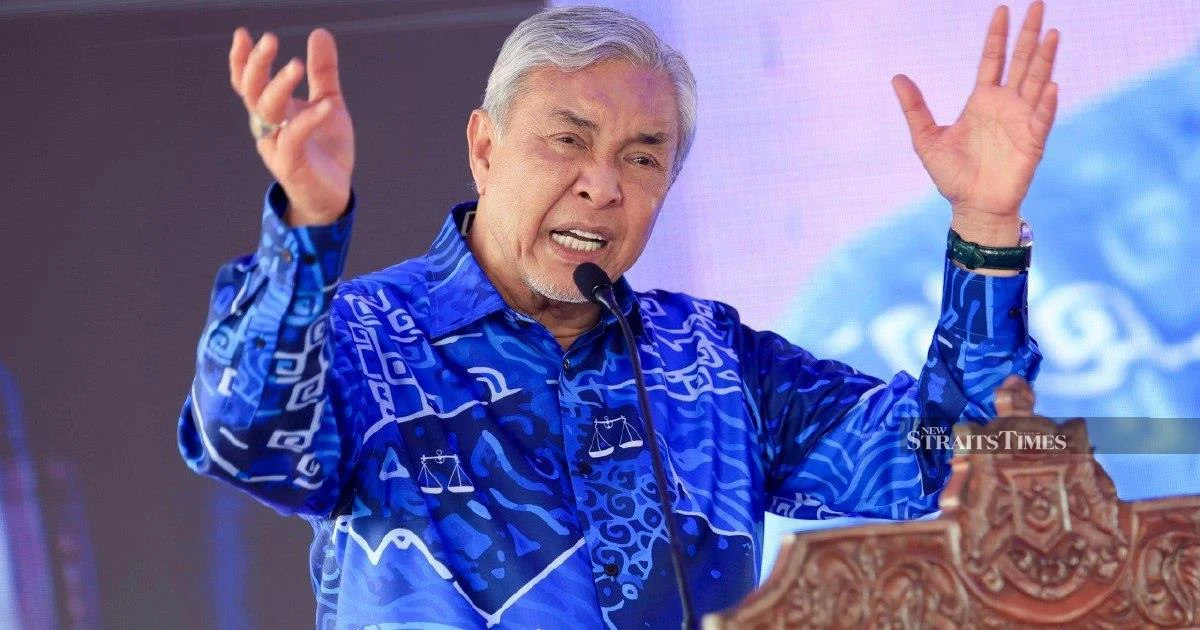
Barisan Nasional chairman Datuk Seri Dr Ahmad Zahid Hamidi delivered a pointed message to Johor voters on Thursday, invoking the cautionary lessons of earlier electoral contests as he campaigned in Labis, a constituency with considerable strategic importance in the peninsular state's political landscape. His remarks underscore the federation's attempt to recapture momentum in a state where political sentiment has shifted noticeably over recent years, with voters increasingly demonstrating their willingness to punish coalitions perceived as underperforming or misaligned with their priorities.
The timing of Zahid's intervention reflects mounting concerns within the Barisan machinery about voter attrition across traditional strongholds. Johor has historically served as a cornerstone of BN support, but the coalition's grip has loosened considerably since 2018, when nationwide electoral upheaval altered the political arithmetic fundamentally. By invoking historical precedent, Zahid implicitly framed the forthcoming contest as a referendum on stability and competence, suggesting that strategic voting choices carry material consequences for state development and economic prosperity.
Zahid's message carried particular resonance given the fractured opposition landscape in Johor. Multiple competing political forces have splintered into factions, each claiming to represent authentic reformist or populist impulses but collectively failing to coalesce into a unified alternative. This fragmentation theoretically advantages Barisan, which maintains institutional networks, administrative machinery, and campaign resources that smaller parties struggle to match. However, it also creates vulnerability if opposition votes consolidate unexpectedly or if voter turnout patterns shift in ways that undermine traditional BN support bases.
The broader context involves substantial economic pressures affecting Johor's electorate. The state economy has faced headwinds from regional competition, manufacturing sector challenges, and post-pandemic recovery complications that have left many residents grappling with cost-of-living anxieties. These material concerns frequently translate into voting behaviour more responsive to immediate welfare promises and local development initiatives than to high-level coalition-level messaging. Zahid's invocation of learning from historical mistakes thus carried implicit acknowledgment that BN must demonstrate tangible, locally-grounded accomplishments rather than merely warning voters against alternatives.
Past electoral cycles in Johor have indeed delivered instructive lessons. The 2018 general election proved to be a watershed moment when Malaysian voters rejected longstanding political arrangements and Barisan suffered its worst national performance in decades. Johor, while remaining relatively favourable to the coalition, nonetheless saw pockets of voter rebellion that foreshadowed broader national trends. Subsequent contests at both state and parliamentary levels revealed that voter preferences had become more volatile and less predictable than in earlier eras, when demographic stability and institutional loyalty produced more consistent electoral patterns.
Zahid's campaign positioning also reflects calculations about the coalition's electoral coalition architecture. Barisan encompasses diverse ethnic and religious constituencies with sometimes divergent priorities, and maintaining cohesion requires messaging that acknowledges this pluralism while emphasizing shared interests in stability and prosperity. His Labis remarks attempted this delicate balance by framing proper coalition choice as essential to protecting investments in social infrastructure, economic development, and institutional reliability that benefit all communities.
The Johor election assumes heightened significance within Malaysia's broader political economy because the state remains a substantial economic contributor, home to strategic manufacturing sectors, port facilities, and growing service industries. Electoral outcomes there ripple through federal political calculations, as Johor's representation in parliament and state assembly shapes coalitional mathematics at the national level. This interconnection means that Zahid's campaign efforts transcend mere state-level considerations and carry implications for federal stability and government composition.
Opposition parties confronting Zahid's messaging have struggled to articulate compelling counter-narratives that simultaneously satisfy competing constituency demands. Some have emphasized corruption accountability and institutional reform, others have focused on welfare expansion and social safety nets, while still others have attempted to mobilize on identity-based grievances. This strategic fragmentation has allowed BN to position itself as the continuity option and the guardian of established institutional arrangements, even as voter scepticism toward political establishment figures remains palpable.
Zahid's invocation of electoral history also carries subtle implications for Johor's growing urban constituencies, where younger voters with less attachment to traditional party loyalties constitute an increasingly important swing electorate. These voters have demonstrated capacity to move decisively between coalitions based on perceived performance and policy alignment, unlike earlier generational cohorts whose voting patterns showed greater stability. The message that voters should learn from past mistakes thus carried particular weight as a reminder that electoral choices possess meaningful consequences for state governance quality.
Looking forward, the Johor election will function as a significant barometer for BN's capacity to rebuild confidence among constituencies that have grown distant from the coalition. Success in consolidating existing support while recapturing defectors from 2018 onwards would provide Barisan with momentum heading into any potential federal election cycle. Conversely, continued erosion in Johor would signal that the coalition faces more structural challenges than messaging alone can address, potentially forcing substantive policy reassessments and leadership recalibrations at the national level.

