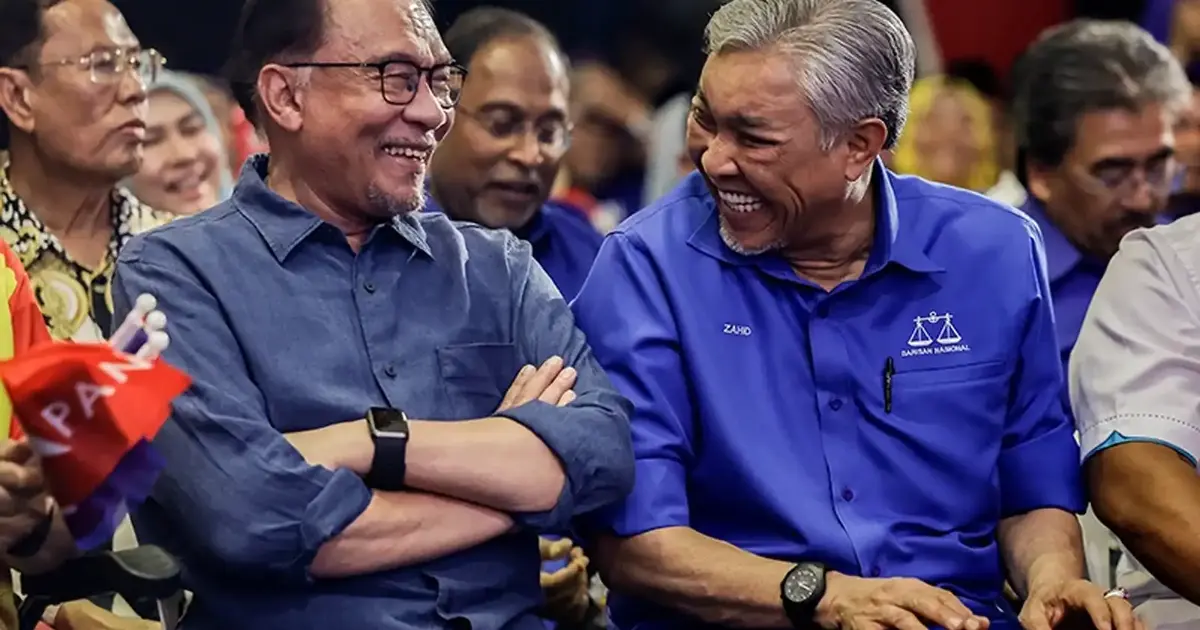
The exchange between Deputy Prime Minister Zahid Ahmad Hamidi and Prime Minister Anwar Ibrahim through poetry marks an unusual moment in Malaysia's political discourse, signalling underlying tensions within the unity government even as leadership figures maintain public commitment to their coalition arrangement. Zahid, who also chairs Barisan Nasional, chose to answer Anwar's poetic message with his own versified response, a diplomatic manoeuvre that allows both leaders to communicate sentiment while maintaining plausible deniability about direct confrontation.
Poetry has long served as a medium for Malaysia's political elite to express nuance and emotion in ways that formal parliamentary statements cannot. The choice of this literary vehicle suggests that both leaders recognise the sensitivity surrounding the unity government's stability, a coalition that emerged from the 2022 general election as an unprecedented partnership between Pakatan Harapan under Anwar and the traditionally dominant Barisan Nasional under Zahid. The ability to respond through metaphor rather than accusation provides essential breathing room for a governing arrangement that requires constant negotiation among competing interests and ideologies.
Zahid's insistence that Barisan Nasional remains firmly committed to the unity government through the completion of its term carries particular weight given the party's historical dominance in Malaysian politics. The declaration functions as reassurance both to coalition partners and to the broader electorate that despite whatever grievances or disagreements may exist within the government, BN will not unilaterally withdraw support. This commitment is not trivial, as Malaysia has experienced coalition collapses before, most notably in 2020 when the Sheraton Move destabilised the Pakatan Harapan government and created the political environment that eventually led to the unity government arrangement.
The unity government itself represents a dramatic departure from Malaysia's political norms. After decades of confrontational opposition, Anwar's Pakatan Harapan government chose to invite Barisan Nasional into a formal coalition rather than attempt to govern alone with a razor-thin majority. This arrangement has brought benefits including greater legislative stability and broader representation across peninsular Malaysia's diverse constituencies, yet it has also created governance challenges as coalition partners with fundamentally different policy preferences attempt to coordinate their actions and messaging.
The exchange through verse rather than open debate suggests that tensions, while present, remain manageable within the current framework. Malaysian politics has grown accustomed to considerable rhetorical flourish and symbolic communication, where poetry, aphorisms, and cultural references carry political meaning. By responding in kind to Anwar's poem, Zahid demonstrates that he understands the rules of engagement within their coalition and is willing to participate in this sophisticated dialogue rather than escalate to direct confrontation or public denunciation.
For Malaysian readers and observers of regional politics, these developments carry implications beyond the immediate personalities involved. The stability of the unity government affects economic policy, foreign relations, and domestic governance across the entire country. Malaysia's status as a major Southeast Asian economy and a crucial hub for regional trade and investment means that political uncertainty can have ripple effects throughout the region. Coalition partners who communicate through poetry rather than conflict resolution mechanisms suggest a degree of maturity in managing disagreements, though observers may worry about whether such indirect communication proves sufficient for addressing substantive policy differences.
Barisan Nasional's explicit reaffirmation of commitment also serves a strategic purpose within the broader coalition ecosystem. Pakatan Harapan members, particularly those from PAS and Amanah, must have assurance that their larger coalition partner will not suddenly abandon the arrangement over tactical disagreements or policy disputes. Zahid's statement provides that assurance in the most emphatic way possible, essentially constraining BN's own future options and making withdrawal a more politically costly proposition should tensions escalate further.
The dynamics within the unity government reflect deeper questions about Malaysian democracy and governance. The country has experimented with various coalition configurations, from BN's historic federal dominance to Pakatan Harapan's 2018 breakthrough to the current inclusive arrangement. Each configuration reflects different calculations about representation, stability, and accountability. The unity government attempts to balance inclusivity with stability, bringing former antagonists into shared governance while maintaining sufficient internal discipline to pass legislation and manage the public service.
Looking forward, such poetic exchanges may become more frequent if tensions within the coalition continue to simmer beneath the surface of official unity rhetoric. Malaysian political culture has sufficient capacity to tolerate these symbolic communications as safety valves for pressure that might otherwise build toward rupture. Whether the unity government can maintain its commitments through a full term, as Zahid insists, will ultimately depend not on poetic responses but on whether coalition members can navigate genuine policy disagreements, ministerial allocation disputes, and electoral positioning without allowing underlying tensions to overwhelm their shared commitment to stable governance.

