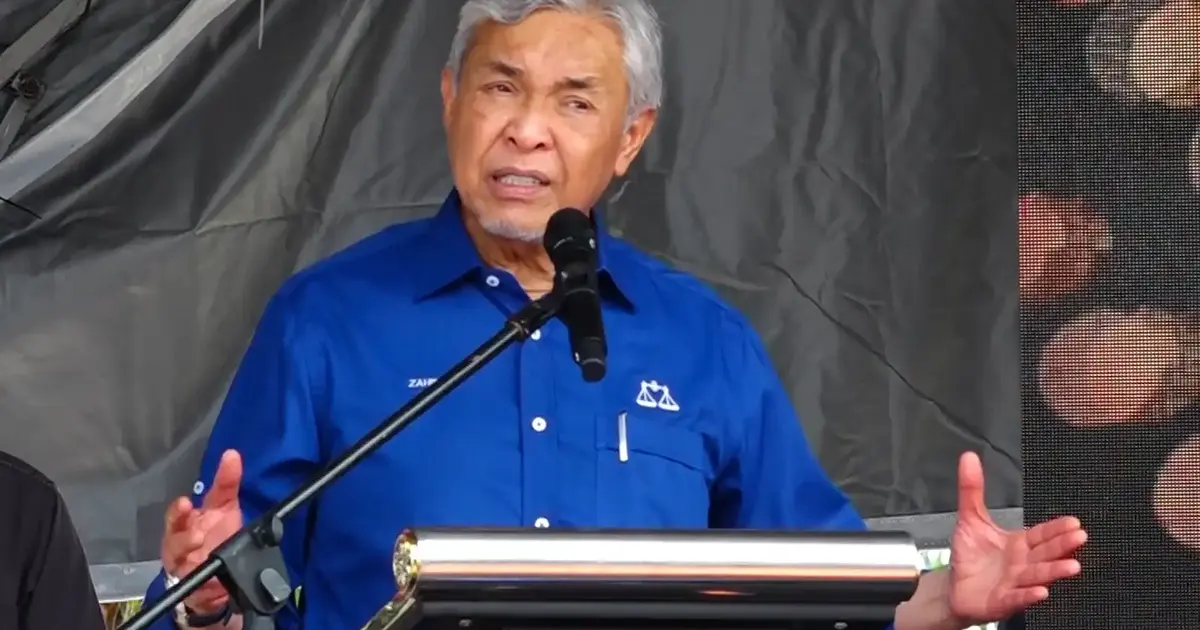
Umno president Zahid Hamzah has directed the party's election machinery to dismiss any remarks Puad Zarkashi may make about Barisan Nasional candidates contesting in the Johor state elections, signalling an effort to contain internal tensions within Malaysia's largest Malay-Muslim political party as campaigning intensifies in the crucial southern state.
The directive reflects growing friction within Umno's ranks ahead of a pivotal electoral test in Johor, where the coalition faces pressure to maintain its dominance in a region historically viewed as a political stronghold. Rather than engage with or respond to the former party leader's critiques, Zahid has chosen a strategy of strategic silence, suggesting that internal dissent should be compartmentalised away from the public-facing campaign apparatus.
Puad Zarkashi, a prominent figure in Umno's recent history who previously held significant positions within the party, has apparently voiced concerns or criticism regarding the selection of candidates fielded by the Barisan Nasional coalition for the Johor contest. Such commentary from senior party figures carries particular weight in Malaysian politics, where internal party dynamics often become public fodder and can influence voter sentiment, particularly among party grassroots supporters who view such individuals as barometers of party health.
Zahid's response to this situation underscores a broader challenge facing Umno as it navigates ideological and strategic divisions that have accumulated over recent years. The party has experienced considerable upheaval, including the imprisonment and subsequent release of former prime minister Najib Razak, multiple leadership transitions, and shifting alliances with other coalition partners. These tremors within the party structure have periodically surfaced as public disagreements among senior figures, complicating the party's message cohesion during critical electoral periods.
The Johor state elections represent a particularly significant battleground for Umno and Barisan Nasional. Johor has traditionally been regarded as friendly territory for the coalition, providing crucial seats and resources that sustain its national position. A diminished performance in Johor would carry symbolic and practical consequences for Umno's standing, potentially emboldening rival coalitions and creating momentum that could extend beyond the state borders into subsequent federal-level contests.
By instructing the party machinery to ignore Puad's commentary rather than actively refuting or engaging with his positions, Zahid appears to be adopting a calculated approach aimed at denying oxygen to internal disputes that might distract from the main campaign narrative. This tactic presumes that public silence regarding factional disagreements will prove more strategically advantageous than allowing back-and-forth exchanges that could amplify the sense of party discord among voters who remain undecided.
However, such directives carry inherent risks. Asking party operatives to ignore a respected former leader effectively requires them to maintain discipline in the face of legitimate concerns or critiques that Puad may be articulating. Should his criticisms resonate with party members or the broader electorate, suppressing engagement could backfire by creating an impression that the party leadership lacks confidence in its own position or candidate selections. The instruction may also frustrate Puad and his supporters, potentially pushing them toward more vocal opposition rather than accepting the suggested restraint.
The timing of this directive assumes particular importance given the intensity of state election campaigns in Malaysia. Election machinery mobilisation involves thousands of party volunteers, grassroots leaders, and mid-level operatives who operate across constituencies and local communities. Maintaining message discipline across such a distributed network becomes exponentially more difficult when internal critics are generating counter-narratives, particularly if those critics possess established credibility and media attention.
For Malaysian voters in Johor and beyond, internal Umno disputes carry tangible implications for governance quality and policy direction. When party figures publicly diverge on candidate selection or strategic direction, it raises questions about the decision-making processes that led to particular choices and the confidence that even senior figures possess in those selections. Such transparency, while potentially disruptive to campaign messaging, also provides citizens with insights into how parties function behind closed doors.
The broader context of Malaysian coalition politics suggests that such internal tensions rarely remain fully contained regardless of leadership directives. In an era where social media amplification and political reporters actively seek out dissenting voices, the notion of completely insulating the campaign from Puad's viewpoint may prove optimistic. Senior figures within Umno will likely encounter questions about his criticisms while canvassing or attending campaign events, forcing them to navigate between the official directive to ignore him and the practical necessity of acknowledging that he has articulated positions worth considering.
Looking forward, the success of Zahid's containment strategy will depend significantly on whether Johor's election results validate the candidate selections and campaign direction that apparently prompted Puad's concerns in the first instance. A strong showing for Barisan Nasional in Johor would effectively vindicate the leadership's choices and reduce the platform for criticism. Conversely, a disappointing electoral outcome would likely resurrect such internal debates with greater intensity and invite retrospective examination of whether dismissed critiques contained prescient observations.
For Malaysian political observers and regional analysts, this episode illustrates the persistent challenge facing large political formations in maintaining unity across geographically dispersed constituencies and ideologically diverse membership bases while simultaneously navigating public electoral contests. The balance between internal accountability and external campaign discipline remains perpetually delicate, and Zahid's approach represents one interpretation of how that balance should be struck during a critical electoral moment.

