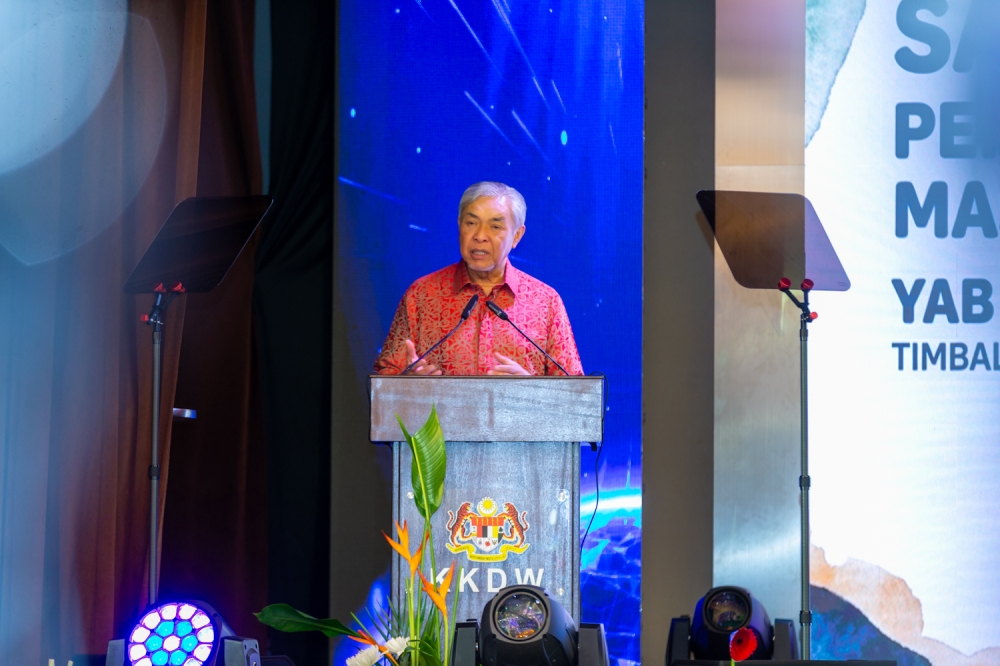
Deputy Prime Minister Datuk Seri Ahmad Zahid Hamidi has firmly rejected widespread social media reports claiming that senior figures from Barisan Nasional, Perikatan Nasional, GPS, and GRS convened to discuss political realignment. Speaking in Putrajaya, Zahid characterised the allegations as baseless and emphasised the government's unwavering commitment to the unity coalition framework that has underpinned Malaysia's governance since 2022.
The emergence of such claims reflects the persistent undercurrents of political manoeuvring that continue to shape Malaysian politics despite the formation of the unity government. Coalition talks, whether real or imagined, periodically generate speculation about potential shifts in the delicate balance that has allowed the Pakatan Harapan-led administration, supported by BN and other partners, to maintain parliamentary stability. The viral nature of these reports underscores how rapidly unverified political narratives spread through digital channels, often gaining traction without substantive evidence.
Zahid's rebuttal carries particular weight given his position within the coalition architecture. As Deputy Prime Minister and a senior UMNO figure, his statements regarding coalition cohesion are closely scrutinised by market observers, diplomatic circles, and political analysts tracking Malaysia's governance stability. The explicit dismissal suggests an attempt to preempt any market uncertainty or international concerns about the government's durability at a time when Malaysia faces multiple policy challenges requiring sustained legislative support.
The unity government model, which consolidated parliamentary seats across ideologically diverse blocs, represents a pragmatic response to Malaysia's fragmented political landscape. However, this arrangement inherently creates friction points where component parties harbour differing policy priorities and territorial ambitions. Periodic reports of behind-the-scenes negotiations reflect genuine tensions rather than merely fabricated gossip, making Zahid's categorical denials a necessary aspect of maintaining investor and coalition confidence.
The involvement of GPS, the dominant party in Sarawak, and GRS, the main political force in Sabah, signals the importance of East Malaysian representation within any potential coalition reshuffling. These parties command significant parliamentary votes and have historically leveraged their strategic position to secure federal investment and autonomy for their respective states. Any substantive realignment would need to account for their interests and likely demand additional concessions from the federal government.
Zahid's reaffirmation of support for the unity government arrives amid broader questions about how long the current configuration can sustain itself. Parliamentary mathematics remain precarious, requiring consistent discipline among coalition members to pass legislation and budget allocations. The Deputy Prime Minister's statement functions as a stabilising signal, intended to reassure both internal coalition partners and external stakeholders that leadership remains focused on governance rather than factional manoeuvre.
Malaysian political observers have noted that speculation about coalition shifts typically intensifies during periods of policy disagreement or when individual parties perceive themselves as undervalued within the existing arrangement. The timing of these particular reports warrants examination against the backdrop of ongoing discussions about allocation of ministerial portfolios, development funding, and legislative priorities. Such periodic claims often reflect genuine discontent that requires careful navigation by senior government figures.
The denial also operates within the context of Malaysia's economic circumstances. The ringgit's performance, foreign direct investment flows, and international credit ratings are all sensitive to perceptions of political instability. Markets have demonstrated during previous coalition fluctuations that uncertainty regarding governance continuity triggers capital flow volatility. Zahid's clear statement serves a stabilisation function, reducing the probability that these unverified reports will translate into economic repercussions.
For Southeast Asian capitals monitoring Malaysian politics, coalition stability carries implications beyond domestic concerns. Malaysia's chairmanship roles in regional organisations, defence partnerships, and economic integration initiatives all depend on effective domestic governance. Any suggestion of political uncertainty in Kuala Lumpur reverberates through regional security and economic calculations, making high-level reassurances about coalition cohesion diplomatically consequential.
The persistent rumour cycle also reflects structural challenges within Malaysia's coalition framework. When multiple parties must cooperate across ideological divides and competing regional interests, managing expectations and preventing unauthorised negotiations becomes administratively demanding. The Deputy Prime Minister's role includes managing such tensions privately while presenting public unity—a balance that requires constant reinforcement.
Moving forward, monitoring the frequency and sophistication of such reports will provide insight into underlying coalition pressures. Zahid's characterisation of current claims as unfounded does not resolve the underlying fragmentation that periodically generates such speculation. The unity government's ability to navigate the remainder of its term will depend partly on how effectively leadership manages both genuine policy disagreements and the informational environment in which political narratives circulate. The Deputy Prime Minister's statement represents one intervention within this broader dynamic, signalling that at present, senior figures remain committed to maintaining existing arrangements rather than pursuing alternative configurations.

