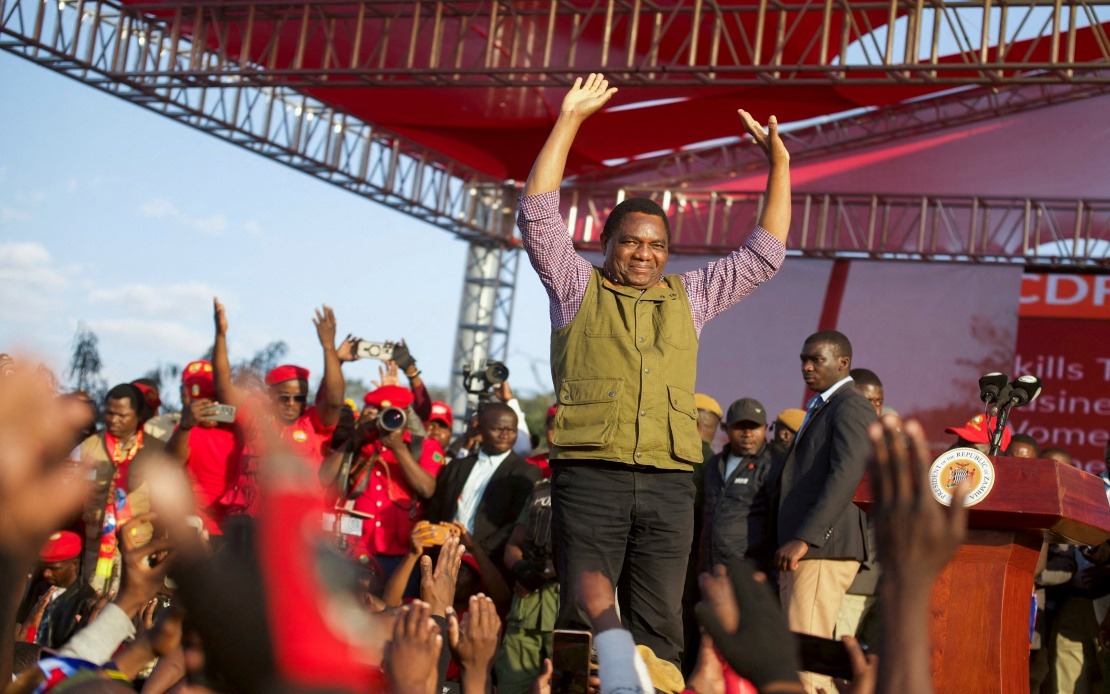
Zambian President Hakainde Hichilema has claimed a resounding victory in the country's presidential election, securing more than 2.9 million votes according to results announced by the Electoral Commission of Zambia early Tuesday morning. The 64-year-old leader's commanding performance means he will serve another term leading the Southern African nation, having comfortably surpassed the constitutional requirement of capturing over 50 per cent of the valid ballots cast.
Hichilema's margin of victory was substantial enough that Electoral Commission chairperson Mwanagala Zaloumis declared the election decided despite outstanding tallies from selected polling stations across five of Zambia's 226 constituencies. This declaration reflected the scale of the incumbent's triumph and demonstrated the mathematical impossibility of the remaining votes altering the outcome. The threshold for declaring a winner was never in serious doubt once the bulk of results had been processed, allowing the commission to proceed with confidence in announcing the president-elect.
The main opposition challenger, Brian Mundubile of the National Restoration Party for Unity and Progress, garnered approximately 1.8 million votes in Thursday's election, placing him a distant second. This margin of over 1.1 million votes illustrates the strength of Hichilema's support across the country and suggests his UPND administration has maintained or expanded its political base since winning power in 2021. The scale of the victory provides a clear mandate for continuation of the current administration's policies and direction.
In his immediate response to the declaration, Hichilema expressed gratitude to the Zambian electorate through a Facebook statement, emphasizing the trust placed in his leadership for another five-year term. His words reflected both humility about the responsibility of high office and recognition of the democratic choice made by voters. The president positioned himself as a servant of the nation rather than adopting a triumphalist tone, a messaging approach likely designed to extend appeals beyond his core supporters and foster national unity.
Party officials echoed this conciliatory stance in their public statements. Collins Maoma, national chairperson of the ruling United Party for National Development, called on Hichilema to maintain the leadership qualities that had earned him re-election while noting that Zambians had demonstrated renewed confidence in his administration. Such rhetoric typically serves to validate the electoral process while setting expectations for the incoming government's priorities and conduct during its second mandate.
The scenes in Lusaka reflected the jubilation of Hichilema supporters, who converged on the streets throughout the night and into early morning despite cold weather conditions. The visible celebration across the capital indicated genuine enthusiasm among segments of the population, though turnout figures and regional voting patterns would provide fuller understanding of the election's geographic and demographic dynamics. Such spontaneous gatherings in African cities often signal not merely partisan support but broader satisfaction with the electoral process itself.
Hichilema's re-election comes as Zambia continues to navigate economic challenges that have characterized recent years, including substantial debt burdens and currency pressures. The victory suggests that voters either credit the administration with managing these difficulties or lack confidence in opposition alternatives to address them more effectively. The mandate provides Hichilema with political capital to implement potentially unpopular but necessary economic reforms without immediate fear of electoral consequences.
For the Southern African region, Hichilema's return represents continuity in a major economy and continued leadership from a president who has positioned Zambia as engaged with international institutions and development partners. His administration has pursued structural adjustment programs supported by the International Monetary Fund and World Bank, decisions that carry both economic implications and domestic political costs. A second term suggests these international relationships will persist as central to Zambian policy.
The election result also has implications for opposition politics in Zambia, where Mundubile's showing raises questions about consolidation within the fragmented non-UPND space. The National Restoration Party for Unity and Progress emerged as the primary challenger, but significant gaps between the second and potentially third-placed candidates would indicate whether opposition voters are coalescing around alternatives or remaining divided across multiple parties. This fragmentation, if confirmed by detailed results, could facilitate UPND dominance in legislative contests as well.
The substantial victory margin provides Hichilema with a window to advance his agenda before attention turns toward 2026 local elections and the longer-term succession question within his party. With electoral pressures temporarily relieved, his administration can focus on implementation of policy rather than constant campaign positioning. However, the economic constraints facing Zambia mean that satisfying voter expectations will depend not merely on political will but on external economic conditions and the success of ongoing reform programs.
For Malaysian observers and broader regional analysts, Zambia's election demonstrates the continued strength of democratic institutions in Southern Africa despite economic pressures that sometimes undermine electoral competition. The peaceful transfer of power through elections, while routine in mature democracies, remains significant in continental context and reflects institutional resilience. Hichilema's victory, achieved through universal suffrage and monitored by domestic and international observers, reinforces democratic norms in a region where such practices have not always been assured.

