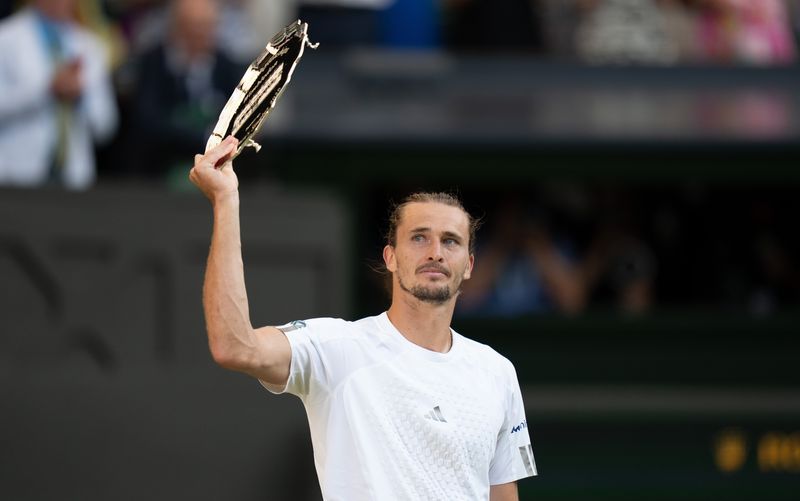
Alexander Zverev's runner-up finish at Wimbledon will propel him to second place in the ATP rankings on Monday, marking a significant milestone in his career revival. Yet for the 29-year-old German, the mathematical advancement masks a deeper shift in his approach to tennis. After reaching his first Grand Slam final in Sunday's Centre Court showdown against Jannik Sinner, Zverev is convinced that his tactical transformation—built around attacking tennis and a more aggressive deployment of his forehand—holds the key to finally bridging the gap between himself and the sport's two undisputed elites, Sinner and Carlos Alcaraz.
The Wimbledon final itself served as a laboratory for this new methodology. Though Zverev ultimately fell short 6-7(7) 7-6(2) 6-3 6-4, the match demonstrated that his strategy is no longer theoretical. Playing the world number one in a best-of-five-sets format on grass, Zverev snapped a dispiriting streak of 14 consecutive sets lost to Sinner and took the Italian into a fourth set that remained genuinely competitive. This represented something qualitatively different from his previous ten consecutive losses to Sinner—a match where aggression and risk-taking created genuine pressure on his opponent rather than merely delaying the inevitable.
Zverev's trajectory this season has been punctuated by moments of genuine breakthrough interspersed with frustration. His French Open victory last month was his maiden Grand Slam title at the 41st tournament attempt, a milestone that carried enormous psychological weight. However, the path to Paris was obscured by the absence of Alcaraz, sidelined by a persistent wrist injury, and Sinner's second-round exit, circumstances that provided ammunition for those reluctant to fully credit the achievement. Yet Zverev himself frames these qualifications as irrelevant to the fundamental shift they represented—proof of concept that he could navigate the demanding requirements of the most gruelling tournaments in tennis.
The confidence that breakthrough in Paris engendered proved transferable to the grass courts of the All England Club, where Zverev produced his strongest ever performance at Wimbledon. His attacking profile became his signature throughout the fortnight, with his first serve percentage remaining consistently around 80 percent during the final against Sinner. More tellingly, his forehand—long criticised as a defensive rather than offensive weapon—became an instrument of deliberate aggression. Rather than waiting for opportunities to materialise, Zverev has adopted a philosophy of seizing the initiative whenever the ball sits on his racket in a position to attack, accepting that missed shots are an inevitable byproduct of a strategy predicated on calculated risk-taking.
In conversation with reporters following his defeat, Zverev articulated a clear philosophical framework underpinning this approach. He emphasised that the attacking style represents not a temporary tactical adjustment but rather a fundamental commitment to how he intends to shape his career going forward. The consistency with which he has implemented this strategy across the season, even through matches where he struggled with execution, reflects a deliberate choice to prioritise long-term development over short-term results. As he practised this approach repeatedly during the early months of the year, his execution has steadily improved, a trajectory he expects to continue.
The psychological dimension of this transformation cannot be overlooked. Reaching his first Grand Slam final represents far more than a statistical achievement—it has fundamentally altered Zverev's relationship with the possibility of winning major tournaments. Where doubt previously clouded his approach, he now carries a tangible reference point, evidence that the blueprint he has constructed actually works. This shift in self-perception manifests in his willingness to be more aggressive when opportunities present themselves, to trust his attacking instincts rather than retreat into defensive patterns that have historically characterised his game.
Zverev's pursuit of Grand Slam glory arrives in an era when Sinner and Alcaraz have established unambiguous dominance at tennis's highest level, collectively holding 12 major titles. The conventional narrative has long positioned Zverev as the third force in men's tennis, a player consistently pursuing but never quite catching the top two. What distinguishes his current mindset is that he no longer accepts the vast gulf that has historically separated him from Sinner and Alcaraz as immutable. Instead, Zverev interprets his recent Grand Slam success and his competitive performance against Sinner at Wimbledon as evidence that the gap is genuinely narrowable through tactical evolution and improved execution.
The Australian Open earlier this year provided another data point in support of this thesis, when Zverev pushed Alcaraz to the limit in a four-set encounter. These near-victories, combined with his breakthrough major triumph in Paris and his Wimbledon final appearance, suggest a player approaching rather than receding from elite-level consistency. From Zverev's perspective, the conversation about identifying a credible third competitor to challenge the Sinner-Alcaraz duopoly can now shift from abstract speculation to concrete evidence of emerging competitive reality.
A notable blemish on his Wimbledon performance emerged in the third set when an inadvertent fall, coinciding with his only genuine break point opportunity in the match, forced Zverev to recalibrate his physical approach. The incident, which Zverev characterises as a re-extension of his knee similar to an injury sustained two years prior, visibly affected his serving mechanics, reducing the velocity and effectiveness of his first serve. Despite this physical setback, Zverev's overall performance level remained elevated, a reflection of the confidence his new tactical framework provides. Even when forced to adjust to compromised physical conditions, his attacking approach generated sufficient problems for his opponent to maintain competitive pressure.
Zverev's articulation of his future ambitions reflects the recalibration of his expectations now that he has proven capable of contending in major tournaments. Rather than aspiring to simply remain a permanent third force, forever pursuing but never quite catching the summit, he now frames his goal in terms of competitive mixing with Sinner and Alcaraz as equals, winning significant tournaments and establishing himself as a legitimate contender rather than a perennial challenger. This reframing—from wanting to be close to the top two to wanting to compete among them for titles—represents a fundamental shift in how he relates to the hierarchy of professional tennis.
For Southeast Asian observers of professional tennis, Zverev's resurgence carries broader significance within the larger ecosystem of competitive tennis. The emergence of players challenging the Sinner-Alcaraz dominance suggests that the men's game, despite its current concentration of excellence among a narrow group, retains sufficient dynamism for multiple players to compete for the sport's highest honours. Whether Zverev can sustain this trajectory through the remainder of the season and into the Australian open campaign will determine whether his Wimbledon run and French Open triumph represent the beginning of an extended period of elite consistency or merely a brief interruption in the established hierarchies of professional tennis.

