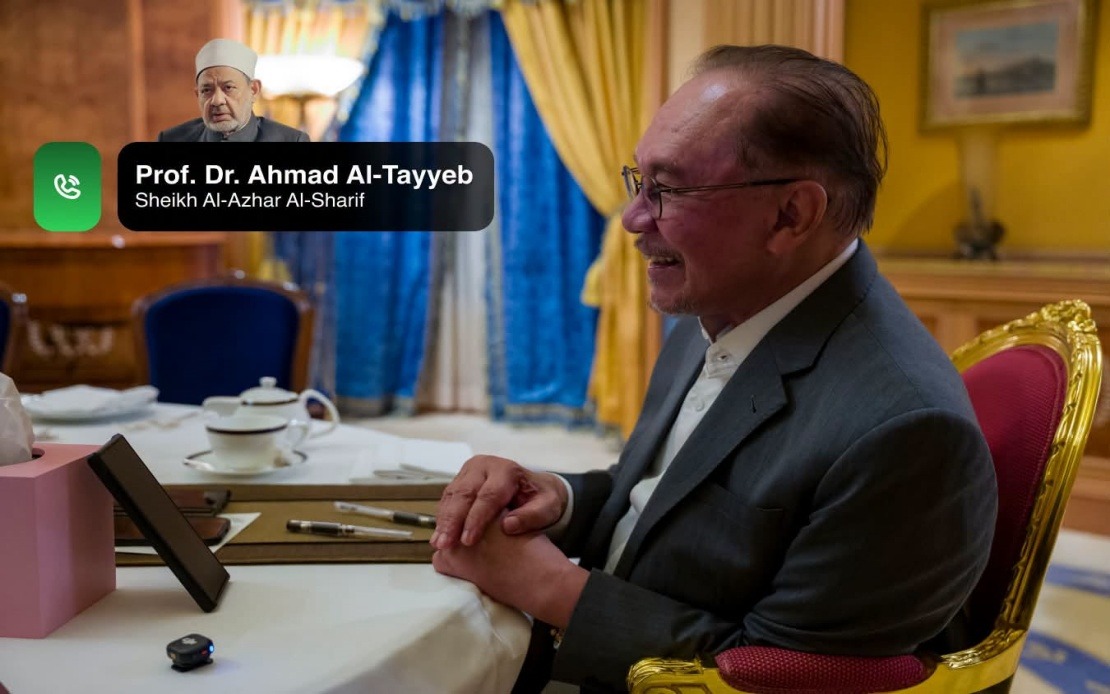
Prime Minister Datuk Seri Anwar Ibrahim has engaged in high-level theological discussions with one of Islam's most revered institutional leaders, Sheikh al-Azhar al-Sharif Prof Dr Ahmad al-Tayyeb, during a phone conversation that focused on advancing Islamic scholarship and religious education across communities. The call came as part of a broader exchange of courtesies following Anwar's recent surgical procedure, with the Grand Imam of Al-Azhar extending personal well-wishes and prayers for the Malaysian leader's swift recovery.
The conversation between the two figures carries particular significance given the stature of Al-Azhar University in Cairo, which stands as one of the oldest and most influential centres of Islamic learning in the Muslim world. As head of this venerable institution, Sheikh al-Azhar al-Sharif represents a scholarly tradition spanning over a millennium, making his engagement with Malaysia's top political leadership a mark of diplomatic and religious importance for the country. Anwar's willingness to discuss substantive matters of Islamic education and practice with such a prominent international religious authority underscores Malaysia's positioning within broader Islamic intellectual networks.
During their exchange, both leaders explored the continuation and expansion of dakwah—Islamic outreach and education—as a shared priority. Anwar conveyed his appreciation for the Grand Imam's spiritual support and outlined his vision for deepening Malaysia's engagement with contemporary Islamic thought. He also referenced Sheikh al-Azhar al-Sharif's prior visit to Malaysia, characterizing that occasion as having made a lasting impression on the Muslim community here. The Malaysian Prime Minister expressed his belief that such international scholarly connections strengthen the nation's Islamic institutions and contribute to a more coherent understanding of religious principles among the broader population.
A central theme emerging from the discussion concerns the cultivation of what both leaders appear to characterise as an Islam that is straightforward, accessible, and grounded in authentic scholarship. This framing suggests a mutual commitment to counteracting more rigid or superficial interpretations of Islamic teaching, and instead promoting an approach that balances traditional scholarship with contemporary relevance. For Malaysia, a multi-religious society where Islam holds constitutional significance, such engagement with international Islamic centres of learning helps establish intellectual authority and credibility when navigating complex questions of religious governance and community cohesion.
Anwar highlighted the possibility of future meetings in either Cairo or Kuala Lumpur to deepen collaborative initiatives. Such exchanges, if formalized, could yield practical benefits including the development of educational curricula, scholarly exchanges, and joint research initiatives that position Malaysia as a bridge between Middle Eastern Islamic tradition and Southeast Asian Muslim communities. The prospect of hosting the Grand Imam again in Malaysia would likely generate significant interest among religious scholars and institutional leaders throughout the region, potentially elevating Malaysia's profile as a site of serious Islamic intellectual engagement.
The Prime Minister's communications also revealed parallel engagement with Mohamed Abdelsalam, Secretary-General of the Council of Muslim Elders (Majlis Hukama Muslimin), another influential voice in international Islamic affairs. Through Abdelsalam, Anwar gained further reinforcement of Sheikh al-Azhar al-Sharif's interest in returning to Malaysia, while also learning about broader institutional ambitions regarding deepened connections between Malaysia and Al-Azhar. These overlapping conversations suggest a coordinated effort among international Islamic leadership to strengthen ties with Malaysia, reflecting possible recognition of the country's geopolitical importance and its position as a Muslim-majority nation with significant economic and diplomatic weight in Southeast Asia.
Anwar's disclosed concern for Abdelsalam's wife, who is currently hospitalized, exemplifies the personal dimension underlying these high-level religious and political relationships. Such moments of genuine human concern, when shared publicly, help humanize international diplomacy and suggest that these connections operate on multiple registers—not merely as transactional political relationships but as bonds rooted in shared faith and mutual respect. This approach aligns with Anwar's broader political messaging, which frequently emphasizes the spiritual and ethical dimensions of leadership.
The Prime Minister also took the opportunity to acknowledge his wife, Datuk Seri Dr Wan Azizah Wan Ismail, commending her role as a supportive partner throughout his political journey. By invoicing her steadfastness and sacrifice in his public statement, Anwar reinforces a narrative of family-centred resilience that resonates with conservative and traditional constituencies within Malaysia's Muslim population. This recognition also subtly positions familial structures as foundational to political and religious endeavour, a messaging strategy common in Malaysian political discourse.
From a Malaysian perspective, these discussions carry implications for the country's soft power projection and its positioning within the Organisation of Islamic Cooperation (OIC) and broader Muslim-world networks. Al-Azhar's influence extends across Africa, the Middle East, and Asia, and official engagement with its leadership can amplify Malaysia's voice on matters of Islamic interpretation and community welfare. Additionally, for a government led by Anwar, whose political history includes periods of imprisonment and whose current standing within certain conservative Islamic circles remains contested, validation from internationally respected religious authorities serves to strengthen his Islamic credentials and legitimacy.
The emphasis on dakwah and religious understanding also reflects contemporary challenges facing Muslim communities globally, including the spread of extremist ideologies, sectarian tensions, and the need to articulate Islam in ways that speak to modern social realities. By positioning Malaysia as a participant in this intellectual project alongside one of Islam's most prestigious institutions, Anwar signals his government's commitment to promoting what might be termed a modernized, inclusive Islamic framework—one that maintains doctrinal integrity while engaging substantively with questions of pluralism, governance, and social development that concern Southeast Asian Muslim societies.
Moving forward, the success of these collaborative initiatives will depend on translating high-level diplomatic engagement into concrete institutional outcomes. Whether such conversations yield formal partnerships, educational exchanges, or joint scholarly projects remains to be seen. However, the very initiation and public articulation of these discussions demonstrate Malaysia's continued investment in positioning itself as a serious participant in global Islamic intellectual discourse, while simultaneously working to model an approach to Islam that emphasizes learning, dialogue, and community benefit—priorities that Anwar has repeatedly emphasized throughout his political career.

