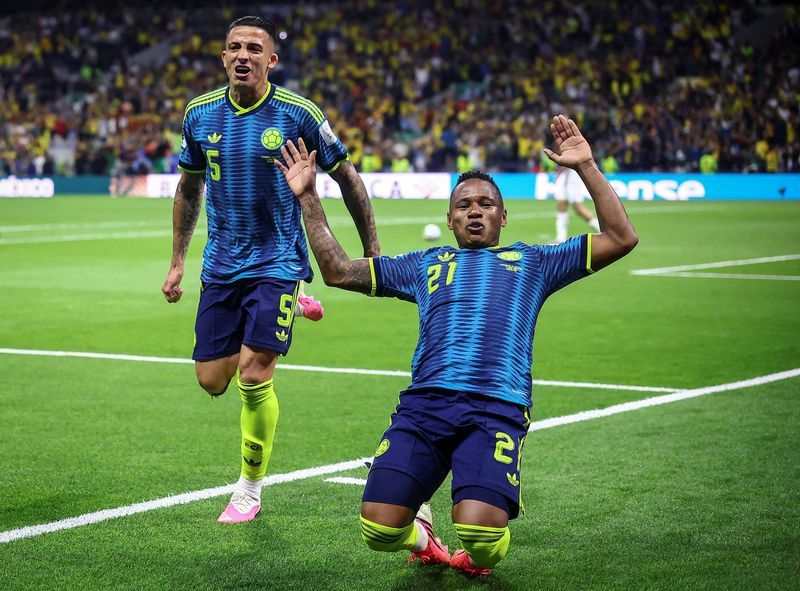
Colombia will attempt to consolidate their World Cup campaign when they encounter DR Congo on Tuesday, building momentum from an opening victory while remaining alert to the threat posed by opponents who have already demonstrated their capacity to trouble elite sides. Under manager Nestor Lorenzo, the South Americans head into this Group K fixture seeking to translate their 3-1 triumph over Uzbekistan into another positive result, though the nature of that opening performance has prompted the Colombian coaching staff to identify and address several defensive shortcomings that could prove costly against a more tactically organised opponent.
The Colombian victory over Uzbekistan, while commanding in its final scoreline, concealed a concerning second-half period during which the Central Asian side penetrated Colombian defences with relative ease and exposed gaps in their structure. This vulnerability now looms as a focal point for Lorenzo's preparation, particularly as DR Congo's recent performance against Portugal has illustrated their capacity to exploit hesitant defending and capitalise on transitional opportunities. A second consecutive win would mathematically secure Colombia's passage to the knockout stage and potentially deliver the group title if Portugal stumble against Uzbekistan in their own fixture, offering Lorenzo's squad both security and the opportunity to rest key personnel ahead of the final group match.
The attacking responsibility continues to rest heavily on Luis Diaz, the Bayern Munich forward whose explosive performance against Uzbekistan yielded both a goal and an assist while earning him the player-of-the-match accolade. Diaz's pace and direct running proved instrumental in dissecting Uzbek defences, yet Lorenzo will be seeking greater involvement from captain James Rodriguez, whose impact on proceedings remained limited during the opening encounter. The interplay between these two creative forces could prove decisive against a DR Congo side that employs a disciplined defensive shape designed to compress space and invite Colombia into possession-dominated patterns that may ultimately prove counterproductive.
DR Congo arrive at the Estadio Azteca with considerable confidence bolstered by their remarkable 1-1 draw against Portugal, a result that has energised a nation whose World Cup participation was limited to a solitary appearance in 1974, when they competed as Zaire. Yoane Wissa's opening-match goal marked a historic moment for Congolese football, and Sebastien Desabre's tactical approach—built on compact defending and rapid counter-attacking—has already earned respect from one of world football's traditional powerhouses. The Eastern African outfit's ability to maintain defensive discipline whilst threatening on the break has provided a blueprint that could prove equally troublesome for Colombia, whose own defensive susceptibilities could be amplified by the tempo and directness of Congolese transitions.
Lorenzo has explicitly acknowledged the tactical challenge that awaits his side, emphasising that DR Congo's propensity for elongated passes and accelerated counter-moves presents a fundamentally different examination than the technical, possession-based approach of Uzbekistan. The Argentine manager recognised that Colombia's abundance of possession in their opening fixture occasionally worked against their interests, with their attacking play becoming laboured and predictable as they over-reliant on individual brilliance to manufacture breakthroughs. Colombian weaknesses in the final third—a lack of clinical finishing and movement—require urgent refinement, particularly given that Diaz cannot perpetually single-handedly dismantle opposition defences through moments of individual inspiration.
The geographical location of the fixture offers Colombia a significant advantage, with thousands of Colombian supporters having transformed Mexico City's Estadio Azteca into an intimidating environment during the Uzbekistan encounter. Based in Guadalajara, Lorenzo's squad anticipates another substantial Colombian presence in the stands, providing psychological reinforcement and creating an atmosphere that approximates a home fixture despite the contest being played in Mexican territory. This tactical advantage—the noise, the encouragement, the familiarity of Spanish-speaking surroundings—has historically provided Colombian sides with genuine benefits in World Cup campaigns and could prove the decisive factor in tight moments throughout Tuesday's encounter.
The stakes for both nations are substantially different yet equally consequential. For Colombia, victory represents passage to the knockout stage and an opportunity to progress from a group in which they were pre-tournament favourites; for DR Congo, another positive result would represent an unprecedented achievement in modern World Cup football and a validation of their defensive philosophy against increasingly sophisticated opposition. Desabre has constructed a team capable of frustrating technically superior sides through organisation and discipline, attributes that will test not merely Colombian attacking resources but also their mental resilience when faced with an opponent playing without the weight of expectation.
Lorenzo's preparations will inevitably focus on transitional defending, with his coaching staff drilling responses to the rapid switches that characterise DR Congo's attacking methodology. Colombian midfielders must balance their responsibility to maintain possession security with the need to recover quickly when the ball is surrendered, a dual obligation that has proven problematic during the opening fixture. Additionally, the flexibility and positioning of Colombian full-backs becomes paramount against a side that will seek to exploit wide areas through direct long-ball distribution followed by explosive running into spaces.
The broader continental implications of this fixture extend beyond immediate tournament progression. A Colombian victory would represent another substantial contribution to South American World Cup success and reinforce the region's footballing credentials against African and Asian opposition. Conversely, a DR Congo result—whether victory or another draw—would extend their remarkable narrative of competitive emergence and challenge the narrative of inevitable European and South American dominance in global football competitions. Tuesday's encounter therefore transcends Group K mathematics, speaking instead to evolving global football hierarchies and the capacity of less historically prominent nations to compete at the sport's highest level.
%22%2F%3E%3C%2Fpattern%3E%3C%2Fdefs%3E%3Crect%20width%3D%22100%25%22%20height%3D%22100%25%22%20fill%3D%22url(%23phje2hg)%22%2F%3E%3Crect%20width%3D%22100%25%22%20height%3D%22100%25%22%20fill%3D%22url(%23phje2hp)%22%2F%3E%3Ctext%20x%3D%2250%25%22%20y%3D%2250%25%22%20text-anchor%3D%22middle%22%20dominant-baseline%3D%22central%22%20fill%3D%22rgba(255%2C255%2C255%2C0.95)%22%20font-family%3D%22Georgia%2C%20'Times%20New%20Roman'%2C%20serif%22%20font-weight%3D%22700%22%20font-size%3D%22320%22%20letter-spacing%3D%22-0.02em%22%3E70%3C%2Ftext%3E%3C%2Fsvg%3E)