The longest arterial road threading through George Town, Penang's Jalan Burma represents far more than a simple thoroughfare—it is a physical manifestation of the city's evolving character, stretching nearly five kilometres from the heritage zone's cusp all the way into the upscale residential neighbourhood of Pulau Tikus. For visitors attempting to navigate Penang's historical quarters, the city rewards those who venture beyond the obvious circuit of Beach Street and Armenian Street, where most tour groups cluster around postcard-perfect colonial facades. Jalan Burma offers something different: an accessible walk through layers of Penang's multicultural identity, punctuated by exceptional food stalls that have earned recognition from Michelin's discerning assessors and anchored by a carefully restored heritage property that speaks to the island's Anglo-Malay architectural traditions.
The road's transformation and its various historical identities tell a fascinating story about how Penang absorbed waves of migration and economic development. Originally called Burmah Road, as visible on aged signboards and archival maps, the thoroughfare bore multiple names across different linguistic communities. In Malay, it was known as Jalan Tarek Ayer or Water Cart Road, reflecting its original practical purpose of facilitating bullock cart transport of water supplies throughout the developing settlement. Hokkien speakers knew it as Gui Chia Chui, while Cantonese residents called it by a similar variant—all essentially conveying the same meaning about water distribution. This linguistic plurality captures something essential about nineteenth-century Penang: a port city where different communities coexisted, each naming their surroundings in their own language without necessarily displacing others' terminology. When a significant Burmese settlement subsequently established itself in Pulau Tikus during the 1800s, the road's primary designation eventually crystallised into its current name, reflecting the demographic shift and the growing prominence of Burmese merchants and labourers in that quarter.
Today's Jalan Burma neighbourhood still bears the unmistakable imprint of that Burmese presence, though casual visitors might miss these markers without guidance. The Dhammikarama Burmese Temple, established two centuries ago and accessible via lanes branching off the main road, stands as a living monument to that heritage. Surrounding thoroughfares carry names evoking Myanmar's geography and history: Rangoon Road, Mandalay Road, and Moulmein Close all serve as subtle geographical anchors, linking George Town back to a distant homeland that Burmese settlers carried in their collective memory. An information board positioned beneath the Komtar Octopus Pedestrian Bridge provides a simplified historical overview for curious pedestrians, though many locals and visitors alike pass by without noticing this modest educational resource.
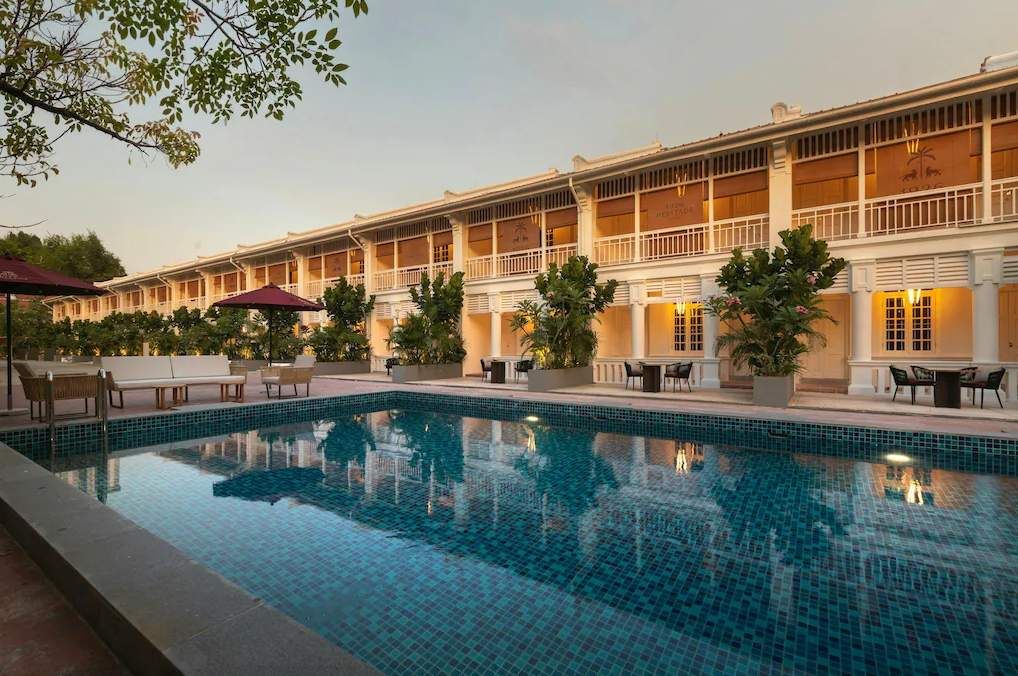
The neighbourhood's contemporary character reflects Penang's broader approach to preserving heritage while accommodating modern hospitality needs. A restored property built in 1926, marking its centennial anniversary this year, exemplifies this balance. Originally constructed as residential quarters for British and local government officials, the building exhibits the Anglo-Malay architectural vocabulary that defined early twentieth-century George Town construction. The Penang Development Corporation transformed the original 24 interconnected link houses into a hotel in 1999, creating 78 rooms and suites across six categories. The Heritage Room caters to solo travellers seeking compact accommodation, while the Straits Suite represents the property's most expansive offering. This conversion strategy—preserving the external architectural integrity while modernising interior functions—has become a hallmark of George Town's hotel development, allowing structures to generate revenue while maintaining visual continuity with Penang's built heritage.
Yet Jalan Burma's primary draw for most visitors remains its remarkable concentration of food establishments, particularly those recognised by Michelin. Penang hosts 74 Michelin-rated eateries overall, with the city centre accounting for the majority. The recognition breaks down into two one-star establishments, 33 venues earning the Bib Gourmand designation indicating exceptional value, and 39 classified as Michelin Selected. For visitors working with limited time and budgets, the Bib Gourmand listings offer especially compelling options, frequently operating from food courts and coffeeshops rather than dedicated fine dining venues. Duck Blood Curry Mee operates a stall on Jalan Burma serving its signature preparation of white curry noodles—a surprisingly approachable entry point into Penang's complex noodle taxonomy that rewards first-time visitors with immediate satisfaction rather than demanding acquired palate appreciation.
The most celebrated noodle establishment in the immediate vicinity, however, remains Green House Prawn Mee & Loh Mee, listed in Bib Gourmand and housed at Restoran Old Green House adjacent to Duck Blood Curry Mee. The restaurant's reputation has spawned what locals describe as a sister operation further along Jalan Burma toward Jalan Penang, identified as Green House Prawn Mee/Law (sic) Mee Corner. Regular customers insist the original location merits priority despite the nominal connection between the two establishments, suggesting that subtle distinctions in preparation technique or ingredient sourcing create meaningful differences in the final product. This preference hierarchy reflects a broader Penang characteristic: the city's nasi kandar and noodle cultures generate intensely loyal followings, with enthusiasts developing strong opinions about which establishment best executes their preferred dish. Rather than representing confusion or fragmentation, this passionate engagement actually simplifies visitors' itineraries—social media recommendations and local guidance create natural pathways through the city's food landscape.
Walking Jalan Burma itself presents an entirely manageable urban experience, particularly for visitors accustomed to Malaysian city terrain. The road generally maintains proper pedestrian pathways throughout its nearly five-kilometre length, with only one or two sections lacking dedicated walking space. The safe, systematic grid of the heritage quarter extends into Jalan Burma, allowing visitors to calculate distances and plan itineraries with reasonable confidence. A round-trip walk from the heritage zone hotels to the initial string of food stalls and back typically requires roughly four kilometres of ambulatory effort, sufficient to justify an afternoon's exploration without becoming prohibitively exhausting. The Penang heat demands respect—borrowing umbrellas and towels from accommodating hotels, or investing in lightweight rain protection, transforms what might otherwise prove uncomfortable into an entirely pleasant afternoon stroll.
The road's transformation into a walkable tourist corridor reflects broader changes in how George Town positions itself internationally. The George Town UNESCO Historic Site designation, encompassing Beach Street, Armenian Street, Lebuh Carnavon, Lebuh Chulia and Pengkalan Weld, established a heritage conservation framework that subsequently encouraged careful restoration and maintenance of colonial-era structures throughout the neighbourhood. Souvenir shops, vintage and pre-loved retailers, and art supply vendors have colonised the ground floors of these preserved buildings, creating a sustainable economic ecosystem that incentivises preservation. Visitors can navigate the heritage zone according to various logical frameworks: designating zones according to cuisine type (halal establishments, pork-free options, street food vendors, casual cafes, or dedicated nasi kandar restaurants), or more simply following Michelin recommendations as a reliable guide through the landscape of celebrated eating opportunities.
For visitors seeking a more unconventional George Town experience beyond the heritage zone's established tourist circuits, Jalan Burma and its immediate vicinity offer compelling alternatives. The Hin Bus Depot, a weekend marketplace housed in a restored 1970s bus terminal, provides a distinctly local dimension to Penang's cultural tourism. Local artisans and vendors occupy the space, selling handcrafted jewellery, homemade apparel, curated artwork, and locally-made food and beverages. Live music performances accompany meals, creating an atmosphere substantially more intimate and locally-driven than the heritage zone's increasingly commercial establishments. This venue exemplifies how Penang continues regenerating its built environment around contemporary leisure practices rather than merely preserving historical atmospheres for passive observation.
The experience of Jalan Burma ultimately encapsulates modern Penang's negotiation between heritage preservation and contemporary development. Visitors can breakfast on Michelin-recognised noodles, check into a restored 1926 colonial structure, walk safely through a historically significant neighbourhood honouring Burmese settlement patterns, and encounter living Burmese temples still actively serving their communities. The same afternoon permits dinner at a modern Chinese restaurant operating within the heritage hotel, followed by exploration of weekend markets where contemporary artists and craftspeople practice their trades. This layered experience—combining historical architecture, celebrated street food, religious and cultural heritage sites, and active artistic communities—distinguishes Penang from heritage tourism destinations emphasising static preservation. Jalan Burma itself remains an active, functional neighbourhood where history serves daily life rather than existing purely as museum content.
%22%2F%3E%3C%2Fpattern%3E%3C%2Fdefs%3E%3Crect%20width%3D%22100%25%22%20height%3D%22100%25%22%20fill%3D%22url(%23ph1i73eg)%22%2F%3E%3Crect%20width%3D%22100%25%22%20height%3D%22100%25%22%20fill%3D%22url(%23ph1i73ep)%22%2F%3E%3Ctext%20x%3D%2250%25%22%20y%3D%2250%25%22%20text-anchor%3D%22middle%22%20dominant-baseline%3D%22central%22%20fill%3D%22rgba(255%2C255%2C255%2C0.95)%22%20font-family%3D%22Georgia%2C%20'Times%20New%20Roman'%2C%20serif%22%20font-weight%3D%22700%22%20font-size%3D%22151%22%20letter-spacing%3D%22-0.02em%22%3EMalaysian%3C%2Ftext%3E%3C%2Fsvg%3E)