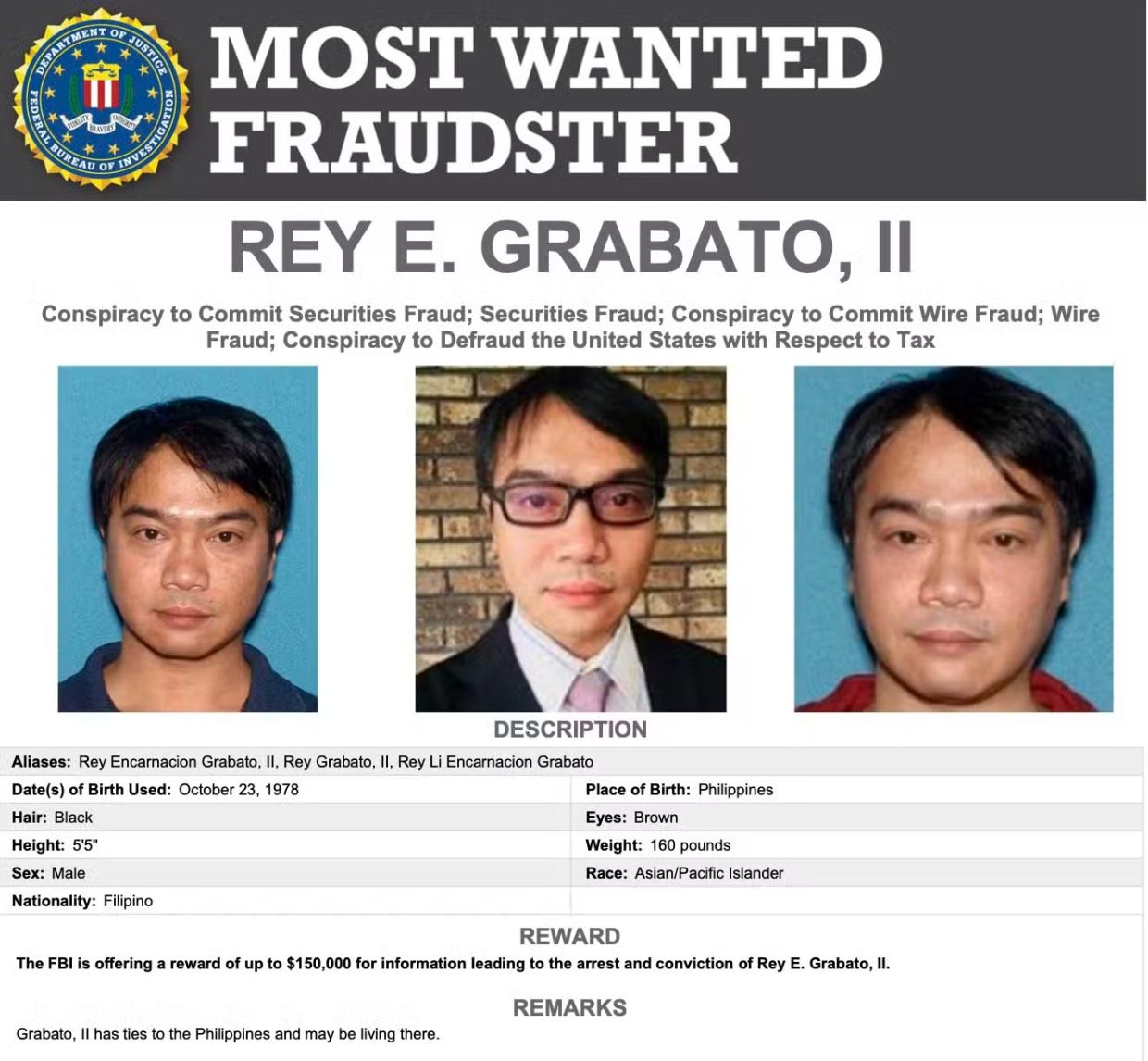
Rey E. Grabato II, whose father serves as mayor of Mina in Iloilo province, has become the latest high-profile fugitive to appear on the FBI's Most Wanted Fraudsters list. The 33-year-old is accused of orchestrating an elaborate scheme that authorities say defrauded roughly 2,000 investors of more than US$650 million through a fake real estate fund, with hundreds of victims concentrated in New Jersey. The FBI has posted a reward of up to US$150,000 for information leading to his capture and conviction, signalling the seriousness with which American law enforcement is pursuing the case.
Grabato's family has deep political roots in the Iloilo municipality. His father, Rey P. Grabato, currently holds the position of mayor, while his mother, Lydia Encarnacion Grabato, previously served in the same office. The family's prominent status in local governance has made Grabato's alleged crimes particularly noteworthy, raising questions about accountability and oversight within Philippine political families who maintain international business interests.
The alleged criminal enterprise centred on National Realty Investment Advisors LLC, or NRIA, where Grabato served as former president and majority owner. Working alongside alleged co-conspirator Thomas Nicholas Salzano, Grabato is accused of convincing investors to pour money into the NRIA Partners Portfolio Fund I LLC, marketed as a legitimate real estate investment vehicle. Federal prosecutors characterise the entire operation as a textbook Ponzi scheme designed to extract wealth from unsuspecting victims across North America.
The mechanics of the fraud reveal a sophisticated marketing strategy aimed at maximising investor recruitment. NRIA launched an aggressive nationwide campaign that saturated multiple media channels, deploying thousands of emails alongside television, radio, and billboard advertisements. The company also conducted investor presentations across numerous states, creating an appearance of legitimacy and financial stability. This multi-platform approach proved effective in attracting diverse demographics of potential investors, many of whom lacked the expertise to independently verify the fund's claims.
Investors were systematically misled about the fund's financial health and investment returns. Prosecutors allege that NRIA presented itself as a financially robust operation generating substantial profits, when in reality the company produced minimal revenue and operated on a classic pyramid structure. Money deposited by new investors was recycled to pay earlier participants, creating the illusion of returns while enriching the scheme's operators. This mechanism sustained the fraud for approximately four years before unravelling.
Beyond the primary investment fraud, Grabato stands accused of misappropriating millions of dollars in investor capital for personal use. Rather than deploying funds according to representations made to victims, prosecutors assert that significant sums were diverted for unauthorised purposes. This aspect of the charges demonstrates not merely incompetence or poor business judgment, but deliberate theft masked by fraudulent claims.
An additional layer of criminal liability stems from alleged efforts to obstruct the Internal Revenue Service. Grabato is accused of participating in a scheme running from November 2007 through August 2022 designed to prevent the IRS from collecting approximately US$26 million in outstanding tax obligations owed by the defendants. This tax obstruction component reveals how the scheme extended beyond investor fraud into deliberate attempts to evade government collection efforts.
The investigation culminated in federal charges filed in the US District Court for the District of New Jersey in Newark, with an arrest warrant issued on October 12, 2022. At that time, authorities identified Grabato as residing in Hoboken, New Jersey, with ties to the Philippines. His alleged co-conspirator Salzano was apprehended in October 2022, but Grabato managed to avoid capture and flee. Immigration authorities believe he has utilised multiple names to complicate tracking efforts, including Rey Encarnacion Grabato II, Rey Grabato II, and Rey Li Encarnacion Grabato.
Grabato joins an increasing cohort of individuals with Filipino connections appearing on law enforcement watch lists. The FBI Most Wanted Fraudsters list, established in June 2026 to highlight major fraud fugitives, now includes several other individuals with ties to the Philippines. Among them is Michael Lizaso Marasigan, a Filipino-American dual citizen with connections to both Guam and the Philippines, who was convicted in May 2025 on charges including illegal gambling, money laundering, and wire fraud. Additionally, the list features John Michael Dimitrion and his wife Julieanne Baldueza Dimitrion, who pleaded guilty to mortgage fraud in Hawaii in 2009 but failed to appear for sentencing in July 2010 and remain at large.
The inclusion of multiple Filipino-connected fugitives on federal most-wanted lists underscores growing concerns about cross-border financial crimes involving Philippine nationals. The sophisticated nature of these schemes, often involving international investment vehicles and coordinated marketing campaigns, suggests organised criminal networks rather than isolated bad actors. For Malaysian investors and business communities, these cases provide cautionary lessons about conducting thorough due diligence on international investment opportunities, particularly those promising unusually high returns with minimal risk.
The case raises broader questions about financial regulation and investor protection in Southeast Asia. Many regional investors, seeking international diversification, are vulnerable to schemes marketed through legitimate-appearing channels. The targeting of New Jersey-based investors with hundreds of additional victims scattered across the United States suggests that NRIA may have attempted similar operations in other jurisdictions. Malaysian regulators and the Securities Commission should remain vigilant against comparable schemes targeting local investors.
For those with information about Grabato's whereabouts, the FBI encourages contact through local field offices or the nearest US embassy or consulate. Given his alleged connections to the Philippines and possible movement through Southeast Asian channels, regional cooperation between law enforcement agencies remains essential for apprehension. The case demonstrates how financial crimes committed by individuals with political family connections can extend their impact globally, affecting thousands of ordinary investors across multiple countries.

