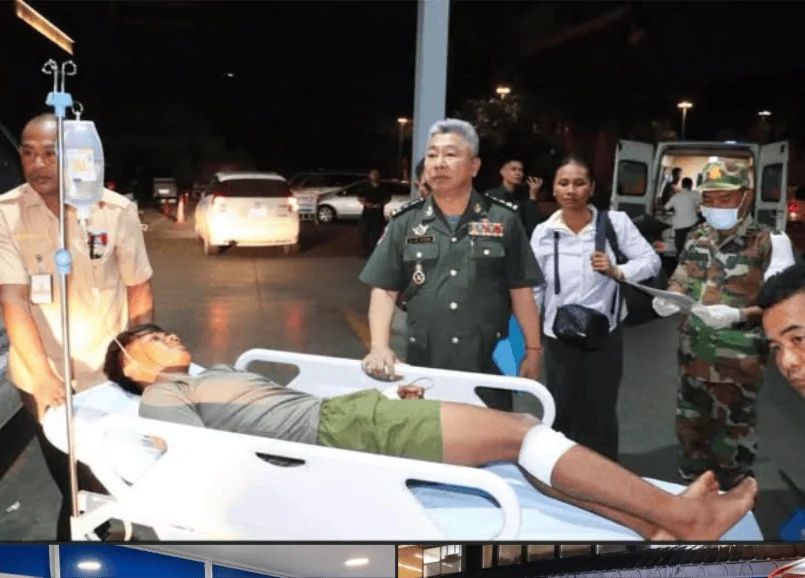
Cambodia's defence ministry confirmed Monday that a blast near the Thai frontier left four military personnel injured during a Sunday patrol operation, marking another incident in an area long troubled by residual ordnance and frontier tensions. The explosion occurred at 12:35 p.m. in a cashew plantation spanning Chouk Kruos and Thma Don villages within Oddar Meanchey province, according to Lieutenant General Maly Socheata, an undersecretary of state and spokeswoman for Cambodia's Ministry of National Defence.
The four wounded soldiers are receiving medical treatment from military healthcare teams and supporting personnel, Socheata confirmed in her statement. Details about the severity of their injuries or their current condition were not immediately disclosed by Cambodian authorities, though the fact that casualties required formal announcement suggests significant concern within the defence establishment.
Thailand's military promptly responded to developments, with Royal Thai Army spokesperson Winthai Suvaree clarifying Bangkok's position within hours of the incident. According to Suvaree, Thai forces conducting standard boundary patrols on their side of the frontier detected the explosion emanating from Cambodian territory but played no active role in triggering it. The Thai military explicitly stated that its units did not discharge weapons, deploy grenades, or undertake any offensive actions that could have caused the blast.
A formal investigation involving responsible Thai military units swiftly corroborated that the detonation occurred exclusively within Cambodian territory and resulted from causes unrelated to Thai operations. This rapid clarification reflects Bangkok's sensitivity to border incidents and the imperative to prevent escalation along a frontier marked by historical disputes and lingering Cold War-era ordnance.
The incident highlights the persistent danger posed by unexploded ordnance throughout Cambodia's border regions. Decades after the Cambodian-Thai conflict and the broader Indochina wars, vast areas of the countryside remain contaminated with mines, cluster munitions, and other explosives. Patrols in such zones, even during routine operations, carry inherent risks that neither side can fully eliminate despite sophisticated detection methods and protective protocols.
Oddar Meanchey province, where Sunday's blast occurred, has long been vulnerable to such incidents. The province borders multiple Thai districts and encompasses challenging terrain where enforcement of safety perimeters proves difficult. Agricultural activities, including cashew cultivation, frequently draw workers into areas where ordnance remains buried or concealed, creating recurring hazards for both civilian populations and military personnel.
For Malaysian observers and Southeast Asian security watchers, the incident underscores how historical legacies continue reshaping contemporary border management across the region. Cambodia-Thailand relations, though generally stable compared to earlier decades, remain sensitive to military incidents. Rapid communication and mutual clarification between Bangkok and Phnom Penh prevented misunderstandings that could otherwise inflame tensions, suggesting that both governments have developed functional mechanisms for managing frontier incidents.
The pattern of explosions along Cambodia's borders also reflects broader regional challenges in post-conflict reconstruction. Many Southeast Asian nations grapple with inherited ordnance problems that require sustained investment in demining operations, victim assistance, and institutional capacity-building. For Cambodia especially, these resources strain already-limited defence budgets, forcing choices between modernisation and hazard mitigation.
Regional observers note that transparent communication from both militaries in this instance represents progress. Thai authorities' immediate denial of involvement and Cambodia's acceptance of that assessment without escalatory rhetoric contrasts sharply with historical precedent, when border incidents often spiralled into diplomatic crises. The incident occurred without triggering wider security concerns or prompting emergency consultations between capitals.
Looking forward, the incident emphasises why continued international support for demining operations across Cambodia and other post-conflict zones remains strategically important for maintaining regional stability. The Association of Southeast Asian Nations has invested diplomatic energy in border dispute resolution, but technical challenges like unexploded ordnance transcend political frameworks and require sustained attention from development agencies, military specialists, and local governments.
For Myanmar, Thailand, Laos, and Cambodia—nations where similar contamination persists—cooperative regional approaches to ordnance remediation could yield significant returns in security and prosperity. The Sunday explosion, while minor in immediate impact, encapsulates larger questions about how Southeast Asia addresses inherited conflicts and their physical remainders, even as political relationships normalise and trade deepens.

