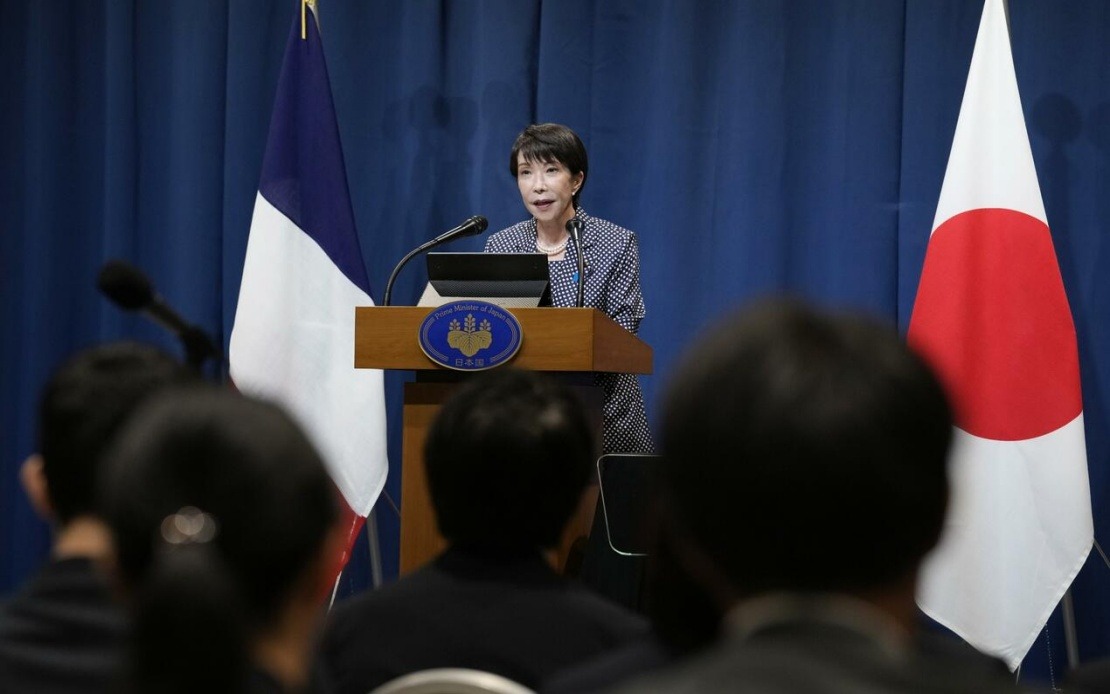
Prime Minister Sanae Takaichi's administration is facing mounting public disapproval, with cabinet support slipping to 55.8 per cent according to the latest Kyodo News survey, marking the lowest approval rating since she assumed office in October. The decline signals growing public anxiety over both domestic economic pressures and international security developments that threaten Japan's critical trade routes and economic stability.
The erosion of public confidence comes at a particularly delicate moment for Japan's political leadership, as the resource-dependent nation confronts overlapping challenges that directly impact household finances and broader strategic interests. The timing of the decline is especially significant given that it follows initial optimism when Takaichi first took the helm, suggesting that the early honeymoon period typical of new administrations has definitively ended. The loss of confidence among nearly half the electorate indicates fundamental concerns about policy direction and economic management rather than superficial political friction.
A critical factor weighing on public sentiment is sustained anxiety regarding Japan's economic vulnerabilities, particularly exposure to Middle East conflicts that could disrupt the flow of energy resources and commerce through vital shipping lanes. The Strait of Hormuz, through which enormous volumes of global oil passes annually, remains geopolitically fragile despite recent diplomatic developments. Japanese households, already stretched by persistent inflation eating into purchasing power, view any potential disruption to energy supplies with considerable concern, since Japan imports the vast majority of its energy needs and possesses virtually no domestic oil reserves.
When surveyed about potential military responses to regional instability, a clear majority of respondents rejected direct Japanese Self-Defence Forces involvement in Strait of Hormuz operations. The poll revealed that 54.7 per cent of respondents saw no necessity for deploying Japanese military assets to the waterway, while 36.6 per cent favoured such action. This sentiment reflects broader Japanese constitutional concerns about military engagement abroad, as well as practical doubts about whether such deployments would effectively address underlying security threats or simply increase Japan's exposure to regional conflicts without corresponding benefits.
The survey was conducted in the wake of a preliminary peace agreement between the United States and Iran that included provisions for Tehran to reopen the Strait of Hormuz, potentially easing acute concerns about passage restrictions. However, the persistence of public anxiety even after this diplomatic development suggests that Japanese voters harbour deeper concerns about long-term regional stability and their country's vulnerability to energy shocks. The preliminary nature of the accord, combined with historical precedent of Middle East tensions resurfacing unpredictably, leaves considerable uncertainty in the minds of the Japanese public about lasting resolution.
Domestic economic hardship remains the most immediate concern for most Japanese families, and this discontent directly translates to criticism of the government's policy response. Households struggling with elevated prices for basic goods and services view the government's fiscal measures as insufficient, creating an opening for opposition criticism. The administration faces persistent pressure to deliver tangible relief to ordinary citizens whose real purchasing power has eroded substantially over recent months. This financial squeeze affects savings rates, discretionary spending, and overall consumer confidence, creating a dampening effect across the broader economy.
Regarding specific tax policy solutions, the survey found that 43.9 per cent of respondents considered a reduction of the consumption tax on food and beverages from the current 8.0 per cent to 1.0 per cent to be an acceptable compromise, provided implementation could be accelerated. This represents the largest single preference among surveyed options, suggesting that public opinion is pragmatically focused on feasible solutions rather than holding out for ideal outcomes. An additional 22.6 per cent of respondents advocated for a complete elimination of consumption tax on food, aligning with campaign pledges made by Japan's ruling coalition parties.
The preference distribution on tax policy reveals important nuances about public priorities and political expectations. While nearly two-thirds of respondents favour some form of consumption tax reduction on essential food items, opinions diverge on the degree of relief necessary. The fact that most respondents accept partial rather than complete elimination suggests a degree of fiscal realism, yet the significant minority advocating for zero tax on food reflects the political promises made during previous election campaigns and the frustration that these commitments remain unfulfilled.
For regional observers in Southeast Asia, Japan's domestic political challenges carry broader implications for regional stability and economic cooperation. As the world's third-largest economy and a crucial partner in regional security arrangements, Japan's internal political weakness could affect its capacity to maintain consistent foreign policy engagement with ASEAN nations. Economic pressures at home may constrain Japan's ability to sustain infrastructure investment and development assistance programmes throughout Southeast Asia, while political uncertainty could delay decisions on regional trade and security initiatives that depend on Japanese participation.
The timing of this political vulnerability also intersects with broader regional dynamics around Middle East tensions and energy security. Japan's difficulties in managing public expectations about economic performance and geopolitical strategy may influence how it engages with other Asia-Pacific nations on questions of maritime security, energy diversification, and supply chain resilience. Countries across Southeast Asia depend substantially on Japanese technology, investment, and trade partnerships, making Japanese political stability a matter of regional concern.
Looking forward, Takaichi's administration faces pressure to demonstrate tangible progress on both economic relief and strategic clarity before public support erodes further. The specific focus on consumption tax adjustments indicates where political negotiations are likely to concentrate, and any successful implementation of tax relief could provide a modest recovery in approval ratings. However, fundamental concerns about inflation, energy security, and Japan's role in managing Middle East risks will likely persist until broader economic conditions improve and regional tensions stabilize. The challenge for Japanese leadership is restoring public confidence through concrete policy achievements rather than rhetorical reassurance.
%22%2F%3E%3C%2Fpattern%3E%3C%2Fdefs%3E%3Crect%20width%3D%22100%25%22%20height%3D%22100%25%22%20fill%3D%22url(%23ph3cdu7g)%22%2F%3E%3Crect%20width%3D%22100%25%22%20height%3D%22100%25%22%20fill%3D%22url(%23ph3cdu7p)%22%2F%3E%3Ctext%20x%3D%2250%25%22%20y%3D%2250%25%22%20text-anchor%3D%22middle%22%20dominant-baseline%3D%22central%22%20fill%3D%22rgba(255%2C255%2C255%2C0.95)%22%20font-family%3D%22Georgia%2C%20'Times%20New%20Roman'%2C%20serif%22%20font-weight%3D%22700%22%20font-size%3D%22320%22%20letter-spacing%3D%22-0.02em%22%3EData%3C%2Ftext%3E%3C%2Fsvg%3E)
%22%2F%3E%3C%2Fpattern%3E%3C%2Fdefs%3E%3Crect%20width%3D%22100%25%22%20height%3D%22100%25%22%20fill%3D%22url(%23ph1nj3dg)%22%2F%3E%3Crect%20width%3D%22100%25%22%20height%3D%22100%25%22%20fill%3D%22url(%23ph1nj3dp)%22%2F%3E%3Ctext%20x%3D%2250%25%22%20y%3D%2250%25%22%20text-anchor%3D%22middle%22%20dominant-baseline%3D%22central%22%20fill%3D%22rgba(255%2C255%2C255%2C0.95)%22%20font-family%3D%22Georgia%2C%20'Times%20New%20Roman'%2C%20serif%22%20font-weight%3D%22700%22%20font-size%3D%22151%22%20letter-spacing%3D%22-0.02em%22%3ETraveller%3C%2Ftext%3E%3C%2Fsvg%3E)