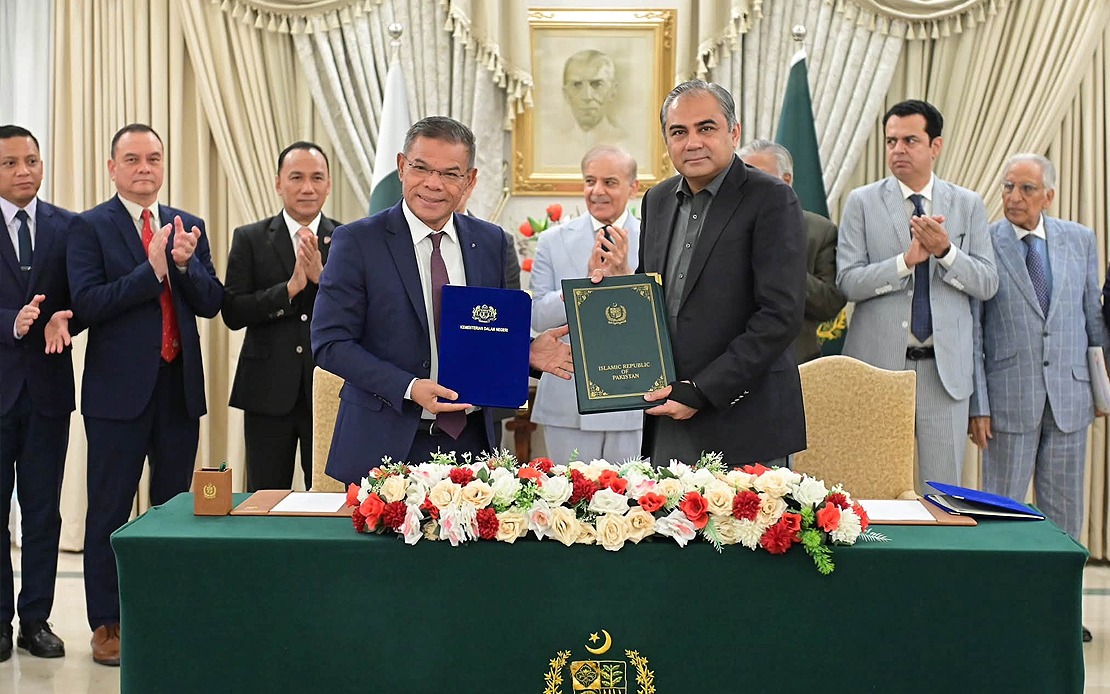
Malaysia and Pakistan have taken a significant step in deepening their bilateral relationship by formalizing the International Transfer of Prisoners (ITOP) treaty, a legal instrument designed to facilitate the movement of nationals between prison systems and enhance rehabilitation outcomes. The agreement was inked during a diplomatic visit by Malaysian Home Minister Datuk Seri Saifuddin Nasution Ismail to Pakistan, where he met with Interior and Narcotics Control Minister Syed Mohsin Raza Naqvi and Prime Minister Muhammad Shehbaz Sharif at the Prime Minister's Office in Islamabad. The ceremony underscores the two nations' commitment to addressing practical governance challenges that span across their borders.
The treaty represents the culmination of substantive negotiations that began in September 2025, involving multiple Malaysian government agencies tasked with justice and law enforcement matters. The Home Ministry worked in tandem with the Foreign Ministry, Attorney General's Chambers, Malaysian Prisons Department, and Royal Malaysia Police to shape the agreement's terms and operational mechanisms. This multi-agency approach reflects the complexity of prisoner transfer arrangements, which require coordination across diplomatic, legal, security, and correctional spheres. The Malaysian Cabinet formally endorsed the treaty on May 13, clearing the path for the formal signing ceremony that took place during Saifuddin Nasution's official visit to Islamabad.
Under the terms of the ITOP, Malaysian citizens currently incarcerated in Pakistani facilities may petition for repatriation to Malaysian prisons to complete their remaining sentences, while Pakistani nationals serving time in Malaysian correctional institutions gain similar rights to return home. This reciprocal arrangement addresses a long-standing issue in bilateral relations: the detention of nationals far from family support systems and cultural contexts that facilitate genuine rehabilitation. Rather than viewing prisoner transfers purely as administrative transactions, both governments recognize that incarceration in one's home country, surrounded by family networks and familiar social structures, creates a more conducive environment for personal reformation and successful reintegration into society.
The rehabilitation dimension of the treaty extends beyond mere proximity to family members. Prisoners transferred under the ITOP framework gain access to correctional programmes specifically designed within their own cultural and institutional contexts. Malaysian prisons operate under rehabilitation philosophies shaped by Malaysian law and penology, while Pakistani correctional facilities function within Pakistan's legal and social framework. When individuals serve sentences in foreign countries, they often face barriers to participation in rehabilitation programmes that may not align with their backgrounds or address the specific needs that led to their incarceration. By enabling transfers, the treaty allows inmates to engage with programmes that resonate more meaningfully with their circumstances, potentially improving outcomes for reintegration into their home communities upon release.
From a diplomatic perspective, the treaty signals Malaysia and Pakistan's intention to mature their relationship beyond traditional security cooperation frameworks. While both nations have longstanding defence and counterterrorism partnerships, the ITOP demonstrates a willingness to address humanitarian and practical governance concerns that affect ordinary citizens. Saifuddin Nasution characterized the agreement as "another important milestone in Malaysia-Pakistan bilateral relations, particularly in strengthening security and legal cooperation between the two countries," framing it within the broader architecture of institutional ties that link the two nations. Such legal instruments, while less visible than ministerial summits or military exercises, often prove durable because they address concrete operational needs and create standing mechanisms for cooperation.
The treaty's implications extend to broader Southeast Asian and South Asian contexts. Malaysia maintains substantial diaspora and labour migration connections with South Asia, including Pakistan. The existence of formal prisoner transfer mechanisms reduces diplomatic friction and provides Malaysian nationals abroad with concrete protections. Conversely, Pakistani citizens in Malaysia benefit from assurances that their incarceration will not consign them indefinitely to foreign prison systems. As labour mobility continues to characterize regional demographics, having such agreements in place becomes increasingly important for countries across both regions. The Malaysia-Pakistan model may encourage similar arrangements between other countries in Southeast Asia and South Asia, contributing to more systematized approaches to cross-border justice matters.
Operationally, implementing the ITOP requires establishing procedures for case review, assessment of transfer eligibility, and coordination between justice systems that operate under different legal traditions. Malaysian law, influenced by common law traditions and constitutional frameworks developed during the independence era, differs in structure from Pakistan's legal system. Both nations maintain distinct prison governance standards, rehabilitation methodologies, and sentencing frameworks. The treaty must therefore function as a bridge between these systems, creating mechanisms for determining which prisoners qualify for transfer, how remaining sentences will be calculated and served, and how ongoing care needs will be addressed. These technical details, while unglamorous, represent the true substance of effective bilateral cooperation.
The timing of the treaty's finalization reflects priority-setting within both governments regarding justice sector modernization. Malaysia's push for the agreement comes amid broader efforts to enhance coordination with neighbouring and regional partners on security matters. Pakistan, meanwhile, faces substantial prison overcrowding and resource constraints that make managing large foreign-national inmate populations challenging. For Islamabad, the treaty provides mechanisms to reduce strain on its correctional system by transferring Pakistani nationals back to their home jurisdiction. For Malaysia, the benefit lies partly in reciprocal arrangements but also in demonstrating commitment to humanitarian principles and modern penological practices that recognize the value of culturally-appropriate rehabilitation.
The agreement also carries symbolic importance for Malaysian-Pakistani relations at a moment when South Asia faces complex geopolitical dynamics and when Malaysia seeks to balance its engagements across the region. Pakistan remains significant to Malaysia for historical, religious, and strategic reasons, and demonstrating concrete institutional cooperation across multiple sectors reinforces the depth of bilateral ties. By putting in place legal frameworks that facilitate practical cooperation on prisoner matters, both nations signal that their relationship transcends ceremonial engagement and extends to the nitty-gritty work of making cross-border governance function smoothly.
Looking forward, the ITOP will require careful administration by prison authorities and justice officials in both countries. Success will depend on establishing clear protocols for transfer requests, maintaining transparent communication between Malaysian and Pakistani correctional administrations, and ensuring that transferred prisoners receive appropriate support during transitions. The treaty also creates opportunities for knowledge-sharing between penal systems; Malaysian prison officials may learn from Pakistan's experiences managing large inmate populations, while Pakistani counterparts might benefit from insights into Malaysia's rehabilitation programming. Over time, the practical operation of the treaty will likely generate lessons applicable to Malaysia's relationships with other countries and contribute to the gradual development of more sophisticated regional approaches to transnational justice challenges.

