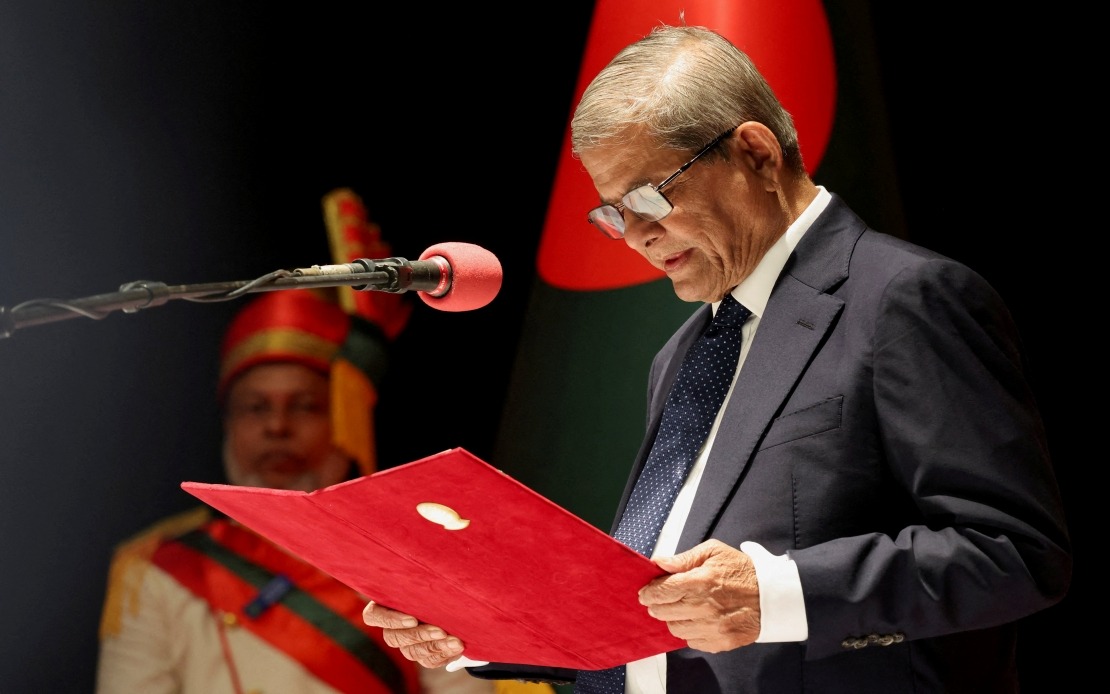
Mirza Fakhrul Islam Alamgir formally took the oath of office as Bangladesh's 23rd President on Friday evening, concluding a constitutional process that solidified his election by parliament. The ceremony unfolded at the Darbar Hall of Bangabhaban at 7.30 pm, with Acting Speaker Barrister Kayser Kamal presiding over the administration of the oath. The proceedings represented a pivotal moment in Bangladesh's political trajectory, bringing one of the nation's most established political figures into the ceremonial head of state role.
The swearing-in ceremony drew an imposing assembly of the country's institutional leadership. Prime Minister Tarique Rahman attended alongside the chief justice, cabinet ministers, members of parliament, and senior officials from both the civil and military establishments. The presence of foreign diplomatic representatives underscored the international dimension of the occasion, reflecting Bangladesh's engagement with the global community at a moment of domestic political change.
Fakhrul's ascension to the presidency carries particular weight given his standing within Bangladeshi political circles. As a former secretary-general of the Bangladesh Nationalist Party (BNP), one of the nation's two dominant political organisations, he brings decades of political experience and institutional knowledge to the role. His trajectory through senior party positions has positioned him as a bridge figure between different eras of Bangladesh's turbulent political history, which has witnessed multiple constitutional transitions and changes of government.
The ceremonial transfer of office followed traditional constitutional protocol. Acting President Hafiz Uddin Ahmad Bir Bikram formally received Fakhrul upon his arrival at Bangabhaban, the official presidential residence. After the oath administration, the two leaders exchanged their respective seats, a symbolic enactment of the transfer of executive responsibility embedded in Bangladesh's presidential system. Fakhrul subsequently signed both the oath of office and the oath of secrecy, formalising his legal obligations to the Constitution and the nation.
The election of Fakhrul through parliamentary vote reflects Bangladesh's constitutional framework, which vests presidential selection in the national legislature rather than direct popular election. This mechanism, common in parliamentary democracies across South Asia, concentrates the selection process within the body of elected representatives, though the presidency itself carries primarily ceremonial powers in Bangladesh's system of government. The parliamentary route to his election demonstrated institutional consensus among legislators regarding his suitability for the largely ceremonial but symbolically significant position.
For Malaysian observers and the broader Southeast Asian region, Fakhrul's presidency signals Bangladesh's continuation of constitutional governance despite the nation's history of political turbulence. Bangladesh remains a significant economic and geopolitical actor in South Asia, with important trade relationships and regional security implications. The smooth transition to new presidential leadership demonstrates the functioning of democratic institutions, albeit within a system where real executive authority rests with the prime minister and cabinet rather than the ceremonial president.
The BNP connection carries particular relevance for understanding Bangladesh's political landscape. The party, founded by former military ruler Ziaur Rahman, has alternated power with the Awami League throughout Bangladesh's democratic period since 1991. Fakhrul's elevation to the presidency, despite his party's relationship to executive authority, reflects the current balance of political forces and the pragmatic distribution of high offices among competing political camps. His appointment suggests ongoing negotiations and accommodations among political elites regarding the distribution of state positions.
The national anthem that concluded the ceremony represented the constitutional completion of Fakhrul's assumption of office. This formal musical conclusion encapsulated the transformation from candidate to sitting president, marking the point at which his constitutional powers and responsibilities became operative. The ceremony thus functioned both as a practical transfer of administrative authority over the office and as a public legitimation of the new president's mandate before the nation and international observers.
For Bangladesh's external relations, Fakhrul's presidency may influence diplomatic protocols and representation at the state level. As the ceremonial head of state, the president embodies Bangladesh before the international community in certain formal capacities, receiving foreign dignitaries and participating in state functions that reinforce bilateral relationships. His political background and international exposure will shape Bangladesh's ceremonial diplomacy during his tenure, though substantive foreign policy decisions remain the prerogative of the prime minister and foreign ministry.
The transition also reflects Bangladesh's broader institutional resilience during a period of significant political change. The nation has navigated complex political transitions previously, and the orderly conduct of this presidential election and oath-taking ceremony demonstrates the functioning of constitutional mechanisms despite historical instances of political instability. This institutional continuity holds importance for regional stability and Bangladesh's standing among democratic nations in South Asia, where constitutional governance faces periodic challenges.
Fakhrul's tenure begins with Bangladesh facing multifaceted development challenges, including managing economic growth, addressing climate vulnerability, and navigating regional geopolitical shifts. While the presidency carries limited executive authority, the symbolic role carries weight in Bangladesh's political culture and international standing. His position as a respected senior politician may lend stability and legitimacy to state institutions during a period when Bangladesh continues to strengthen its democratic institutions and constitutional frameworks.

