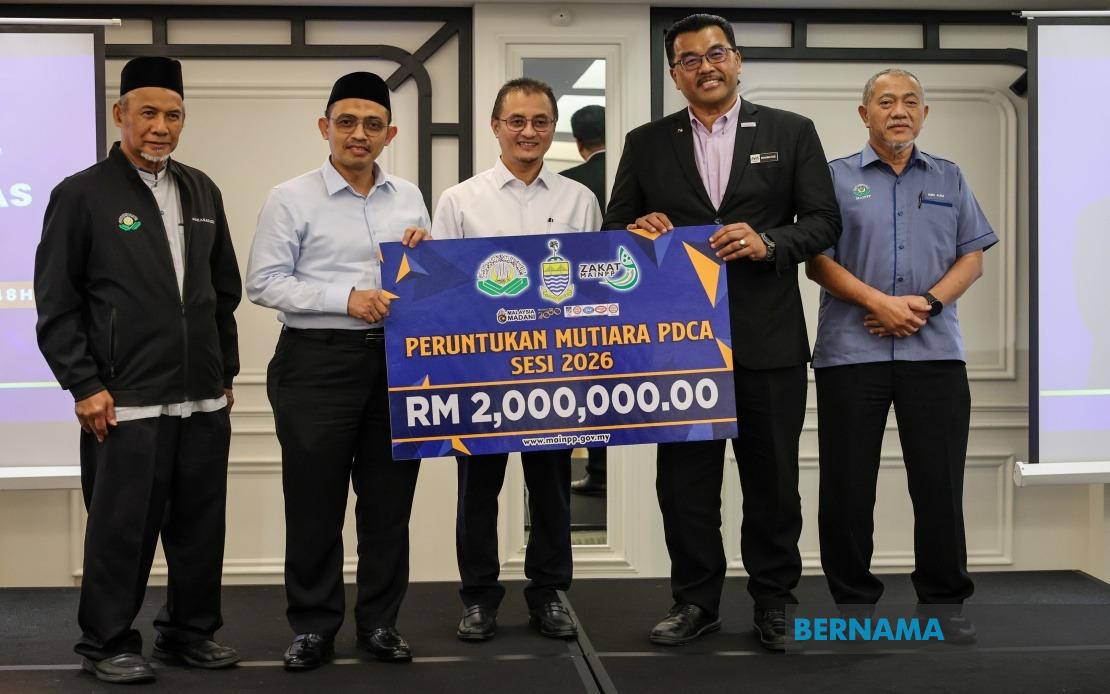
The Penang State Islamic Religious Council (MAINPP) has earmarked RM2 million to fund the Mutiara Didik Cemerlang Akademik (MPDCA) programme for 2026, providing comprehensive academic support to over 7,400 Bumiputera pupils and students throughout the state. The funding announcement, made by Penang Deputy Chief Minister I Datuk Dr Mohamad Abdul Hamid at a coordinating teachers' briefing in Kepala Batas, underscores the council's sustained commitment to elevating educational outcomes among disadvantaged communities through targeted intervention and structured learning frameworks.
The RM2 million allocation will be distributed across a range of educational initiatives designed to address foundational learning gaps and prepare students for critical examination milestones. These interventions include subsidised tuition classes, systematically developed learning modules, academic seminars focused on subject mastery, and practical workshops teaching effective examination technique and answering strategies. By channelling resources into these specific areas, MAINPP aims to create a holistic support ecosystem that extends beyond classroom instruction to equip students with the confidence and skills necessary to perform well in formal assessments.
The MPDCA programme, established in 2006, represents a collaborative effort spanning multiple government bodies and state institutions. MAINPP works alongside the Penang State Education Department (JPNPP), the Penang Bumiputera Participation Coordination Division under the Prime Minister's Department Implementation Coordination Unit, and the Penang Regional Development Authority (PERDA). This multi-agency partnership reflects recognition that sustained educational improvement requires coordinated action across financial, administrative, and pedagogical dimensions, with each organisation contributing distinct expertise and resources to programme delivery.
For the 2026 academic year, the programme will engage 698 coordinating teachers across 109 schools comprising 71 primary and 38 secondary institutions. This extensive network of trained educators ensures consistent quality delivery and allows the programme to maintain regular contact with participating students and their families. The scale of this teaching infrastructure demonstrates that MAINPP's commitment extends beyond symbolic funding gestures to substantial institutional investment in human resources capable of delivering personalised academic guidance and monitoring student progress over extended periods.
Curriculum coverage under the MPDCA initiative reflects careful alignment with national examination frameworks and learning standards. Year Six pupils receive focused tuition in four foundational subjects—Bahasa Melayu, English, Mathematics, and Science—which form the bedrock of subsequent academic achievement. For students preparing for the Sijil Pelajaran Malaysia (SPM) examination, the programme expands to encompass thirteen subjects spanning languages, sciences, social studies, and religious studies, including Bahasa Melayu, History, English, Mathematics, Science, Arabic, Additional Mathematics, Physics, Chemistry, and Biology. Additionally, the initiative incorporates three Integrated Dini Curriculum subjects for government-aided religious schools, namely Dini-Lughatul Arabiyyah Mu'asirah (LAM), Dini-As Syariah, and Dini-Usuluddin, ensuring religious educational pathways receive equal support.
Data compiled by JPNPP since the programme's inception in 2006 indicates measurable positive impact on participating students' academic trajectories and achievement levels. While the announcement does not specify precise performance metrics, the programme's continuation and expansion suggest sustained institutional confidence in its efficacy. For educational administrators and policymakers across Southeast Asia, this two-decade track record offers empirical validation that targeted, free tuition programmes can generate meaningful improvements when implemented with adequate teacher coordination and curriculum development resources.
The RM2 million educational investment forms part of MAINPP's broader budgetary commitment to human capital development within Penang's Muslim and Bumiputera communities. In parallel with MPDCA funding, the council has allocated RM22.36 million for Higher Education Bursaries enabling Bumiputera students to access tertiary education, RM6.3 million for the Permulaan IPT Scheme supporting the transition to higher education, RM3 million for Early Schooling Aid assisting young learners' foundational years, and RM3 million for School Uniform Aid removing financial barriers to school attendance. Combined, these allocations totalling over RM36 million represent a comprehensive progression pathway addressing educational needs from early childhood through university completion.
Teachers implementing the programme report substantial benefits for participating students, particularly those from economically disadvantaged backgrounds. Hartina Arjan, a Bahasa Melayu instructor at Sekolah Kebangsaan Permai Indah in Bukit Minyak, emphasises that MPDCA's systematically designed learning modules facilitate targeted skill development in speaking, reading, and writing proficiency. These modules specifically prepare students for Classroom-Based Assessment (PBD) and end-of-year evaluations, translating classroom learning into improved assessment performance. The free access provided by MPDCA proves transformative for academically diverse cohorts who might otherwise lack exposure to structured revision resources.
Teachers working within lower-income school communities have documented particular programme benefits for families unable to afford private tuition fees, which constitute significant financial burdens for households operating on limited incomes. Sadiah Roslan from Sekolah Rendah Islam Al-Masriyah Halimatun in Bukit Mertajam notes that interactive teaching approaches incorporating quiz-based activities and updated instructional materials have demonstrably increased student engagement and classroom participation. The pedagogical innovation embedded within MPDCA delivery—moving beyond traditional lecture formats to incorporate contemporary educational techniques—amplifies learning effectiveness beyond what basic content repetition alone could achieve.
The MPDCA programme's expansion and funding continuation warrant attention from Malaysian and regional policymakers examining cost-effective approaches to educational equity and social mobility. By concentrating resources on evidence-based, teacher-coordinated tuition targeting students at critical examination junctures, MAINPP has developed a replicable model balancing fiscal responsibility with demonstrable educational outcomes. As Malaysia navigates the transition toward higher-skilled workforce requirements, programmes that systematically reduce achievement gaps among disadvantaged Bumiputera populations directly contribute to national economic competitiveness and social cohesion objectives.
Looking forward, the programme's 2026 implementation will provide additional data regarding the efficacy of structured academic support within increasingly diverse classroom environments. With participation exceeding 7,400 students across primary and secondary sectors, the scale of MPDCA's reach positions it as a significant component of Penang's educational equity infrastructure. As other Malaysian states and Southeast Asian nations contemplate similar interventions, MAINPP's sustained investment and documented outcomes offer a credible foundation for expanded replication and policy learning.

