For most people, sunlight is simply a natural cycle—something present and taken for granted. Yet for Penang-based artist Puteri Mas Aishah Ramyusnali, the sun's rays have become a fundamental creative tool, one that transforms ordinary leaves, flowers, and objects into striking blue compositions that speak to our connection with the natural world. At just 24 years old, the Master of Fine Arts and Technology student at Universiti Teknologi MARA has spent the past three years developing her practice in cyanotype, a centuries-old photographic process that relies entirely on ultraviolet light to create images. Her journey represents a growing movement among contemporary artists who are rediscovering analog and light-dependent techniques as a means of fostering deeper environmental consciousness.
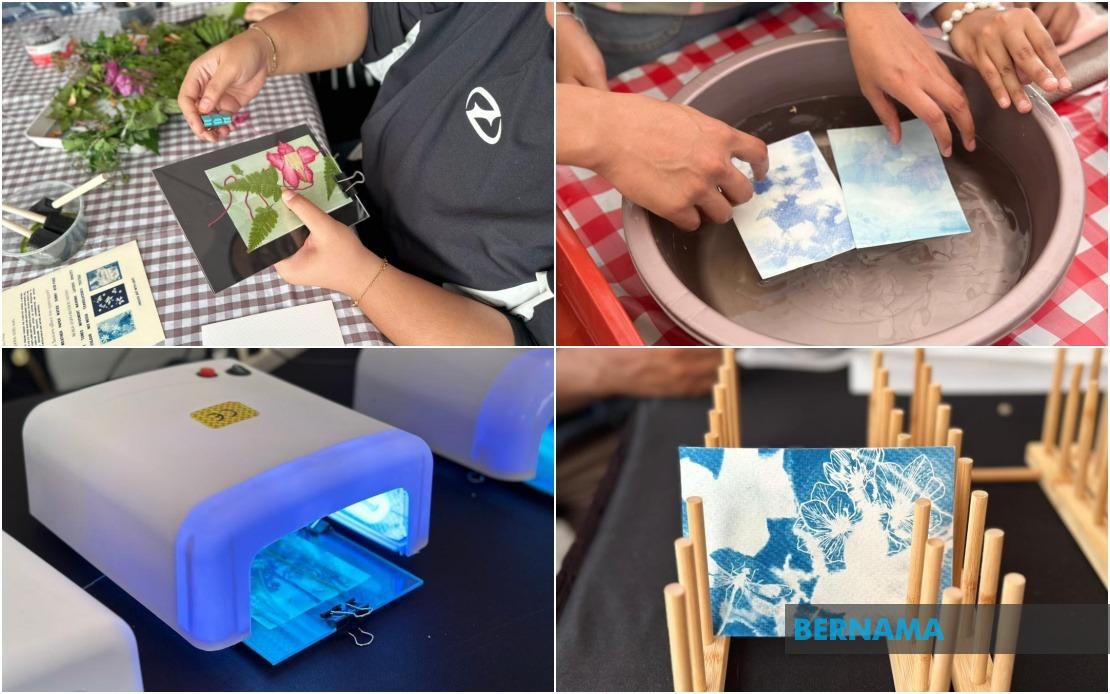
Cyanotype's mechanics reveal the intimate dance between human intention and natural forces. The process begins when paper is coated with a light-sensitive chemical solution and arranged with botanical specimens or other objects. Once exposed to sunlight for approximately 10 to 15 minutes, the ultraviolet rays initiate a chemical reaction that gradually fixes the composition onto the paper. After the objects are removed, the print is washed in a sequence of acidic and alkaline solutions, during which the characteristic prussian blue image emerges with a slow, almost meditative revelation. This patient unfolding of the final image mirrors the gradual awakening to environmental awareness that Puteri Mas Aishah hopes her work will inspire in viewers.
What distinguishes cyanotype as a creative practice is its absolute dependence on meteorological conditions—a reality that forces the artist into constant dialogue with weather patterns and atmospheric variables. The intensity of ultraviolet exposure fluctuates significantly based on cloud cover, seasonal variations, and time of day, each variation leaving its distinct fingerprint on the finished work. Puteri Mas Aishah has learned to treat these conditions not as obstacles but as collaborators, acknowledging that higher UV levels produce more vivid and concentrated blues, while diffuse light from overcast skies yields softer, more delicate tones. This attentiveness to environmental factors has fundamentally reshaped how she conceptualizes the creative act itself—no longer viewing art-making as an isolated studio practice but as a negotiation between human vision and the natural world's unpredictable interventions.
The artist's introduction to cyanotype occurred during her industrial training period, when she first encountered the technique and recognized its potential as both a personal artistic pursuit and a pedagogical tool. Her initial hesitation about leading public workshops without direct supervision from faculty members gradually transformed into confidence as she engaged with participants and witnessed their own moments of discovery. These workshops, which she has since conducted in collaboration with various galleries and art studios throughout Shah Alam, Selangor, have become platforms where audiences actively participate in creating their own cyanotype prints, demystifying what often appears to be an esoteric artistic practice and making it accessible to diverse communities.
For Malaysian audiences particularly, cyanotype's growing visibility carries significance beyond purely aesthetic considerations. Southeast Asia's tropical climate presents both advantages and challenges for the technique: the region's abundant sunlight enables rapid exposure times, yet intense humidity and unpredictable monsoon patterns demand substantial experimentation and adaptation. Artists working with cyanotype in Malaysia are effectively pioneering a localized dialogue with the medium, developing methodologies tailored to equatorial conditions rather than simply importing European or North American approaches. Puteri Mas Aishah's work exemplifies this localization, as her practice remains rooted in Penang's specific environmental characteristics and seasonal rhythms.
Beyond technical proficiency, Puteri Mas Aishah's artistic vision advocates for a reconceptualization of how society values creative practices. She articulates a concern that persists across Malaysia and the broader region: the tendency to dismiss art as peripheral to practical concerns, as ornamentation rather than essential knowledge. Her intervention—positioning cyanotype as a medium through which people can develop environmental literacy and recognize their interdependence with natural systems—challenges this utilitarian dismissal. By making the invisible visible, cyanotype renders apparent the fundamental forces and materials we habitually ignore, encouraging viewers to attend more carefully to atmospheric conditions, seasonal changes, and the delicate equilibriums that sustain life.
The environmental implications of Puteri Mas Aishah's artistic practice deserve sustained attention. While cyanotype is often celebrated as an ecologically conscious technique—it requires no electricity and minimal chemical inputs compared to conventional darkroom photography—the medium's deeper contribution lies in its capacity to cultivate what might be termed ecological consciousness. Through workshops and public engagements, participants confront the reality that their creative outcomes depend fundamentally on factors beyond individual control: today's cloud cover, this month's rainfall patterns, seasonal variations in solar intensity. This experiential understanding fosters a more humble, attentive relationship toward environmental systems, potentially translating into more thoughtful environmental citizenship.
The RIUH Pi HAWANA Carnival at the PICCA Convention Centre in Butterworth, where Puteri Mas Aishah recently conducted a cyanotype workshop, represents precisely the kind of public cultural engagement that builds broader appreciation for experimental art forms. Festival contexts offer opportunities for casual encounters with artistic practices that participants might never deliberately seek out, creating moments where curiosity can flourish. For young people in particular, encountering cyanotype in such settings can catalyze recognition that art exists not as a specialized professional domain but as a legitimate means of engaging with pressing contemporary concerns, including environmental sustainability and humanity's role within ecological networks.
Moving forward, Puteri Mas Aishah's vision extends beyond personal artistic development toward genuine cultural transformation. Her hope that young people will increasingly perceive art as a vehicle for environmental connection rather than mere aesthetic commodity speaks to a broader reimagining of what art can accomplish. In Malaysia's context, where rapid industrialization and urbanization have often overshadowed conversations about environmental stewardship, artists like Puteri Mas Aishah offer alternative frameworks for understanding development, creativity, and human flourishing. By working with sunlight and botanical matter, she reminds us that the most powerful artistic statements often emerge not from rejection of nature but from profound attentiveness to its rhythms and patterns.