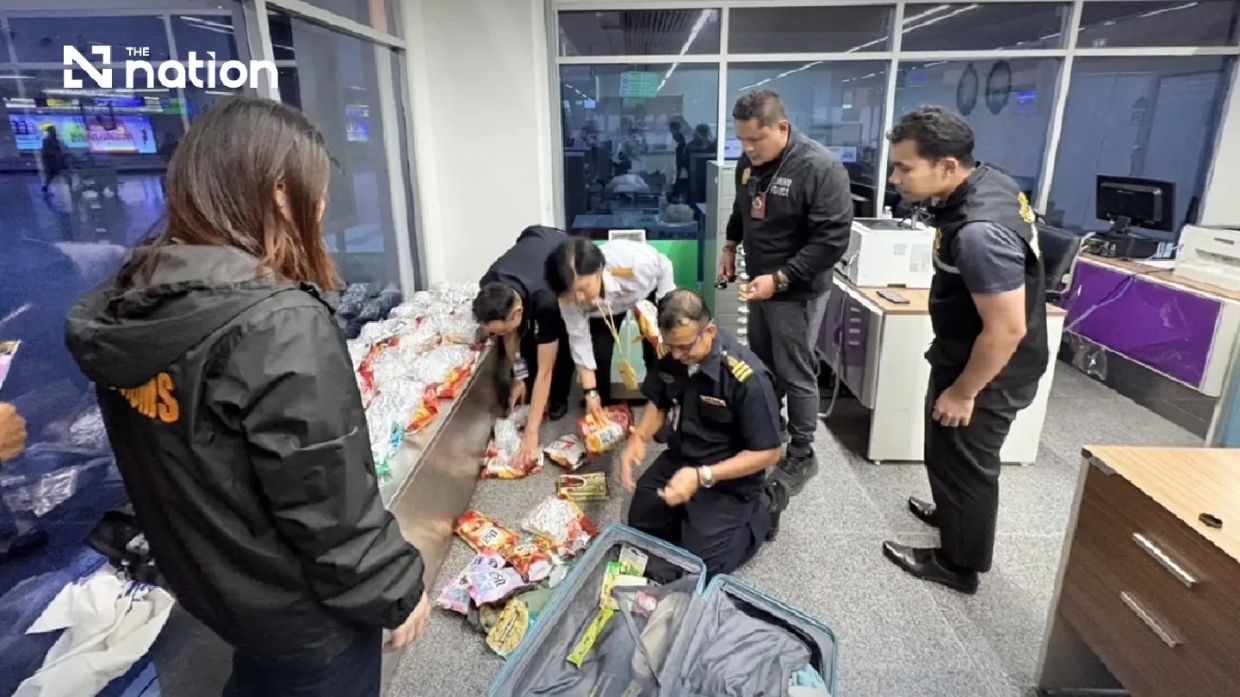
A Russian national was apprehended at Phuket International Airport on Wednesday as he prepared to depart Thailand, following the discovery of a substantial cache of cannabis concealed within his checked baggage. The seizure represents a significant drug trafficking interdiction at one of Southeast Asia's busiest holiday destinations and underscores the region's ongoing struggle with organised narcotics smuggling through major transportation hubs.
Customs authorities intercepted 30-year-old Sergei Chalabari during routine screening procedures at the airport's international departure terminal in Mai Khao subdistrict, Thalang district. The inspection of two blue BP WORLD wheeled suitcases, which together weighed only 8 kilogrammes despite their smuggled contents, revealed an elaborate concealment operation spanning multiple vacuum-sealed packages distributed throughout the luggage.
The contraband haul totalled 17.6 kilogrammes, comprising two distinct cannabis products commonly trafficked through Asian airports. Officers discovered 35 vacuum-sealed packages of cannabis flowers weighing 11.4 kilogrammes in aggregate, alongside 12 additional packages of cannabis resin totalling 6.2 kilogrammes gross weight. The methodical packing suggested preparation by individuals experienced in airport security evasion techniques, with the vacuum-sealing approach designed to minimise detection by drug-sniffing dogs and sophisticated screening equipment increasingly deployed at international terminals.
During preliminary interrogation, Chalabari acknowledged ownership of both the suitcases and all seized materials, providing authorities with a straightforward admission that simplified the evidentiary foundation for prosecution. His cooperation during initial questioning, whether voluntary or otherwise, established clear possession and intent markers essential for mounting charges under Thailand's stringent narcotics legislation.
Thai customs and police authorities charged the suspect with attempted smuggling of goods across international borders without proper declaration or customs clearance. This particular charge reflects Thailand's comprehensive approach to drug interdiction, treating the attempted export of controlled substances as seriously as importation offences. The legal framework governing such cases carries substantial penalties, with conviction typically resulting in extended imprisonment and substantial fines for foreign nationals.
The operation coordinated multiple agencies within Thailand's law enforcement hierarchy, demonstrating the collaborative approach authorities employ at major transit points. Pol Col Salan Sankhisasanakun, superintendent of Sakhu Police Station, oversaw the broader investigation framework, while Pol Lt Col Rattanawut Nukaew directed investigative procedures. Customs leadership including Nucha Jeeradit, chief of the Phuket Airport Customs House, and Thanomjit Burirak, director of the customs control division, coordinated the initial seizure operations.
Chalabari was transferred to Sakhu Police Station for continued detention and formal processing through Thailand's criminal justice system. Pol Capt Chaphinya Surithamkul, serving as deputy investigation inspector, assumed responsibility for advancing the case toward prosecution. The coordination between airport customs, local police, and national narcotics enforcement reflects institutional procedures refined through years of combating drug trafficking at Phuket's international facility.
Phuket International Airport serves as a critical nexus in global aviation networks, welcoming nearly 10 million annual passengers pre-pandemic and functioning as a gateway for substantial Thai tourism revenue. This makes the facility particularly attractive to international drug trafficking networks seeking to exploit passenger volume and the complexity of managing security at high-traffic terminals. Russian nationals have previously featured in significant drug trafficking cases throughout Southeast Asia, with the region's perceived accessibility and geographical proximity to major production centres in the Golden Triangle making it a strategic transhipment zone.
The seizure highlights Thailand's commitment to international drug enforcement cooperation, particularly relevant given the Kingdom's strategic importance along major trafficking corridors connecting production zones in Myanmar and Laos with consumer markets in Europe, Australia, and North America. Cannabis remains a lower-priority enforcement target compared to methamphetamine or heroin in Southeast Asian contexts, yet authorities maintain rigorous interdiction protocols at international borders recognising the substance's increasing commodification within global illicit markets.
For Malaysian observers, the incident reinforces that regional airports and border checkpoints remain focal points for transnational crime networks seeking to move contraband through Southeast Asia. Malaysia's own ports and airports have experienced comparable cannabis seizures involving foreign nationals, suggesting coordinated smuggling operations targeting multiple regional transit hubs simultaneously. Enhanced cooperation between ASEAN nations' customs and law enforcement agencies, alongside investment in advanced screening technologies, continues shaping responses to evolving smuggling methodologies.
The case also demonstrates how even modest-weight shipments can represent significant commercial trafficking operations when disaggregated across multiple travellers or transit routes. Criminal syndicates frequently utilise distributed smuggling networks where individual couriers carry smaller quantities, reducing individual risk exposure while maintaining aggregate trafficking volume. Chalabari's solo operation with 17.6 kilogrammes suggests either exceptional operational confidence or potential compartmentalisation within a larger smuggling enterprise whose full scope remains unknown to investigating authorities.

