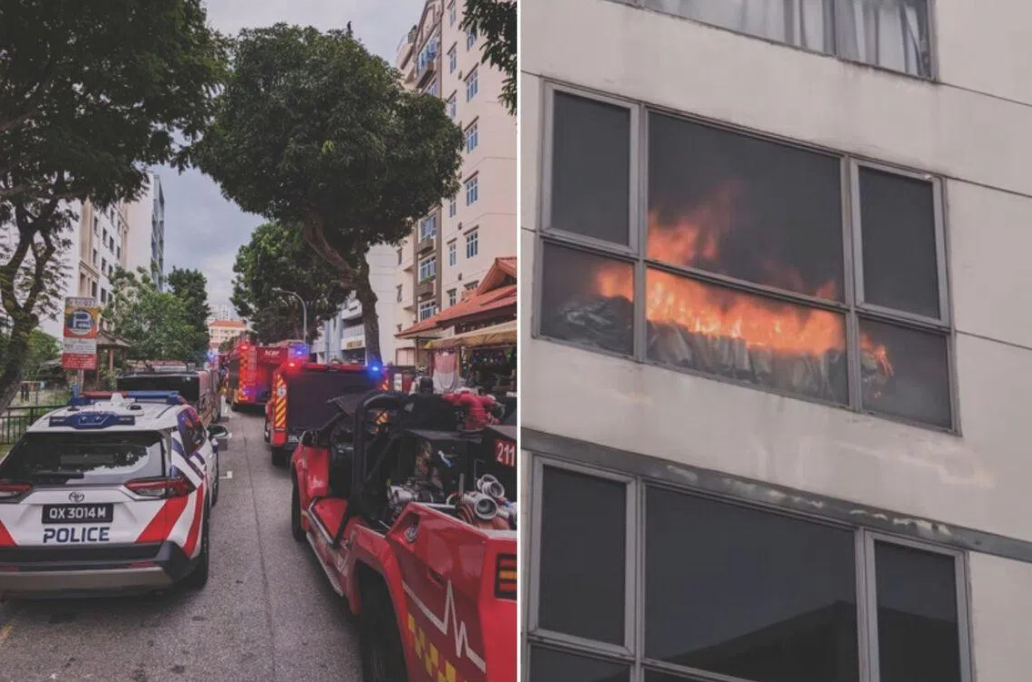
Five residents were forced to evacuate from a residential unit in Singapore's Geylang district after a power-assisted bicycle battery caught fire while charging unattended on Sunday evening. The Singapore Civil Defence Force received the emergency call at 5.35pm from 9 Lorong 26 Geylang, identified as Casa Aerata condominium, and swiftly responded to contain what could have escalated into a serious incident affecting the entire complex. The evacuation, carried out jointly by police and SCDF personnel as a precautionary measure, proceeded without injury to any of the residents involved, though the incident underscores growing concerns about battery-related fires in high-density residential buildings across the region.
The fire originated in the living room of a seventh-floor unit where the power-assisted bicycle battery was being charged without supervision. SCDF personnel deployed a hosereel and compressed air foam backpack to extinguish the blaze, containing the damage before it could spread to adjacent units or cause structural harm to the building. The preliminary investigation attributed the fire to an electrical fault originating from the power-assisted bicycle itself, highlighting a particular vulnerability in the design or manufacturing of such devices, especially when combined with residential charging practices.
The incident drew attention from local political leadership, with Bishan-Toa Payoh GRC Member of Parliament Cai Yinzhou arriving at the scene after observing smoke and hearing emergency sirens in the neighbourhood. He documented how residents below the burning unit were evacuated in anticipation of window damage from the intense heat, which eventually occurred as the temperature inside the seventh-floor room continued to climb. This rapid response from both formal emergency services and community-aware leadership prevented what could have been a more dangerous situation involving falling debris or secondary injuries.
In response to the incident, the SCDF has reiterated critical safety guidance regarding active mobility devices, a category that includes power-assisted bicycles and personal mobility devices. The authority specifically cautioned the public against purchasing or using non-original batteries as replacements for their active mobility devices, as these counterfeit or third-party batteries often lack proper safety mechanisms and quality control standards. This warning carries particular significance for Malaysian consumers, many of whom purchase such devices through online platforms where battery authenticity cannot always be verified before purchase.
The charging practices associated with these batteries represent another major risk factor. The SCDF explicitly advises against leaving power-assisted bicycle or personal mobility device batteries charging for extended periods or overnight, practices that are unfortunately common among users who charge devices at home without direct supervision. The combination of unattended charging, inadequate ventilation in living spaces, and potentially faulty batteries creates a perfect storm for electrical fires that can spread rapidly through residential units before occupants can safely evacuate.
Statistical data from Singapore's emergency response agencies reveals the evolving nature of this hazard. In 2025, the SCDF documented 304 electrical fires across residential premises, with 34 of these specifically involving active mobility devices including power-assisted bicycles and personal mobility devices. While the overall number of active mobility device fires showed a decline from 67 cases in 2024 to 49 cases in 2025, personal mobility device fires bucked this trend by increasing from 25 cases to 31 cases over the same period, suggesting that certain categories within this technology group pose escalating risks.
For Southeast Asian readers, particularly those in Malaysia where the adoption of e-bikes and electric scooters has surged in recent years, the Singapore experience carries sobering lessons about urban fire safety. Malaysian residential buildings, especially older apartment complexes and condominiums in densely populated areas, may face similar vulnerabilities if battery safety standards and user practices are not prioritized. The incident at Casa Aerata demonstrates that modern convenience technologies can pose unexpected hazards when integrated into older residential infrastructure not specifically designed to accommodate the thermal and electrical characteristics of lithium-ion batteries.
The reliance on unattended charging stems partly from the lifestyle demands of urban commuters who charge devices overnight or while at work, behaviour that is difficult to change without cultural shifts and improved alternative charging infrastructure. Public charging stations with proper ventilation, fire suppression systems, and monitoring would reduce the need for in-home charging, but such infrastructure remains limited in most Southeast Asian cities. The gap between technological adoption and safety infrastructure creates a period of heightened risk that regulators across the region must address proactively.
Manufacturers and retailers of power-assisted bicycles and personal mobility devices bear responsibility for ensuring that only original, certified batteries reach consumers, yet enforcement of these standards remains inconsistent across Southeast Asia. The proliferation of counterfeit batteries in regional markets undermines safety efforts by providing cheaper alternatives that consumers may not realize lack essential protective circuits. Education campaigns targeting both retailers and end-users have become essential components of fire prevention strategies in Singapore and should be replicated in other regional markets before incidents similar to the Casa Aerata fire become commonplace.
The broader implication of this incident is that the transition to personal electric mobility requires parallel investments in safety systems, charging infrastructure, and consumer awareness. Regulatory bodies in Malaysia should examine Singapore's experience and consider implementing similar warnings about non-original batteries and unattended charging. Building owners and residents associations must also take responsibility for establishing safe charging protocols within residential complexes, potentially designating specific areas with proper ventilation for battery charging rather than allowing residents to charge devices throughout living spaces.

%22%2F%3E%3C%2Fpattern%3E%3C%2Fdefs%3E%3Crect%20width%3D%22100%25%22%20height%3D%22100%25%22%20fill%3D%22url(%23ph1g6lig)%22%2F%3E%3Crect%20width%3D%22100%25%22%20height%3D%22100%25%22%20fill%3D%22url(%23ph1g6lip)%22%2F%3E%3Ctext%20x%3D%2250%25%22%20y%3D%2250%25%22%20text-anchor%3D%22middle%22%20dominant-baseline%3D%22central%22%20fill%3D%22rgba(255%2C255%2C255%2C0.95)%22%20font-family%3D%22Georgia%2C%20'Times%20New%20Roman'%2C%20serif%22%20font-weight%3D%22700%22%20font-size%3D%22194%22%20letter-spacing%3D%22-0.02em%22%3EBersatu%3C%2Ftext%3E%3C%2Fsvg%3E)