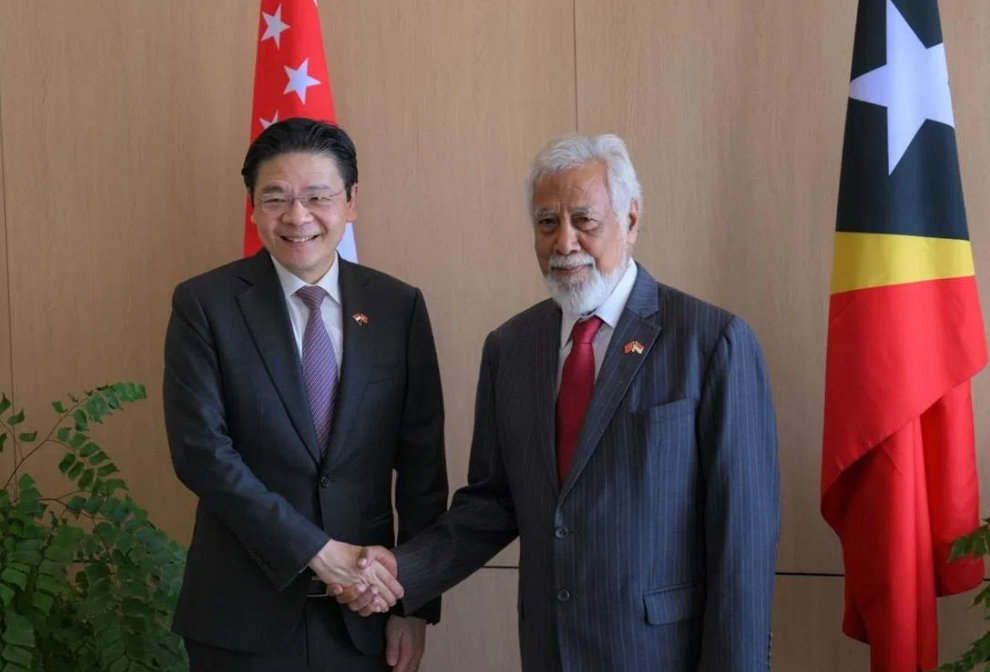
Prime Minister Lawrence Wong's inaugural visit to Timor-Leste as Singapore's leader has yielded a comprehensive bilateral framework designed to cement economic and institutional ties between the two nations. Signed on July 3 at the Government Palace in Dili, the cooperation pact establishes formal mechanisms for sustained dialogue and coordinated action across multiple sectors, marking a significant diplomatic milestone for Southeast Asia's youngest member state.
The centrepiece of the agreement establishes regular consultation channels between the foreign ministries of both countries, creating structured forums to address not merely bilateral matters but also the broader regional and international landscape that affects their mutual interests. PM Wong emphasised that this institutional apparatus would facilitate the kind of strategic coordination increasingly vital in an evolving geopolitical environment, enabling both governments to align positions on issues of mutual concern and seize collaborative opportunities as they emerge.
Economically, Singapore's role in Timor-Leste's development trajectory is already substantial and poised to expand further. Singapore companies currently rank among the nation's largest foreign investors, with active involvement spanning wholesale commerce, energy infrastructure, and renewable energy initiatives. This diversified investment portfolio reflects growing confidence in Timor-Leste's medium-term economic prospects and signals investor appetite for deeper market engagement as the country consolidates its Asean membership and institutional frameworks.
A particularly noteworthy development is Singapore's commitment to facilitate labour mobility beginning in the second half of 2027, when the city-state will open selected occupations and sectors to Timorese workers on employment passes. This represents a strategic shift in Singapore's traditionally restrictive labour policies and reflects confidence in Timorese workforce capabilities. The construction sector and marine shipbuilding industries have already expressed interest in tapping this labour source, with Singapore's Manpower Ministry acknowledging early employer inquiries. The arrangement will provide Timorese nationals with substantial employment opportunities while addressing Singapore's persistent sectoral labour shortages with a geographically proximate and increasingly skilled workforce.
The healthcare dimension of the partnership carries particular significance for a developing nation still building institutional capacity. The National University Hospital has committed to a five-year collaboration framework with Timor-Leste's Ministry of Health commencing in July, addressing priority areas identified by Dili's health authorities. These include emergency medicine, pre-hospital care systems, paediatric services, ophthalmology, obstetrics and gynaecology, and foundational medical support. This arrangement extends beyond conventional aid by emphasising knowledge transfer and systemic strengthening rather than merely providing services or equipment.
Educational cooperation forms the third pillar of deepened engagement, with Singapore directing technical assistance toward Timor-Leste's teacher training institute and educational leadership development programmes. The rationale is straightforward: nations develop long-term human capital through education, and supporting Timor-Leste's ability to cultivate school leaders represents an investment in generational capacity building. This aligns with regional trends toward human-centred development strategies and reflects Singapore's experience leveraging education as a nation-building tool.
Timor-Leste's full integration into Asean, formally completed in October 2025, has created urgent capacity-building imperatives that Singapore is positioning itself to address. The city-state launched its Singapore-Timor-Leste Asean Readiness Support package in December 2022 and substantially enhanced it in July 2025. Under the expanded framework announced during PM Wong's visit, Singapore will conduct tailored workshops on Asean chairmanship protocols and procedures, while facilitating attachments whereby Timorese officials can observe Singapore's own Asean chairmanship operations firsthand when Singapore assumes that rotating role in 2027. This represents practical mentorship in managing regional obligations, positioning Timor-Leste for its scheduled 2029 chairmanship.
PM Wong articulated a philosophical framing that resonates across Southeast Asia's smaller economies: that national size does not constrain ambition or capacity for self-determination. This message carries particular weight in a region where external pressures and great power competition frequently overshadow smaller nations' agency. Timor-Leste, as a newly independent nation still consolidating institutions and democratic systems, likely finds such affirmations of autonomous development pathways deeply relevant to its national consciousness.
The diplomatic dimensions of the visit extended beyond functional agreements. President Jose Ramos-Horta conferred upon PM Wong the Order of Timor-Leste (Grand Collar), recognising Singapore's sustained institutional support and PM Wong's personal commitment to capacity building. In his acceptance remarks, Wong attributed the honour to Singapore's civil servants and professionals who have worked in Timor-Leste, emphasising that bilateral partnerships ultimately reflect individual commitment and personal sacrifice across organisational hierarchies.
For Malaysian observers and policymakers, the Singapore-Timor-Leste cooperation model offers instructive lessons. It demonstrates how a developed, densely populated city-state can leverage proximity, technical expertise, and strategic positioning to deepen regional partnerships beyond traditional aid frameworks. The labour mobility provisions, in particular, establish precedent for managed migration arrangements within Asean that respect sovereign labour market management while creating mutual benefits. Malaysia, facing its own labour market complexities and positioned as a larger, wealthier economy than Timor-Leste, might consider whether similar structured approaches to regional labour cooperation could advance both humanitarian and economic objectives.
The timing of these initiatives also reflects strategic awareness of Timor-Leste's vulnerability and potential. As a nation with substantial natural resources, growing energy potential, and strategic location proximate to major shipping routes, Timor-Leste's institutional stability matters beyond bilateral relations. Singapore's investment in Timorese capacity building represents enlightened self-interest: a stable, prosperous, well-governed Timor-Leste benefits the entire Southeast Asian region by reducing uncertainty and supporting economic integration. This logic applies equally to Malaysia and other Asean members positioned near developing or transitional economies.
The cooperation framework also illustrates how formal bilateral instruments increasingly encompass soft power dimensions that transcend traditional commercial and diplomatic categories. By supporting healthcare systems, teacher training, and civil service capacity, Singapore embeds itself within Timor-Leste's institutional fabric in ways that generate sustained influence and reciprocal goodwill. These partnerships create networks of Timorese professionals trained in Singapore systems, familiar with Singapore practices, and naturally inclined toward Singapore-compatible approaches—a form of institutional influence more durable than transactional relationships.
Looking forward, the implementation of these agreements will test both countries' institutional capacities. Healthcare collaboration requires sustained clinical expertise transfer and potentially sensitive discussions about standards and protocols. Educational partnerships demand curriculum adaptation and teacher retraining efforts. Labour mobility necessitates regulatory alignment and management of public perception on both sides. Yet the existence of formal frameworks and high-level commitment suggests both governments recognise these arrangements as strategic priorities worth the administrative effort required for successful execution.

