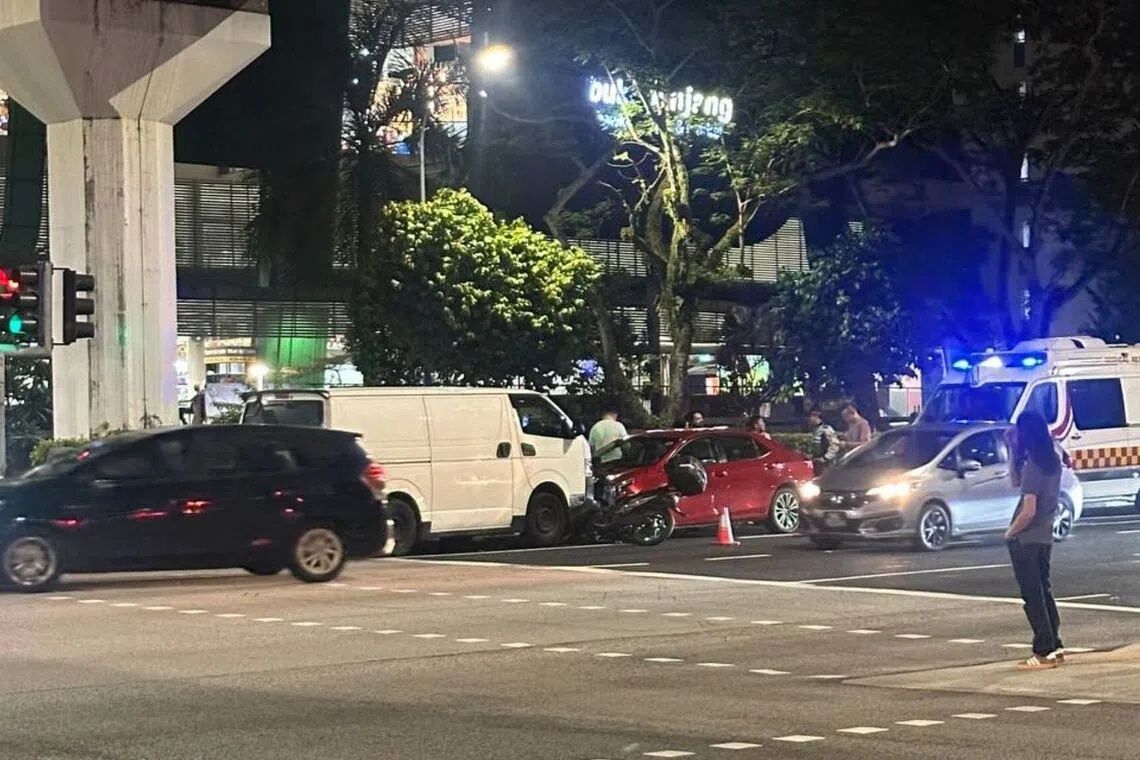
A van driver aged 27 has been detained by Singapore police following a serious multi-vehicle collision in the Bukit Panjang area on Friday night, with authorities alleging he was operating the vehicle while impaired by drugs. The incident, which occurred at approximately 9pm on Bukit Panjang Road near the junction with Bukit Panjang Ring Road, involved a total of four vehicles and resulted in two people sustaining minor injuries, though both declined hospital treatment.
According to police and the Singapore Civil Defence Force, the accident appears to have involved unusual driving behaviour that raises questions about the driver's condition at the time. Video footage captured by bystanders and shared through the Instagram account sgfollowsall shows a van positioned nose-to-nose with a red sedan, with a motorcycle visibly trapped between the two vehicles. A black sedan can be seen several metres behind the red car, suggesting the collision may have involved vehicles travelling in different directions or with compromised vehicle control.
The circumstances surrounding the collision align with the police's subsequent findings at the scene. Officers discovered two vaporising devices along with three pods inside the van involved in the accident, leading to the immediate arrest of the 27-year-old driver on suspicion of driving under the influence of drugs. This discovery is particularly significant given Singapore's strict regulations surrounding drug use and driving, where any evidence of impairment or controlled substance use can result in serious criminal charges.
The vaporiser-related aspect of the case has been referred to the Health Sciences Authority, Singapore's lead health and biomedical science agency, for analysis and assessment. This procedural step is crucial in determining what substances may have been involved and establishing a clear evidentiary chain for potential prosecution. Police confirmed that investigations into the incident remain ongoing, indicating that officers are still gathering evidence and witness statements to build a comprehensive picture of events leading up to the collision.
For Malaysian readers and others in the Southeast Asian region, this incident underscores the serious consequences that can arise from drug-impaired driving across the peninsula and island territories. Singapore's approach to such matters is notably stringent, with law enforcement agencies treating allegations of driving under the influence with significant gravity. The swift response from both police and civil defence forces reflects the protocols in place for managing traffic incidents involving potential criminal behaviour.
The involvement of multiple vehicle types in the collision—a van, sedan, motorcycle, and another car—highlights how a single incident involving a potentially impaired driver can place numerous innocent road users at risk. The fact that only minor injuries were reported appears fortunate given the apparent severity of the impact, with the motorcycle sandwiched between two heavier vehicles representing a particularly vulnerable position. The two occupants who sustained injuries but refused hospitalisation may have escaped more serious harm due to the relatively slow-speed nature of the collision or defensive measures taken by other drivers.
This case also raises broader questions about road safety enforcement and the detection of drug-impaired driving in busy urban areas. The early evening timing of the incident, occurring around 9pm on a Friday, suggests this occurred during a period of reasonably heavy traffic flow on major routes serving the Bukit Panjang district. The presence of bystanders who recorded the incident demonstrates the role that public documentation now plays in traffic accident investigations, providing immediate visual evidence that can corroborate official accounts.
The discovery of vaporising devices in the van introduces a contemporary dimension to drug-driving enforcement. As vaping becomes more prevalent across Southeast Asia, authorities face challenges in detecting its use and determining impairment levels, particularly when various substances—both legal and illegal—can be consumed through such devices. The Health Sciences Authority's involvement will likely help establish protocols for analysing such devices and determining what was being inhaled prior to the collision.
Police procedures in this matter reflect Singapore's multi-agency approach to traffic safety and law enforcement. The coordination between the police, Civil Defence Force, and specialist agencies like the Health Sciences Authority creates a comprehensive investigative framework. This systematic approach aims to establish clear causation between alleged drug use and driving behaviour, essential for supporting any prosecution that may follow.
The arrest represents an important intervention point in what could have escalated into a tragedy. Road safety advocates would note that early intervention in cases of suspected drug-impaired driving prevents recurrence and demonstrates deterrent value to other potential offenders. The public nature of such arrests and the media coverage they receive serve as reinforcement of enforcement priorities in the broader community.
As investigations continue, authorities will likely examine factors including toxicology reports, witness testimony regarding the driver's appearance and behaviour, traffic camera footage, and vehicle damage patterns to construct a comprehensive case. The ongoing nature of the investigation suggests police are conducting thorough examinations that may take weeks to complete, particularly given the need for laboratory analysis of materials seized and specialist evaluation of vaporising equipment.

