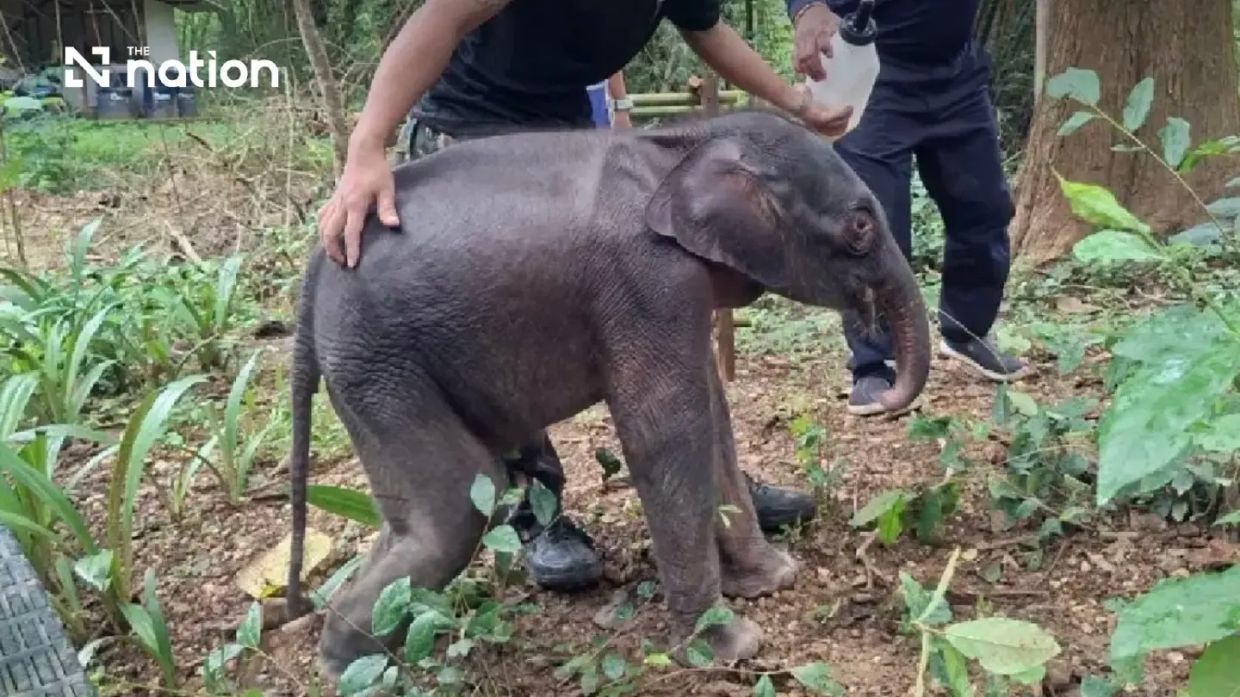
A critically ill newborn elephant calf discovered abandoned and weakened on a riverbank in Sai Yok district, Kanchanaburi, has been brought under intensive veterinary care following a challenging rescue operation conducted by Thai national park officials. The young male animal, estimated at no more than two weeks old and weighing approximately 40 kilograms, appears to have become separated from its mother and herd during heavy flooding caused by prolonged rainfall in the region. The discovery represents yet another instance of Thailand's vulnerable wildlife facing environmental pressures and the ongoing challenges of human-wildlife coexistence in Southeast Asian protected areas.
Residents of Ban Mae Nam Noi village alerted Sai Yok National Park Protection Unit No. 5 at 6am on Thursday, July 30, after spotting the distressed animal stranded on the bank of Huai Mae Nam Noi stream. The calf's location presented considerable logistical challenges for rescue personnel. Officers required a boat journey lasting between one and two hours to reach the site, as the terrain was extremely difficult to traverse by foot. Upon arrival, rescuers discovered the calf in a solitary state with no adult elephants visible in the vicinity, suggesting it had already been separated from its herd for an extended period.
Veterinary assessment conducted by specialists from Protected Areas Regional Office 3 (Ban Pong) and its Phetchaburi branch revealed a disturbing medical picture. The examination, completed on Friday, July 31, identified severe dehydration as the primary concern, alongside multiple physical injuries consistent with prolonged exposure and distress. The calf exhibited mouth ulcers measuring approximately the size of a Thai 10-baht coin, open wounds at the navel site, and blistered areas on its trunk with visible dead tissue. Additional complications included conjunctivitis caused by bee-like insects gathering around its eyes, dark yellowish-red urine suggesting infection or advanced dehydration, and loose stools with a distinctly foul odour.
The feeding challenges revealed during assessment underscored the severity of the calf's condition. When veterinarians attempted to provide supplementary milk—a critical intervention given the animal's separation from its mother—the young elephant consumed only small quantities. The painful mouth ulcers and blistered wounds made sucking difficult, forcing the calf to resort to nutritionally insufficient alternatives. Park officers observed the animal attempting to extract sustenance by sucking on tree roots and nearby stones, a behaviour indicating desperation and progressive weakness. This inability to consume adequate nutrition compounds the life-threatening dehydration already compromising the calf's survival prospects.
Environmental factors appear instrumental in the separation incident. Heavy rainfall over the two days preceding the calf's discovery significantly raised water levels in Huai Mae Nam Noi stream, creating conditions that may have swept the young elephant downstream from its herd. The surrounding terrain presented extreme constraints on the calf's movement, with steep banks limiting the animal to approximately 1.5 metres of accessible space, with the river directly adjacent and the riverbank only 30 centimetres away. Park officers theorised that the herd likely crossed the swollen waterway while the calf, unable to navigate the hazardous conditions, became trapped and unable to follow. The calf's continued vocal calls for its mother throughout the night elicited no response, strongly suggesting the herd had moved considerably beyond earshot and rescue range.
Successfully extracting the calf from its precarious position required coordination between national park staff and local community members. The boat required to access the site was provided by villagers, indicating the ongoing partnership between conservation authorities and rural communities living adjacent to protected areas. Officers maintained overnight surveillance of the animal on Thursday evening, initially hoping the herd might return to retrieve the separated calf. When no such reunion occurred by the following morning, rescue personnel moved forward with extraction and transport to the park headquarters for sustained veterinary intervention. The decision reflected both the animal's deteriorating condition and the increasingly apparent reality that maternal reunion had become unlikely.
Minister of Natural Resources and Environment Suchart Chomklin publicly acknowledged the rescue operation, commending the veterinary teams and park officers who worked under hazardous conditions created by inclement weather and dangerous water currents. His expression of official concern signalled government recognition of the incident's broader significance within Thailand's wildlife conservation framework. Suchart issued urgent directives for the Department of National Parks, Wildlife and Plant Conservation (DNP) to mobilise specialist veterinarians capable of managing the complex medical needs presented by this case. The ministerial intervention reflects the heightened profile of elephant welfare issues in Thailand, where public concern about wildlife conservation intersects with the nation's cultural reverence for these animals.
The calf now faces testing for elephant endotheliotropic herpesvirus (EEHV), a potentially fatal pathogen that affects young elephants and frequently appears in cases of profound stress. The combination of severe dehydration, malnutrition, physical injuries, and immunosuppression from environmental exposure creates ideal circumstances for opportunistic infections. DNP specialists have initiated comprehensive monitoring and intensive care protocols at the park headquarters, though the animal's critical condition leaves its long-term survival uncertain. The treatment regimen focuses on gradual rehydration, wound management, nutritional rehabilitation, and continuous monitoring for secondary infections or viral complications.
This incident carries significant implications for understanding wildlife vulnerability within Southeast Asia's protected areas. Climate change-induced extreme weather events, including erratic rainfall patterns and severe flooding, increasingly disrupt elephant populations' normal behavioural patterns and migration routes. Young animals, particularly neonates, face heightened mortality risk when separated from maternal herds and lacking the physical resources to navigate hazardous environmental conditions. The successful rescue and mobilisation of veterinary resources demonstrate institutional capacity for emergency wildlife response, yet simultaneously highlight the frequency with which such interventions have become necessary across the region.
The calf's eventual fate will depend substantially on whether specialists can stabilise its severe dehydration and manage the multiple medical complications affecting its various organ systems. Recovery would require not only overcoming immediate health crises but also successful long-term integration back into elephant social structures, a notoriously complex objective in wildlife rehabilitation. The incident exemplifies the mounting pressures on Thailand's national parks and their management capacity, raising broader questions about whether existing conservation infrastructure and veterinary expertise can adequately address the escalating health emergencies affecting Southeast Asian wildlife populations. For Malaysian observers, the situation underscores parallel challenges facing regional elephant populations, particularly in Peninsula Malaysia and Sabah, where human-wildlife habitat conflict and environmental degradation similarly threaten vulnerable young animals.

