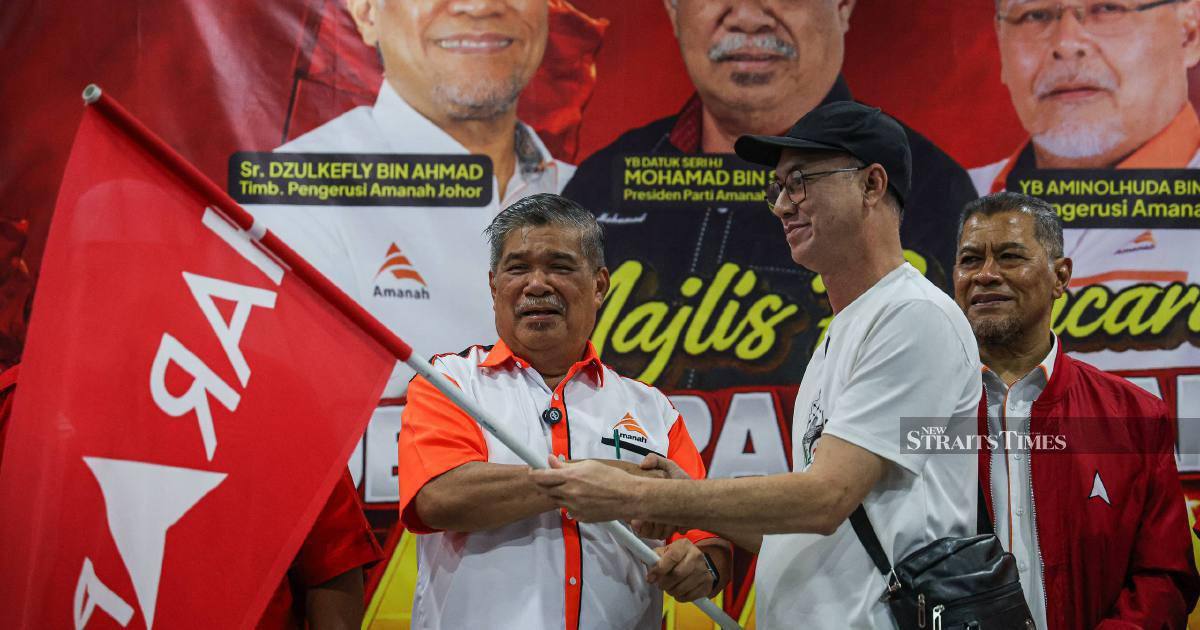
Amanah is banking on a significant infusion of fresh political talent for the upcoming Johor state election scheduled for July 11, with the Islamist-oriented party announcing that 13 of its 19 candidates will be newcomers to the electoral arena. The decision to prioritize new faces represents a deliberate repositioning strategy as the party seeks to expand its footprint in a state where it has historically struggled to establish strong grassroots support, particularly outside urban areas.
This candidate composition signals that Amanah leadership has concluded that revitalizing its appeal requires moving beyond the familiar faces that have represented the party in previous contests. Rather than recycling experienced but potentially fatigue-worn politicians, the party has opted to invest heavily in developing new political actors who can potentially resonate more effectively with voters seeking alternatives to the traditional political establishment. The move is particularly significant given that Amanah has long positioned itself as a reform-minded Islamic party, and newcomers would theoretically embody that reformist narrative more convincingly than seasoned operators.
The Malaysian political landscape has undergone considerable transformation since the 2018 election, and parties across the spectrum have grappled with the challenge of balancing institutional knowledge with the appearance of renewal. Amanah's approach reflects a calculation that the Johor electorate may be receptive to candidates without deep entanglement in previous political machinations. This becomes especially relevant in Johor, where voter sentiment has shifted considerably over the past five years and where parties must constantly calibrate their messaging to address both urban and rural constituencies with divergent priorities.
For Amanah specifically, the party has struggled to maintain relevance in several states following the 2022 general election and subsequent state polls. Johor represents an opportunity for the party to demonstrate that it remains a viable political force capable of attracting voter support. By introducing 13 new candidates, Amanah is essentially broadcasting that it has attracted fresh talent willing to stake their political futures on the party's vision, a signal that internal party dynamics remain healthy and forward-looking rather than mired in factional disputes.
The composition of these 13 new faces will be scrutinized closely by political observers and rival parties. Typically in Malaysian politics, such candidate selections reveal the party's internal power dynamics, emerging leaders within the organization, and the demographic shift the party is attempting to project. Whether these candidates skew younger, whether they bring professional backgrounds distinct from the typical political class, and whether they represent geographical diversification within their constituencies will all carry interpretive weight.
Amanah's strategy contrasts with approaches taken by some competitor parties that have emphasised retaining experienced incumbents or prominent personalities. In Johor, where the political competition remains intense among multiple parties and coalitions, the party must weigh the advantages of stability and proven electoral machinery against the potential benefits of presenting itself as genuinely renewed. The risk calculation inherent in fielding 13 inexperienced candidates is that some may underperform due to lack of campaign experience, limited personal networks, or insufficient name recognition within their constituencies.
The timing of this announcement, well in advance of the July 11 polling date, suggests that Amanah intends to provide these candidates adequate runway for campaign preparation and constituency engagement. Malaysian voters often reward candidates who demonstrate visible presence and connection to community issues, and a longer campaign window theoretically benefits newcomers who need time to build visibility and address voter concerns directly. Amanah's leadership will be banking on their new candidates to compensate for any experience deficit through demonstrated commitment and energy.
From a broader perspective, Amanah's move reflects the ongoing strategic recalibration occurring throughout Malaysian politics as parties respond to shifting voter preferences and generational change. The party has consistently advocated for Islamic governance according to its interpretation of reform principles, and it has sought to position itself as distinct from both UMNO-dominated traditionalism and secular-focused opposition movements. Fielding a predominantly new slate of candidates allows the party to refresh its public image while maintaining its ideological consistency.
The implications for Malaysian and Southeast Asian politics warrant consideration, as regional observers monitor how Islamic-oriented parties balance doctrinal commitments with electoral competitiveness. Amanah's approach of heavy candidate renewal could serve as a test case for whether such strategies succeed in translating internal party optimism into electoral gains. The results from Johor will provide valuable data regarding voter receptivity to new political faces and whether the electorate responds positively to parties that appear to be investing in institutional regeneration.