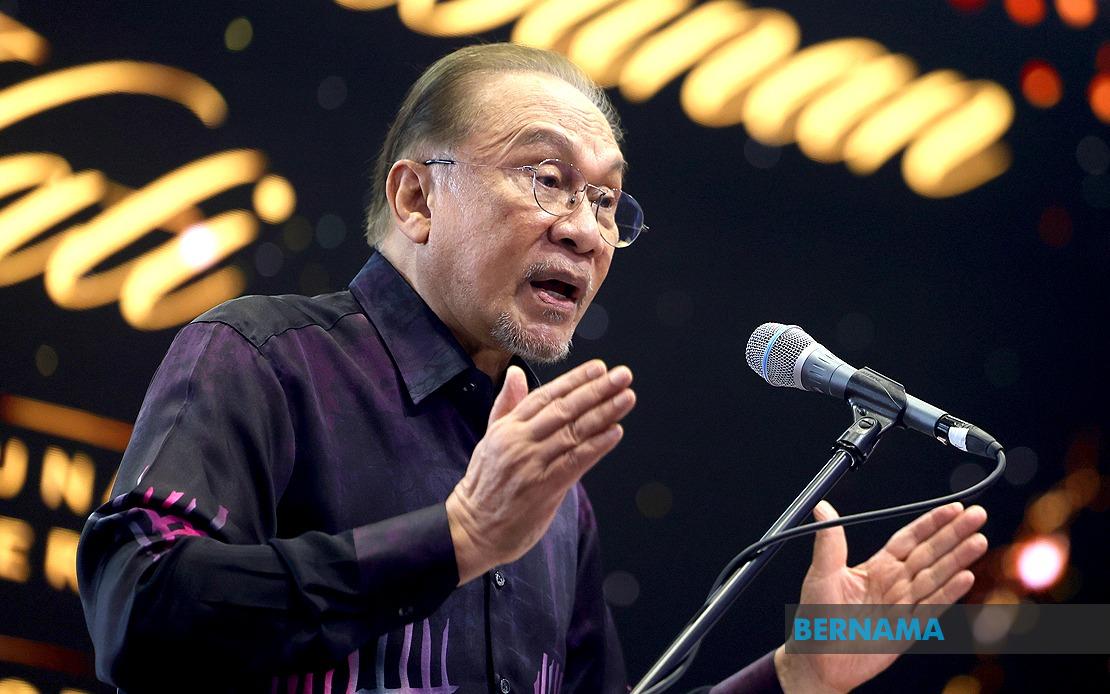
Prime Minister Datuk Seri Anwar Ibrahim delivered a forceful message on unity and social cohesion at a gathering in Seremban, cautioning the nation against the corrosive effects of racial polarization. Speaking at a dinner hosted by Pertubuhan Lima Generasi Malaysia, Anwar emphasized that Malaysia's greatest competitive advantage rests not in any single ethnic group's dominance, but in the deliberate cultivation of harmony and collaborative strength across its diverse population.
The premier articulated a direct challenge to what he characterized as a deliberate strategy by certain political figures to deepen ethnic fault lines. Anwar identified a troubling pattern wherein leaders seek to manufacture antagonism between Malays and Chinese, between Chinese and Indians, and between Indians and Malays—in essence, systematically eroding the bonds that hold Malaysian society together. Such narratives, he suggested, represent a fundamental betrayal of the nation's foundational compact and undermine the institutional capacity required for national development.
Anwar's remarks carry particular significance given the contemporary political landscape in Malaysia, where questions of race-based policies, religious identity, and constitutional protections remain contentious. The prime minister's framing positions multiethnic cooperation not as a mere aspiration but as an operational necessity for national prosperity. This stance reflects a governing philosophy that seeks to distinguish between legitimate debate around specific policies and the deployment of racially inflammatory rhetoric designed primarily for electoral or factional advantage.
The gathering itself underscored the political importance attached to community mobilization around these themes. With over 1,000 members of Pertubuhan Lima Generasi in attendance, alongside Negeri Sembilan Menteri Besar Datuk Seri Aminuddin Harun, the event demonstrated an organized effort to build grassroots support for a unity-oriented political message. The presence of state-level leadership alongside the federal prime minister signaled coordination across governance levels around this particular narrative.
The emphasis on existing cooperation among Malays, Chinese, Indians, Kadazans and other communities served a dual rhetorical purpose. First, it provided concrete evidence that diverse groups already function effectively together in various spheres—a counter-narrative to claims that ethnic cooperation is either impossible or inherently fragile. Second, it reframed unity not as an abstract ideal but as a lived reality that requires ongoing protection and reinforcement through conscious political choice.
For Malaysian readers, Anwar's intervention speaks to recurring anxieties about social stability and economic performance. Research consistently demonstrates that ethnic polarization correlates with reduced institutional effectiveness, diminished foreign investment confidence, and lower quality governance outcomes. Nations that successfully manage diversity typically exhibit stronger institutions, more predictable policy environments, and superior economic trajectories. Conversely, those fractured by ethno-nationalist competition frequently experience capital flight, brain drain, and institutional decay.
The timing of these remarks also merits attention. Malaysia navigates an increasingly complex regional environment where ASEAN cohesion depends partly on member states demonstrating internal stability and mature management of diversity. Additionally, global investment decisions increasingly factor in social stability metrics alongside traditional economic indicators. Political leaders who can credibly demonstrate commitment to inter-ethnic cooperation position their nations favorably in competition for regional influence and foreign capital.
Anwar's characterization of divisive leaders as enemies of national strength represents an attempt to reframe the political costs of ethnic politicization. Rather than presenting unity as merely morally praiseworthy, the prime minister positions it as strategically essential. This framing potentially resonates with economically-oriented voters who prioritize development over identity-based grievances, as well as with the business community whose interests align with social stability.
The assertion that Malaysia's ethnic diversity constitutes strength, when properly managed, challenges a competing narrative that portrays diversity as inherently problematic or requiring majoritarian dominance to ensure stability. This philosophical positioning has implications for ongoing debates around affirmative action, religious freedom, language policy, and other domains where competing communal interests intersect. By insisting that diversity strengthens rather than weakens, Anwar stakes out terrain from which to argue for particular policy approaches to contentious issues.
Yet the gap between rhetorical commitment and institutional follow-through remains substantial in Malaysian politics. Translating calls for unity into concrete policy changes—whether around education, economic participation, or political representation—requires navigating genuine competing interests and building consensus across constituencies with different preferences. The challenge confronting Anwar's administration involves demonstrating that unity rhetoric translates into tangible improvements in inter-community relations and shared prosperity.
For Southeast Asian observers, Malaysia's ongoing negotiation of these tensions holds broader significance. The region contains multiple countries managing diverse populations, and Malaysia's approaches—whether successful or not—offer instructive lessons. How effectively Malaysia operationalizes unity principles may influence regional stability and ASEAN's collective capacity to address transnational challenges requiring member-state coordination.
%22%2F%3E%3C%2Fpattern%3E%3C%2Fdefs%3E%3Crect%20width%3D%22100%25%22%20height%3D%22100%25%22%20fill%3D%22url(%23ph4oa4pg)%22%2F%3E%3Crect%20width%3D%22100%25%22%20height%3D%22100%25%22%20fill%3D%22url(%23ph4oa4pp)%22%2F%3E%3Ctext%20x%3D%2250%25%22%20y%3D%2250%25%22%20text-anchor%3D%22middle%22%20dominant-baseline%3D%22central%22%20fill%3D%22rgba(255%2C255%2C255%2C0.95)%22%20font-family%3D%22Georgia%2C%20'Times%20New%20Roman'%2C%20serif%22%20font-weight%3D%22700%22%20font-size%3D%22272%22%20letter-spacing%3D%22-0.02em%22%3EJohor%3C%2Ftext%3E%3C%2Fsvg%3E)