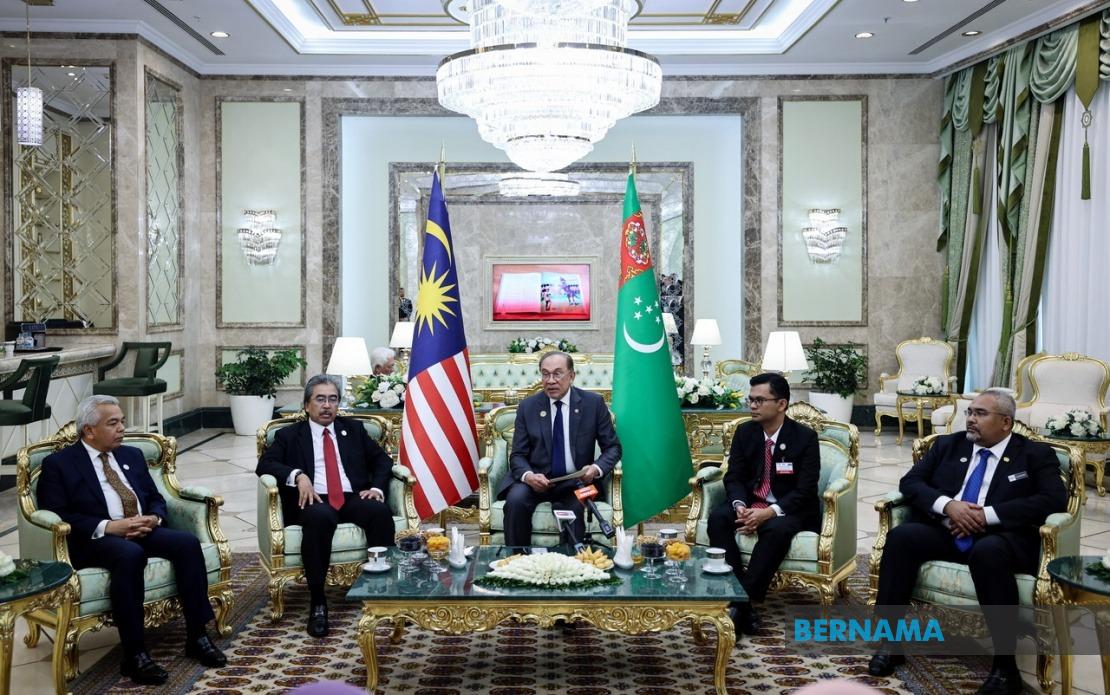
Prime Minister Datuk Seri Anwar Ibrahim returned from Turkmenistan this week having successfully achieved the central objectives of his inaugural official visit to the Central Asian nation, signalling Malaysia's intention to broaden its diplomatic footprint beyond its traditional regional sphere. The two-day working visit, which commenced on June 18 at the invitation of Turkmenistan President Serdar Berdimuhamedov, represents a deliberate move to explore untapped economic and strategic opportunities with a resource-rich nation that has remained somewhat peripheral to mainstream Southeast Asian foreign policy engagement.
According to Anwar's assessment, the visit transcended ceremonial protocol and instead functioned as a genuine foundation-laying exercise for substantive bilateral cooperation. Speaking publicly through a Facebook post, the Prime Minister articulated that the mission had succeeded in reinforcing cordial relations whilst simultaneously catalysing what he termed a fresh chapter in Malaysia-Turkmenistan ties. This framing suggests that prior engagement between the two nations, though existing, lacked the institutional momentum and high-level political commitment that Anwar's visit now provides.
Energy cooperation emerged as the paramount focus of discussions during the visit, and this emphasis carries profound implications for Malaysia's long-term economic positioning. Turkmenistan possesses some of the world's most substantial natural gas reserves, and the prospect of accessing these resources through direct bilateral channels could diversify Malaysia's energy portfolio at a time when the nation seeks alternatives to traditional suppliers. For Malaysian energy corporations like PETRONAS, whose officials accompanied the Prime Minister's delegation, the visit opened potential avenues for exploration, technology transfer, and joint venture arrangements that could yield substantial commercial returns.
The composition of Anwar's entourage itself conveyed strategic intent. Accompanying the Prime Minister were Minister of Investment, Trade and Industry Datuk Seri Johari Abdul Ghani and Minister of Economy Akmal Nasrullah Mohd Nasir, alongside technical experts from the Prime Minister's Office and the Foreign Ministry. This multidisciplinary delegation underscored that the visit encompassed not merely diplomatic pleasantries but substantive discussions spanning investment frameworks, trade mechanics, and economic integration possibilities. PETRONAS's inclusion specifically highlighted the energy sector as central to Malaysia's agenda.
For Central Asia more broadly, Anwar's visit represents a tangible signal that Southeast Asian nations are actively recalibrating their international partnerships. Turkmenistan, situated at the intersection of European, Asian, and Middle Eastern geopolitical spheres, has historically occupied a somewhat ambiguous position in global affairs. Malaysia's high-level engagement therefore constitutes recognition of Turkmenistan's strategic value and resource endowments. The visit may catalyse further Southeast Asian interest in deepening ties with Central Asian republics, potentially reshaping regional alignment patterns.
The Prime Minister's gracious acknowledgment of President Berdimuhamedov's hospitality and the contributions of various Malaysian institutions, including the Embassy in Ashgabat, suggests that foundational groundwork had already been prepared prior to the visit. The Malaysian diplomatic presence in Ashgabat, though modest by comparison to larger embassies, would have conducted preliminary negotiations and established the technical framework that enabled substantive discussions during Anwar's presence. Security personnel and media delegations also featured in his public appreciation, indicating that the visit received comprehensive coordination across government apparatus.
This initiative arrives at a strategically propitious moment for Malaysia's foreign policy. As the nation navigates complex regional dynamics, particularly in Southeast Asia, cultivation of relationships with energy-rich Central Asian states presents diversification benefits. Turkmenistan's stable governance framework and resource abundance position it as a potentially reliable partner for Malaysian capital and expertise. Conversely, Malaysian investment and technical capacity in downstream energy applications and petrochemical manufacturing could complement Turkmenistan's upstream natural resource endowments.
The emphasis on mutual prosperity in Anwar's statement reflects a developmentalist framing that seeks to position the bilateral relationship not as resource extraction but as reciprocal economic cooperation. This rhetorical approach proves important for domestic audiences in both nations, as it justifies engagement through shared development objectives rather than narrow national advantage. For Turkmenistan, it legitimises engagement with an external partner; for Malaysia, it justifies expenditure of political capital on partnerships beyond its immediate geographic region.
Looking forward, the visit's success will ultimately be measured through concrete institutional outcomes. These might include establishment of joint energy committees, signature of memoranda of understanding on specific projects, or initiation of high-level dialogue mechanisms. The opening of new cooperation chapters, as Anwar characterised the visit, requires subsequent translation into regulatory frameworks, commercial arrangements, and human exchange programmes that sustain momentum beyond the diplomatic occasion itself.
The visit also reflects Malaysia's broader strategic positioning within an increasingly multipolar international environment. By cultivating partnerships with Central Asian nations whilst maintaining existing regional commitments, Malaysia signals diplomatic flexibility and pragmatism. This approach potentially enhances the nation's influence and ensures that it remains relevant to diverse geopolitical configurations rather than becoming locked into rigid alliance structures that may prove constraining as global power distributions continue their ongoing recalibration.