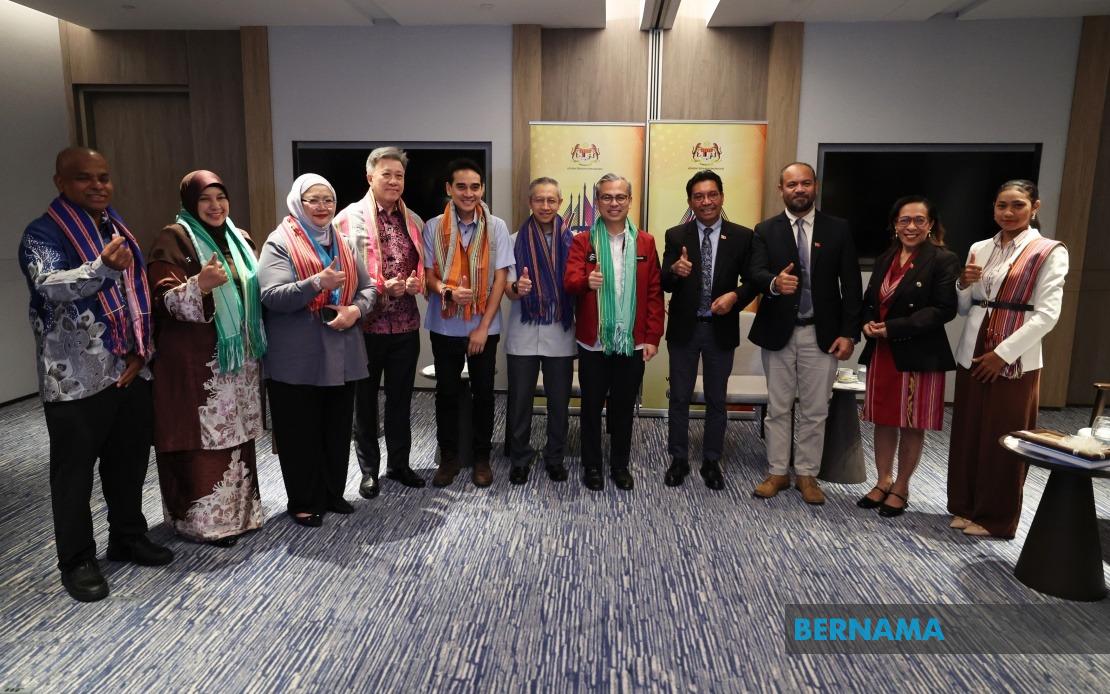
In a significant move to strengthen journalistic ties within the Association of Southeast Asian Nations, Malaysia's premier news agency Bernama and Timor-Leste's Agência Noticiosa de Timor-Leste (TATOLI) have formalised a comprehensive partnership through a memorandum of understanding. The agreement, signed during the National Journalists' Day (HAWANA) 2026 celebration in Butterworth, marks an important development in regional media cooperation at a time when ASEAN continues to consolidate its standing as a unified voice on the global stage.
The partnership represents a strategic expansion of Bernama's regional footprint and signals its commitment to supporting fellow ASEAN members in developing robust news infrastructure. At the ceremonial signing, Bernama Chief Executive Officer Datin Paduka Nur-ul Afida Kamaludin emphasised that the collaboration transcends routine content exchange, encompassing comprehensive journalism training and capacity building for TATOLI personnel. Prime Minister Datuk Seri Anwar Ibrahim witnessed the formal exchange of the MoU between Nur-ul Afida and TATOLI President Noémio Mateus Soares Falcão, alongside Communications Minister Datuk Fahmi Fadzil and Timor-Leste's Secretary of State for Social Communication, Expedito Loro Dias Ximenes, underscoring the diplomatic significance of the accord.
For Malaysian readers and media professionals, this partnership carries particular relevance given the broader context of ASEAN integration and the role news agencies play in shaping regional narratives. Timor-Leste, which became ASEAN's 11th member state in October 2025, has been actively seeking partnerships to modernise its media capabilities. TATOLI's outreach to Bernama predated its formal ASEAN accession, reflecting deliberate efforts to align with established regional media institutions. This timing illustrates how newer ASEAN members view collaboration with experienced agencies as essential to building credibility and reach within the bloc.
The distribution framework outlined in the MoU demonstrates Bernama's evolving multilingual strategy and its ambitions to serve diverse Southeast Asian audiences. Bernama currently reports in six languages—Bahasa Melayu, English, Tamil, Mandarin, Arabic, and Spanish—with plans to add Portuguese following this partnership. TATOLI content will circulate through Bernama's networks in Tetum, Portuguese, Bahasa Indonesia, and English, creating reciprocal exposure that benefits both populations. This linguistic diversity carries practical implications for Malaysian businesses, diaspora communities, and citizens seeking to understand developments in the region, particularly as Portuguese opens doorways to lusophone Southeast Asian affairs.
The journalism training component addresses a critical gap in Timor-Leste's media ecosystem and reflects a regional trend toward knowledge transfer among ASEAN institutions. Bernama has committed to hosting groups of TATOLI reporters for professional development before year's end, leveraging its two decades of training experience and the expertise resident in its Bernama School of Journalism. This mentorship model taps into Bernama's institutional strength across multiple platforms—online, television, digital, radio, and photography—allowing Timor-Leste journalists to acquire skills in contemporary news production aligned with international standards. Such capacity building ultimately strengthens the entire regional information environment.
The emphasis on journalistic ethics and press freedom articulated by both agencies reflects shared commitments that extend beyond commercial interests. Falcão, TATOLI's president, highlighted the imperative for responsibility in an era of rapid digital information dissemination, where misinformation and unverified content pose existential threats to public discourse. His assertion that factual, verified reporting guided by professional principles remains fundamental—even as platforms multiply and speed accelerates—resonates with ongoing debates within Malaysia regarding media standards and the balance between freedom and accountability. The partnership implicitly positions both agencies as custodians of journalistic integrity within their respective societies.
From a geopolitical standpoint, this collaboration underscores ASEAN's capacity to develop intra-regional solutions to shared challenges rather than relying exclusively on international news organisations. By enabling Timorese citizens to access Malaysian perspectives through local media channels, and vice versa, the MoU fosters mutual understanding and reduces information asymmetries that might otherwise be filled by external actors. The distribution of Bernama content within Timor-Leste creates opportunities for Malaysian narratives to reach a new audience, whilst Malaysian readers gain enhanced insights into developments in the youngest ASEAN nation—a mutually reinforcing dynamic that benefits all stakeholders.
The broader institutional context further illuminates this partnership's significance. Bernama, established in 1967 and formally inaugurated in 1968, operates with parliamentary backing and statutory authority to serve as Malaysia's official national news agency. Its longevity, institutional stability, and government-aligned mandate position it as a natural partner for emerging agencies seeking to establish credibility and operational excellence. TATOLI, established in 2016 as the official disseminator of Timorese government information, operates in a younger, smaller media market with comparatively limited infrastructure. The asymmetry in institutional maturity makes the knowledge transfer particularly valuable for TATOLI whilst offering Bernama prestige in championing regional development.
The presence of media representatives from Cambodia and Laos at the HAWANA 2026 event suggests this partnership may catalyse broader multilateral arrangements. Both nations, like Timor-Leste, represent emerging or consolidating media institutions within ASEAN, and their attendance signals receptiveness to similar cooperation frameworks. Malaysian readers should note that such partnerships create ripple effects across the region, gradually establishing editorial standards, training norms, and content-sharing practices that homogenise and elevate media quality throughout Southeast Asia. This institutional web also enhances Malaysia's soft power by positioning Bernama as a mentor and model.
The practical implementation will reveal the partnership's true impact. The commitment to train TATOLI personnel before year's end provides a measurable milestone, though longer-term success depends on sustained engagement and reciprocal benefit. For Malaysian journalism students and professionals, the partnership offers potential opportunities to participate in exchange programmes or contribute to training initiatives, broadening their regional exposure. Newsrooms in Malaysia should also prepare for increased Timor-Leste-related coverage, as improved news flows and stronger institutional relationships typically generate enhanced editorial focus on partner countries.
This agreement arrives at a critical juncture for Southeast Asian media, where digital disruption, financial pressures, and geopolitical contestation over information narratives intensify daily. By formalising cooperation between national news agencies, Bernama and TATOLI assert that state-backed institutional journalism remains vital to democratic societies and regional stability. The emphasis on accuracy, verification, and professional ethics serves as counterweight to algorithms and social media dynamics that frequently privilege sensation over substance. Malaysian stakeholders invested in regional stability should view this partnership as a positive indicator of ASEAN's determination to build resilient, trustworthy information ecosystems.
Looking ahead, the partnership's success will depend on both agencies translating formal commitments into substantive operational changes. Beyond news exchange and training, opportunities exist for joint investigative projects, shared coverage of regional events, and collaborative fact-checking initiatives that address misinformation. As ASEAN continues integrating economically and politically, strengthened media cooperation becomes increasingly indispensable. For Malaysia, positioned as a regional economic hub and information leader, partnerships like the Bernama-TATOLI accord reinforce its standing whilst contributing meaningfully to ASEAN's collective aspirations for informed, engaged citizenries capable of navigating an increasingly complex information landscape.
%22%2F%3E%3C%2Fpattern%3E%3C%2Fdefs%3E%3Crect%20width%3D%22100%25%22%20height%3D%22100%25%22%20fill%3D%22url(%23ph4oa4pg)%22%2F%3E%3Crect%20width%3D%22100%25%22%20height%3D%22100%25%22%20fill%3D%22url(%23ph4oa4pp)%22%2F%3E%3Ctext%20x%3D%2250%25%22%20y%3D%2250%25%22%20text-anchor%3D%22middle%22%20dominant-baseline%3D%22central%22%20fill%3D%22rgba(255%2C255%2C255%2C0.95)%22%20font-family%3D%22Georgia%2C%20'Times%20New%20Roman'%2C%20serif%22%20font-weight%3D%22700%22%20font-size%3D%22272%22%20letter-spacing%3D%22-0.02em%22%3EJohor%3C%2Ftext%3E%3C%2Fsvg%3E)