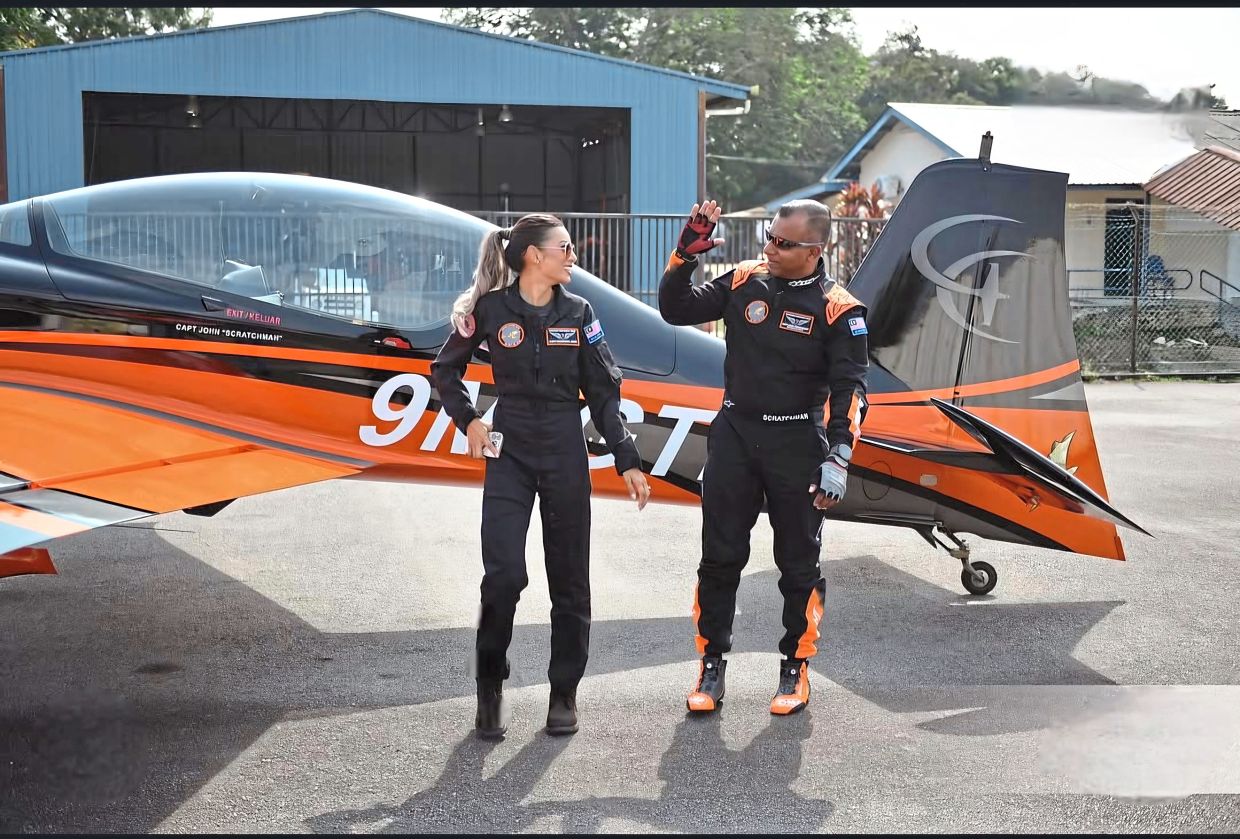
Samantha Laura John represents a growing cadre of young Malaysian women breaking into commercial aviation, following a path carved by her father, retired Royal Malaysian Air Force (RMAF) fighter pilot Lieutenant-Colonel (R) John Sham Alagarsamy. At 26, she has just graduated from flight school in Ipoh in 2025 with her pilot's licence in hand, embodying a continuation of her family's deep connection to aerospace and national service.
John's aviation career spanned more than a quarter-century with the RMAF, where he served as a fighter pilot, instructor and examiner before transitioning to the commercial sector in 2019. His trajectory reflects the evolving landscape of Malaysian aviation, where military experience often provides the foundation for subsequent civilian operations. Yet his distinction extends beyond conventional pilot credentials: he holds a unique recognition from the Civil Aviation Authority of Malaysia as the country's first and only civil aviator certified for aerobatics display flying. Over the years, his performances at major events including the Langkawi International Maritime and Aerospace Exhibition (Lima), where he pilots the GB1 GameBird aircraft, have made him a recognisable figure in Malaysian aviation circles.
What distinguishes John's story further is his multifaceted career trajectory. Beyond the cockpit, he has pursued expertise in music and deejaying, earning national recognition when he won the Malaysian Open DJ Competition in 1992 during the vinyl and turntablism era, operating under the moniker "Scratchman". This breadth of accomplishment—combining military discipline with creative expression—has clearly shaped how he approaches mentorship within his own family. Currently heading training operations at a flying school in Ipoh, he remains embedded in aviation education and development.
Samantha's journey to the cockpit, however, was not predetermined by parental pressure but rather emerged from organic curiosity nurtured by an environment that valued achievement and personal ambition. Growing up on various RMAF bases across Malaysia—from Labuan to Kuantan, Alor Setar and Butterworth in Penang—she absorbed the discipline and purposefulness that characterise military aviation operations. These postings, though requiring frequent family relocations before she reached primary school age, cultivated in her a visceral understanding of aviation's role in national defence. She witnessed firsthand the responsibility RMAF pilots carry in safeguarding Malaysia's airspace and maritime borders, an experience that transcended abstract patriotism.
The family's sojourn to Canberra in 2012 proved formative in broadening her perspective. When John was attached to the Australian Defence Force while pursuing a master's degree in military and defence studies from the Australian National University, Samantha gained exposure to international defence frameworks and comparative aviation systems. This international dimension added nuance to her understanding of aviation beyond Malaysian borders, positioning her within a regional and global context rather than a purely domestic one.
Crucially, Samantha's path included a deliberate pause for exploration. After completing her International General Certificate of Secondary Education (IGCSE), she initially pursued a different direction, enrolling in 2018 in a two-year cadet pilot programme with an airline based in Sepang, Selangor. Though the role proved rewarding, it ultimately did not align with her evolving aspirations. Rather than viewing this as failure, she recognises it as a necessary detour that clarified her true calling. The experience reinforced her conviction that commercial piloting represented her authentic vocation.
This pattern—where children of accomplished professionals eventually align their careers with family precedent—reflects broader research on career development and family influence. Academic work from Universiti Teknologi Malaysia's social science journal, including studies titled "Parental Influence and Undergraduates' Career Choice Intentions", demonstrates that robust parent-child relationships characterised by open communication and mutual trust can significantly influence career trajectories. Such influence operates not through coercion but through creating environments conducive to exploration and long-term planning. Within the Malaysian context, families like the Shamans and examples such as sisters Safia Amira Abu Bakar and Safia Anisa Abu Bakar, who followed their father Captain Abu Bakar Shafie into aviation, illustrate that aviation remains a sector where familial networks and mentorship play consequential roles in career development.
John's philosophy on parental influence emphasises outcome over instruction. His oft-repeated aphorism—"if they aim for the stars, at least they'd reach the sky"—encapsulates an approach that encourages ambition without mandating specific life choices. He has consistently articulated that he hoped his children would follow aviation but never compelled them to do so. This distinction matters profoundly: it allows children agency while providing inspirational scaffolding. His own recognition through the Most Gallant Order of Military Service (Kesatria Angkatan Tentera) during his RMAF tenure underscores the esteem in which he is held, yet he frames legacy not through individual accolades but through "the positive impact we leave on others, especially our children, who often learn more from what we do than what we say."
Currently, Samantha is based in Kota Kinabalu, where she and her husband David Chong, 30, operate an event management company. She also provides vocal coaching, suggesting that, like her father, she harbours multifaceted interests beyond her primary professional domain. Though she holds a valid pilot's licence, she has not yet pursued full-time commercial flying, instead maintaining aviation as a calling she intends to resume. When airborne, she describes the experience in viscerally professional terms: "Once you're in the cockpit, you have to be fully focused and aware of your surroundings. You're always looking ahead, thinking ahead, and staying situationally aware. It's almost like working in six dimensions." This articulation reflects not merely technical competence but a philosophical orientation toward aviation as a holistic, cognitively demanding discipline.
The family dynamics—Samantha, her mother Lynda Shanti Ganesaguru, a businesswoman aged 45, and her brother Shayne Zacchaeus John, 22—paint a picture of a household where diverse professional pursuits coexist alongside shared values of discipline and purposefulness. Recent family gatherings, such as lunch at an Indonesian restaurant during one of John's weekend visits from Ipoh, involve reminiscence about their nomadic military years. These moments serve a dual function: they reinforce family bonds while normalising the sacrifices and rewards inherent in careers built on service and expertise.
For Malaysian observers tracking aviation's demographic evolution, Samantha's story carries particular resonance. Female representation in commercial aviation has historically lagged behind global averages, though Malaysian carriers have progressively hired women pilots. Her entry into this sector, coupled with her father's pioneering status in aerobatics and her mother's entrepreneurial background, illustrates how family environments that model professional achievement across sectors create conditions where daughters see aviation not as an anomalous choice but as a legitimate career pathway. The intergenerational transmission of both technical skill and professional ethos—combined with exposure to international standards through her Canberra years—positions her within a cohort of Southeast Asian pilots navigating a region experiencing rapid aviation sector expansion.
Looking forward, Samantha's stated intention to eventually return to commercial flying suggests that her present roles in event management and vocal coaching constitute a temporary professional interlude rather than a definitive departure from aviation. Should she transition to full-time flying, she would join a still-small but expanding contingent of Malaysian female commercial pilots. Her journey underscores a fundamental reality: the most enduring professional legacies often emerge not from directive parenting but from environments where curiosity, competence and character are cultivated across generations, allowing each individual to chart a course that honours inherited values while remaining authentically their own.