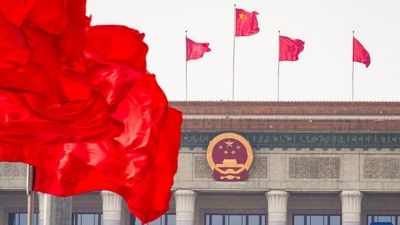
China's anti-corruption establishment has initiated an investigation into Zhu Changjie, a 69-year-old former vice-chairman of the Xinjiang Uygur autonomous region, over allegations of serious violations involving both Party discipline and breaches of national law. The Central Commission for Discipline Inspection of the Communist Party of China and the National Commission of Supervision announced the action on Saturday, June 20, though neither body disclosed specifics regarding the nature or scope of the alleged violations at the time of announcement.
The move reflects the intensifying scrutiny of senior officials who served in key leadership positions across China's western regions. Zhu's career trajectory exemplifies the typical rise of cadres within the Communist Party system, having originated from Dongming county in Heze, Shandong province, where he was born. He completed his undergraduate studies in agronomy before formally joining the Communist Party of China in 1985, positioning him among the cohort of officials who came of age during the reform and opening-up period.
Zhu's professional journey began in 1976 and unfolded primarily across Xinjiang's administrative hierarchy, where he held successive positions that reflected his advancement within the regional bureaucracy. His early postings took him through various local government structures in the resource-rich western region, including assignments in the Bayingolin Mongol autonomous prefecture and the Aksu prefecture, areas strategically important to both Beijing's governance framework and the broader development initiatives across Xinjiang.
The most significant phase of Zhu's career came during his tenure as director of Xinjiang's regional public security department, a position he held from 2009 to 2017. This eight-year stretch coincided with major shifts in Beijing's security and governance policies across the region, making the portfolio one of considerable influence and responsibility. Concurrently, he served as vice-chairman of the Xinjiang regional government from 2011 to 2018, roles that overlapped and underscored his standing as one of the autonomous region's senior administrators during a consequential period.
The investigation carries particular significance given the international attention and scrutiny directed at governance practices in Xinjiang over recent years. While the anti-corruption bodies have not elaborated on the specific violations attributed to Zhu, investigations at this level typically encompass allegations ranging from abuse of power and corruption to violations of Party regulations on personal conduct or ideological discipline. The secretive nature of such probes is characteristic of China's anti-corruption process, which prioritizes confidentiality during preliminary investigations before potentially advancing to formal charges.
Zhu's case represents a continuation of Beijing's persistent campaign against official malfeasance, launched following Xi Jinping's consolidation of power and formalized through the establishment of the comprehensive anti-corruption infrastructure. Senior cadres across all provincial-level regions have faced similar investigations, reflecting a systematic approach to accountability that has become a defining feature of Party governance over the past decade and a half.
The timing and announcement of Zhu's investigation may carry implications for broader understanding of governance standards and expectations within Xinjiang's administrative structure. Officials who served during the period when Zhu held his positions have faced heightened scrutiny, and his case adds to a pattern of senior regional administrators being held to account for their management of public affairs. The investigation underscores the Communist Party's stated commitment to maintaining discipline and integrity among its cadre ranks, particularly those in positions of high authority.
For Malaysian observers and Southeast Asian stakeholders monitoring developments in China's governance landscape, such investigations demonstrate the competitive and occasionally precarious nature of senior official positions within the Chinese bureaucratic system. The absence of formal charges or public allegations at this stage reflects standard procedure, though the designation of violations as "serious" suggests that authorities view the case as sufficiently substantive to warrant high-level intervention. The investigation may take considerable time to conclude, during which Zhu would likely be placed under various forms of restriction pending the outcome of preliminary inquiries.
%22%2F%3E%3C%2Fpattern%3E%3C%2Fdefs%3E%3Crect%20width%3D%22100%25%22%20height%3D%22100%25%22%20fill%3D%22url(%23ph32hyvg)%22%2F%3E%3Crect%20width%3D%22100%25%22%20height%3D%22100%25%22%20fill%3D%22url(%23ph32hyvp)%22%2F%3E%3Ctext%20x%3D%2250%25%22%20y%3D%2250%25%22%20text-anchor%3D%22middle%22%20dominant-baseline%3D%22central%22%20fill%3D%22rgba(255%2C255%2C255%2C0.95)%22%20font-family%3D%22Georgia%2C%20'Times%20New%20Roman'%2C%20serif%22%20font-weight%3D%22700%22%20font-size%3D%22151%22%20letter-spacing%3D%22-0.02em%22%3EPerikatan%3C%2Ftext%3E%3C%2Fsvg%3E)