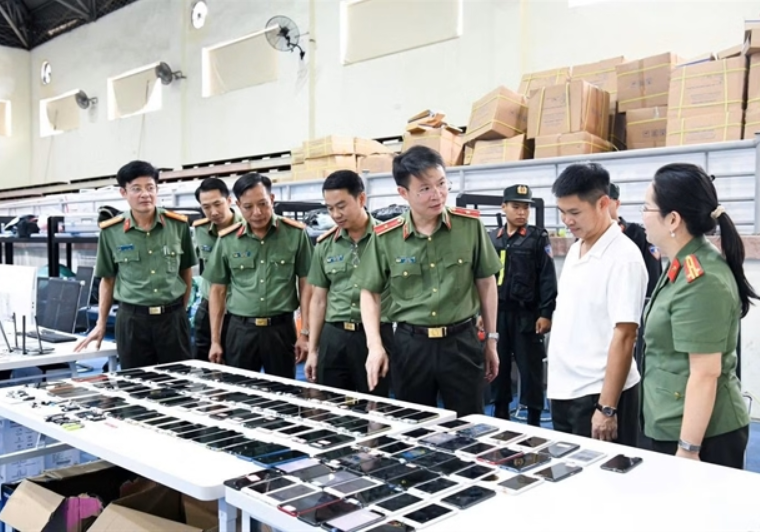
Police in Phu Tho province announced charges against four individuals on Thursday following a successful investigation into an international criminal scheme designed to establish a fraudulent call centre in Vietnam. The case underscores the growing sophistication of organised scam networks operating across Southeast Asia and their strategic adaptation to law enforcement pressure in one jurisdiction by simply relocating to another. As criminal syndicates face intensified investigations in Cambodia, Vietnamese authorities have moved to intercept their planned migration, preventing what could have become a significant expansion of online fraud operations into Vietnamese territory.
The central figure in the conspiracy is Zhao Wei Zhong, a 37-year-old Chinese national who authorities say entered Vietnam specifically to establish infrastructure for the relocation. Police determined that Zhao was acting under instructions from overseas handlers and arrived with a clear mandate: to secure residential facilities and arrange logistical support for the anticipated arrival of staff members from Cambodia-based scam operations. This division of labour between overseas coordinators and on-the-ground operatives reflects how modern transnational fraud networks distribute responsibilities across borders to minimise exposure and maximise operational efficiency.
Investigators traced Zhao's background to previous assignments at Chinese-operated fraudulent companies in Cambodia, where he developed the professional contacts that would eventually facilitate his recruitment into the Vietnam operation. His experience managing scam call centres made him a valuable asset for the relocation effort, as he possessed both technical knowledge of how such operations function and established networks within the criminal ecosystem. The fact that sophisticated fraudsters are consciously moving between countries demonstrates how they view borders less as barriers and more as administrative boundaries to circumvent when one location becomes too risky.
To accomplish his mission within Vietnam, Zhao systematically recruited local assistance. He connected with two Vietnamese nationals—Tran Thi Thu Huong, aged 24, and Đinh Nam, aged 27, both from Bac Ninh province in the north—who he had previously encountered during his Cambodia years. Police allege that Zhao leveraged these existing relationships to secure cooperation, enlisting the pair to provide translation services, transportation, and reconnaissance for suitable locations where the incoming foreign workers could be housed. The targeting of individuals with prior exposure to the scam ecosystem suggests a deliberate strategy to recruit those already familiar with—and potentially sympathetic to—the criminal enterprise.
The conspiracy expanded to include Nguyen Thanh Long, a 43-year-old Hanoi resident who allegedly assisted with the broader logistical planning required to support the operation's establishment. Long's involvement in arranging practical support indicates that the network extended beyond Zhao's immediate recruits to include individuals positioned in key urban centres who could facilitate the movement and accommodation of personnel. This layered structure provided redundancy and made the operation less dependent on any single individual, a common feature of professional criminal organisations seeking to shield core members from exposure.
Vietnamese authorities' detection and dismantling of the scheme before it reached operational status represents a significant intervention in the regional scam ecosystem. Had the operation succeeded in establishing itself, it could have expanded significantly, potentially attracting additional resources and personnel from Cambodia and other Southeast Asian jurisdictions where similar networks already operate. The prevention of the relocation demonstrates that law enforcement agencies are increasingly coordinating and sharing intelligence to disrupt the geographic expansion strategies that criminal networks depend upon for survival when facing intensified pressure in their current base of operations.
Police proceeded with formal charges on June 17 following what they described as thorough evidence gathering. Zhao, Huong, and Long now face charges related to organising the illegal stay of foreign nationals in Vietnam, a predicate offence that authorities employ to prosecute those facilitating criminal immigration schemes. All three were ordered held in pretrial detention, reflecting the seriousness with which authorities view their conduct and the apparent flight risk or danger they may pose. Đinh Nam, by contrast, received a movement restriction order rather than custodial detention, a decision that may reflect either differing assessments of his culpability or his level of involvement in the conspiracy compared to his co-accused.
The physical evidence seized from properties linked to the suspects provides tangible proof of the operation's intended scope and sophistication. Police recovered 73 computers, 134 mobile phones, 34 USB drives, and 20 Wi-Fi routers alongside other technical equipment destined for the scam call centre's use. This arsenal of devices represents the technological infrastructure necessary to conduct simultaneous fraudulent communications across multiple platforms and with numerous victims, allowing operators to manage dozens of simultaneous scam conversations while maintaining the operational security measures common to such organisations. The quantity and specification of equipment seized indicates planning for a substantial operation rather than a small-scale experiment.
For Malaysian readers and Southeast Asian observers, this case illustrates critical patterns in how transnational crime networks adapt and migrate in response to enforcement actions. The region's porous borders, relatively well-developed telecommunications infrastructure, and substantial populations of migrant workers create an environment where sophisticated fraud operations can readily relocate their physical presence while maintaining their criminal communications architecture. The fact that Cambodia served as a staging ground before Vietnam was targeted suggests these networks are constantly conducting reconnaissance for optimal relocation destinations, evaluating each jurisdiction's law enforcement capacity, legal frameworks, and operational costs. Vietnam's successful interdiction of this particular operation offers a model for regional coordination, yet the underlying vulnerabilities that make Southeast Asia attractive to such networks remain largely unaddressed. As long as substantial profits can be extracted from victim populations with relative impunity, organised scam networks will continue to treat the region's borders as temporary obstacles rather than genuine barriers to their expansion.